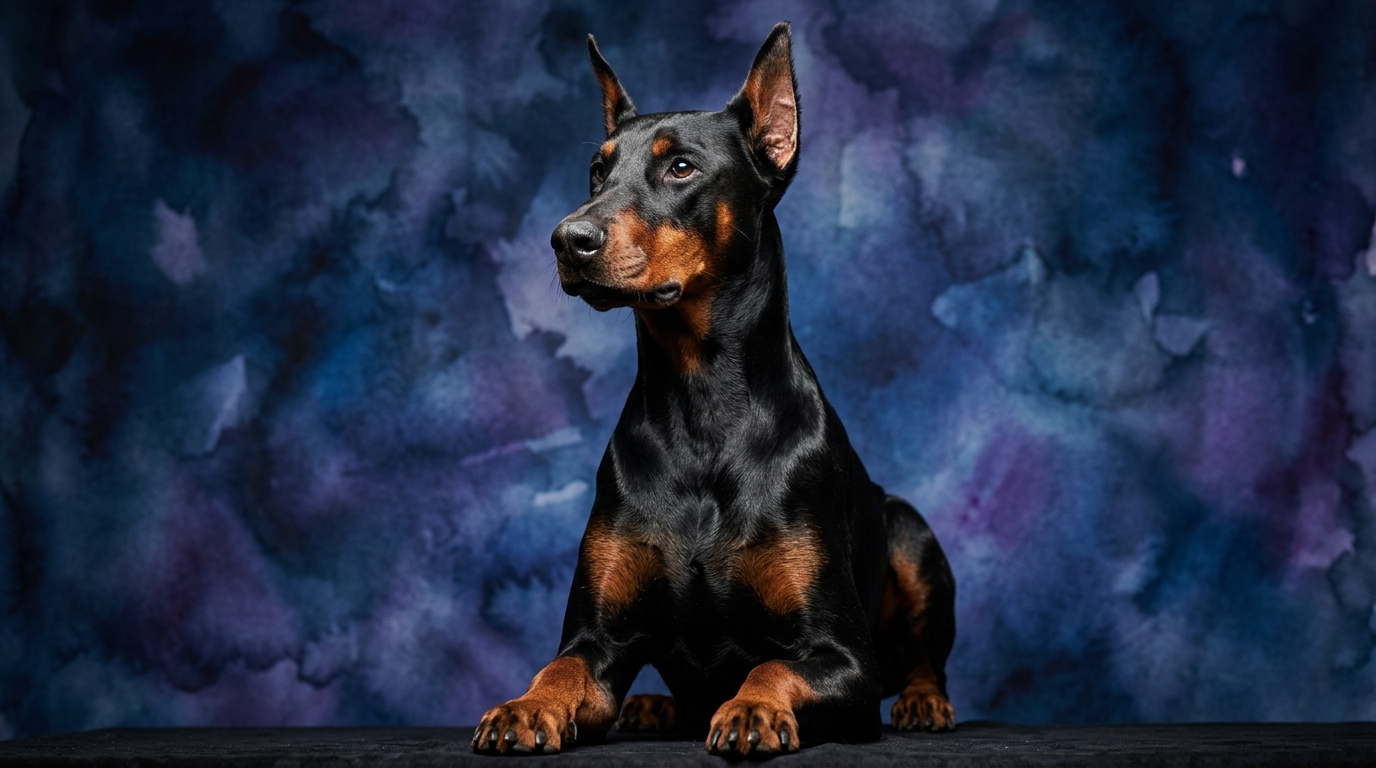
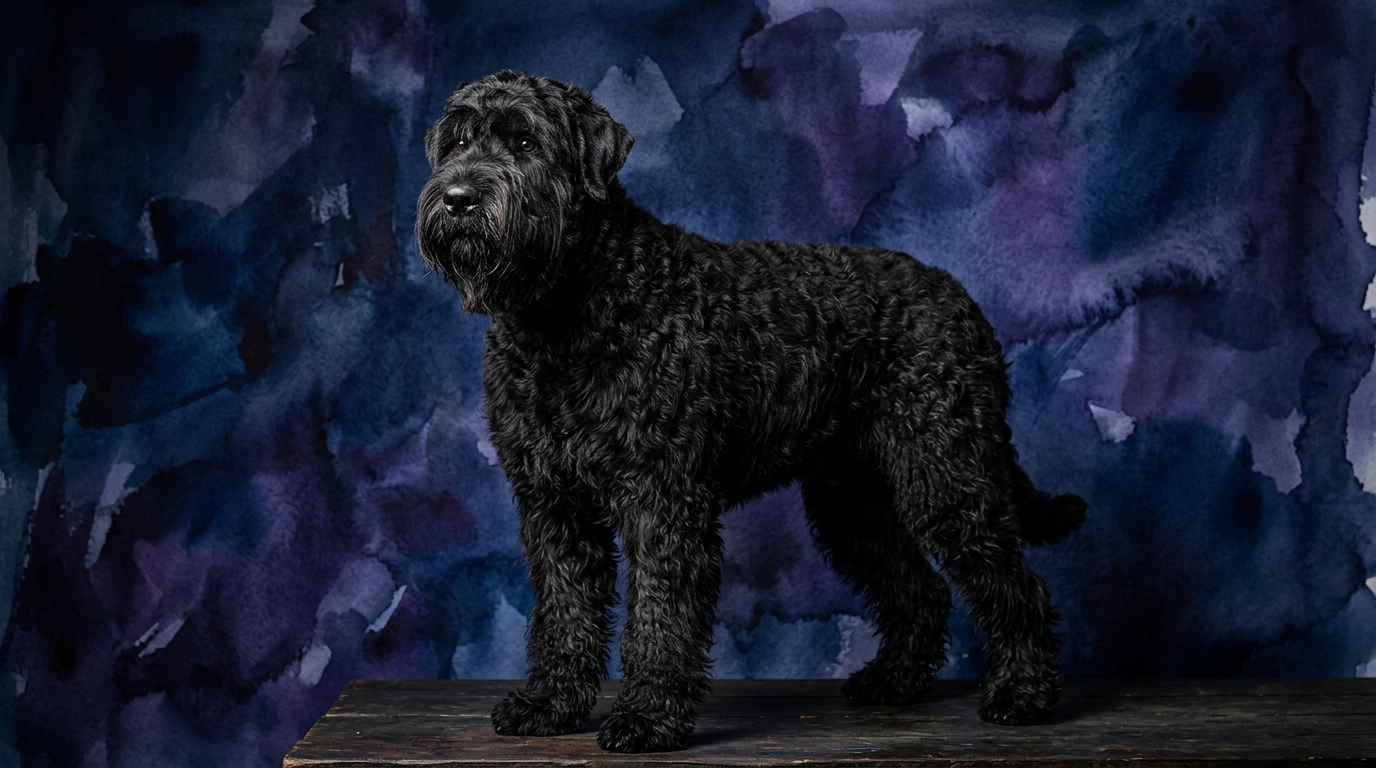
Side-by-Side IQ Profile: Doberman Pinscher vs. Black Russian Terrier
The Cosmic Pet Pet IQ Lab employs five key dimensions to evaluate canine intelligence, offering a nuanced understanding beyond simple obedience. For the Doberman Pinscher, ranked #5 in Coren's broader intelligence scale, its profile reveals a formidable cognitive athlete. Its Problem Solving is rated 5/5, indicating an exceptional capacity for quickly analyzing unfamiliar situations and devising solutions, demonstrating remarkable cognitive flexibility and quick thinking. Training Speed also scores 5/5, meaning Dobermans absorb new commands and routines with astonishing efficiency, often grasping complex concepts in just a few repetitions. Social Intelligence stands at 4/5, showing they are highly attuned to human cues and social dynamics, capable of nuanced interaction and understanding of family structure. An Instinctive Drive of 5/5 highlights a powerful inherent motivation for work, protection, and physical activity, making them eager and consistent participants in tasks. Finally, Memory at 5/5 signifies their ability to retain information, commands, and experiences over long periods, making training durable and complex routines manageable.
In contrast, the Black Russian Terrier, while not Coren-ranked, presents a distinct and equally capable cognitive makeup, tailored for its specific working heritage. Its Problem Solving is rated 3/5, suggesting a more straightforward, methodical approach to challenges, relying on established patterns rather than rapid improvisation. Training Speed at 3/5 indicates that while perfectly capable of learning, they require more consistent repetition and clear instruction to master new skills, learning at a steady, deliberate pace. Social Intelligence scores 3/5, reflecting a reserved demeanor; they form deep bonds with their family but are typically aloof with strangers, less overtly expressive of their understanding of social nuances. The Black Russian Terrier's Instinctive Drive is 3/5, pointing to a robust inherent motivation for guarding and protection, but perhaps less frantic or constantly 'on' than a Doberman, operating with a calm self-assurance. Lastly, Memory at 3/5 means they retain learned behaviors and experiences, though they might require more reinforcement to solidify complex information over time compared to a Doberman's swift recall.
Where the Doberman Pinscher Wins Cognitively
The Doberman Pinscher’s cognitive strengths are particularly evident in its rapid processing and adaptive learning. Its 5/5 Problem Solving allows it to quickly assess and navigate novel situations, whether it's figuring out a new puzzle toy, learning a complex scent discrimination task, or adapting to an unfamiliar environment. This isn't merely about physical dexterity; it's the mental agility to connect disparate pieces of information and formulate effective strategies on the fly. Owners often observe Dobermans making calculated decisions, demonstrating foresight and a remarkable capacity for independent thought when faced with a challenge.
Complementing this, the Doberman’s 5/5 Training Speed and 5/5 Memory create an almost unparalleled learning machine. They can master advanced obedience routines, intricate dog sports like agility, or multi-stage service dog tasks with exceptional efficiency. The ability to grasp concepts in minimal repetitions and retain them over long periods means that once a skill is acquired, it becomes a reliable part of their repertoire. Their high Instinctive Drive (5/5) further fuels this intellectual pursuit, providing a consistent eagerness to engage in mental and physical challenges, consistently bringing energy and focus to training sessions and problem-solving exercises. This combination makes them ideal candidates for roles requiring quick thinking, precise execution, and extensive learned behaviors.
Where the Black Russian Terrier Wins Cognitively
While the Black Russian Terrier's scores are consistently at 3/5, these numbers translate into a unique set of cognitive advantages, particularly suited for its role as a steadfast protector. Its 3/5 in Social Intelligence means it is less swayed by external social pressures or distractions, allowing it to maintain unwavering focus on a task, especially in guarding scenarios where direct human intervention isn't always immediate. This independence in thought and action can be a significant asset, as it fosters a dog that makes its own judgments based on its ingrained purpose rather than constantly seeking human validation or direction.
The BRT's methodical 3/5 Problem Solving, though not as rapid as a Doberman's, often results in a thorough and tenacious approach. They may take longer to process a challenge, but once a solution is adopted, they commit to it with unwavering resolve. This steadfastness is a cognitive strength in roles requiring consistent, unyielding execution rather than constant improvisation. Their 3/5 Instinctive Drive, while not frantic, is powerful and channeled into a calm, watchful presence and a deeply ingrained sense of duty. This mental robustness, combined with their 3/5 Memory, which reliably retains critical protective behaviors and routines, makes them exceptionally durable and dependable in demanding environments where a more sensitive or complex-thinking dog might become stressed or distracted. They offer a unique blend of self-reliance and purposeful dedication.
Which is Easier to Train and Why
Based on their cognitive profiles, the Doberman Pinscher is unequivocally easier to train for the average owner. Their 5/5 Training Speed means they pick up new commands almost immediately, requiring fewer repetitions and generalizing learned behaviors quickly to new situations. This rapid acquisition makes the training process highly rewarding and accelerates progress through various levels of obedience and specialized skills. Furthermore, their 5/5 Memory ensures that once a skill is learned, it is retained over long periods, reducing the need for constant re-training. Their 4/5 Social Intelligence also means they are typically keen to please and highly responsive to positive reinforcement, making the training process a collaborative and enjoyable experience for both dog and handler.
The Black Russian Terrier, conversely, requires a different approach and significantly more patience. Their 3/5 Training Speed means commands must be broken down into smaller, manageable steps, with ample repetition over a longer duration to solidify learning. The 3/5 Memory implies that consistency in training is paramount; any lapses can lead to forgotten lessons requiring dedicated reinforcement. Their 3/5 Problem Solving means they might not intuitively grasp what is desired as quickly as a Doberman, necessitating clearer, more direct instructions. While capable of learning complex tasks, their independent nature and reserved Social Intelligence (3/5) mean they are not inherently driven by a desire to "please" in the same overt way a Doberman might be. Training a BRT is about establishing trust, clear boundaries, and consistent leadership, appealing to their instinctive drive for purpose rather than constant human approval. This makes them more suitable for experienced owners who understand the nuances of working with powerful, independent breeds.
Which Suits Active Owners vs. Relaxed Owners
The Doberman Pinscher is best suited for highly active owners who can provide substantial mental and physical engagement. Their 5/5 Instinctive Drive, combined with their sharp cognitive abilities, means they thrive on structured activities like advanced obedience, agility, tracking, or protection sports. They need daily vigorous exercise and consistent mental challenges to prevent boredom and channel their considerable energy constructively. Owners who enjoy teaching new tricks, participating in dog sports, or embarking on long, stimulating hikes will find a Doberman an eager and capable partner. A lifestyle lacking in consistent mental and physical stimulation would likely result in a Doberman developing undesirable behaviors due to unfulfilled cognitive and physical needs.
The Black Russian Terrier, while also a working breed requiring activity, suits owners who are active in a more purposeful, perhaps less frantic, way. Their 3/5 Instinctive Drive, while robust, often translates into a calm, watchful presence rather than a constant demand for varied stimulation. They require consistent, moderate-to-vigorous physical activity to maintain their formidable physique and mental well-being, such as long, structured walks, secure yard play, or dedicated protection work. They don't necessarily demand the same level of intricate mental games or constant novelty as a Doberman. Owners who appreciate a powerful, self-possessed companion for regular, purposeful exercise and a stable routine, rather than intense, varied dog sports, will find the BRT a good fit. They are less about constant interaction for mental stimulation and more about a consistent, secure environment with clear purpose, making them ideal for experienced owners who value independence and a strong, watchful presence.
The Verdict
Choose a Doberman Pinscher if you seek a highly adaptable, rapidly learning companion eager for complex mental challenges and active engagement in diverse dog sports or service roles.
Choose a Black Russian Terrier if you value a robust, independent protector with a steadfast, methodical approach to life, thriving with consistent routines and purposeful physical activity from an experienced handler.
🧠 Find Your Pet's IQ Score
Our Pet IQ Lab assessment covers 25+ tests across 5 cognitive dimensions — personalized to your breed.
Take the Full IQ Test →Frequently Asked Questions
Do Black Russian Terriers require less mental stimulation than Dobermans?
While both are working breeds, the Black Russian Terrier's cognitive profile suggests it may not require the same constant, intricate mental puzzles or novelty as a Doberman. Its focus is often on consistent routine and purpose, rather than continuous complex challenges, though regular engagement is still vital for its well-being.
Can a Black Russian Terrier learn complex tasks like a Doberman?
A Black Russian Terrier is certainly capable of learning complex tasks, but its 3/5 training speed and memory mean the process will require significantly more patience, repetition, and clear, consistent instruction than with a Doberman, which grasps concepts and retains information much faster.
How does social intelligence affect ownership for these breeds?
A Doberman's 4/5 social intelligence makes it highly attuned to family dynamics, often seeking interaction and cues, making it a very responsive companion. A Black Russian Terrier's 3/5 social intelligence indicates a more reserved, independent nature; it forms deep family bonds but is typically aloof with strangers and less outwardly expressive of its understanding of social nuances, valuing a calm, self-contained presence.