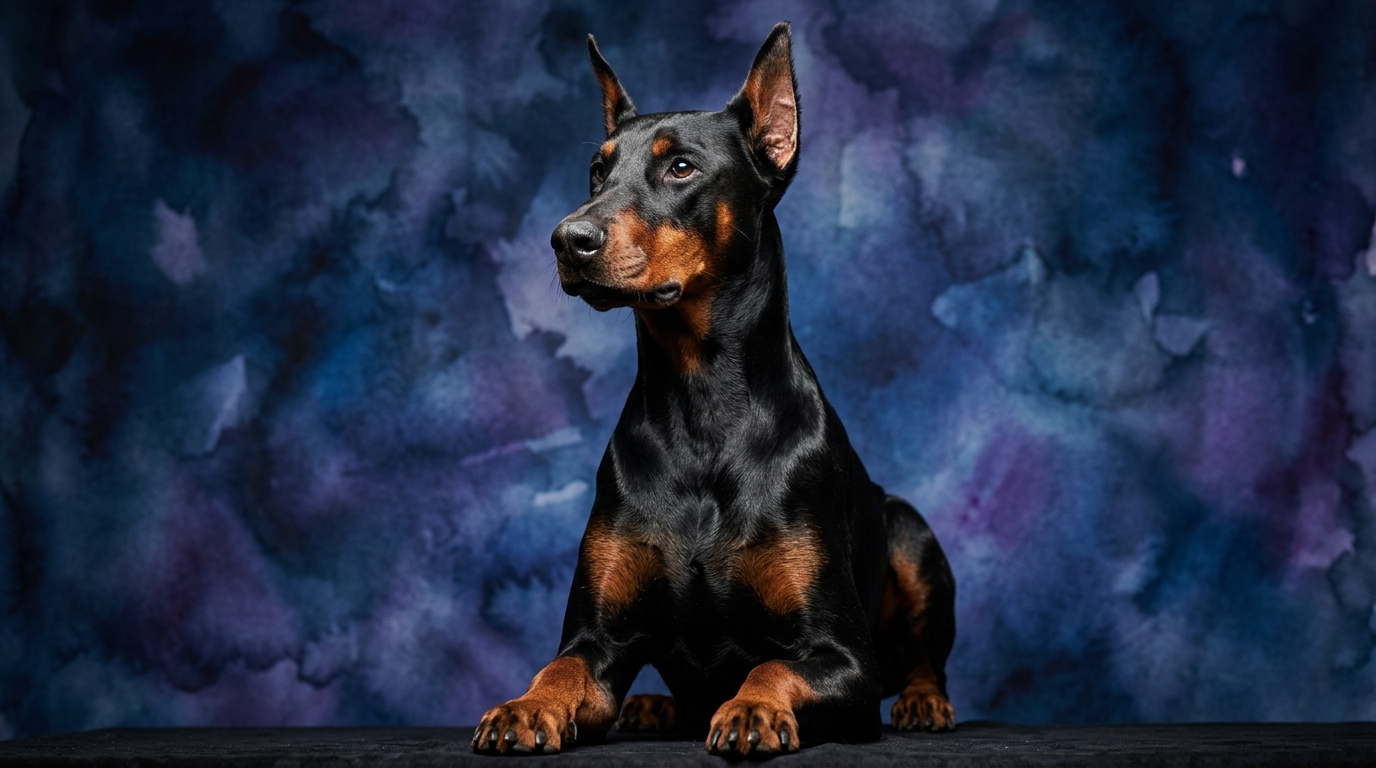

Side-by-Side IQ Profile: Doberman Pinscher vs. Rat Terrier
At The Cosmic Pet Pet IQ Lab, we assess canine intelligence across five key dimensions. The Doberman Pinscher, a Working Group breed ranked #5 by Coren, presents a profile reflecting its demanding roles. Its Problem Solving is rated 5/5, indicating an exceptional ability to analyze complex situations and devise effective solutions, such as navigating intricate scenarios or following multi-step commands with remarkable efficiency. Training Speed also scores 5/5, demonstrating an unparalleled capacity for rapid acquisition of new commands and behaviors, mastering tasks in very few repetitions. Social Intelligence stands at 4/5, showing a strong understanding of human cues and family dynamics, adept at discerning emotional states, though potentially reserved with strangers. Instinctive Drive is a powerful 5/5, manifesting as strong innate urges for protection, vigilance, and physical activity, fueling a robust work ethic. Finally, Memory is 5/5, retaining learned information and experiences with exceptional fidelity over extended periods, contributing to their reliability.
The Rat Terrier, a Terrier Group breed not Coren-ranked, showcases a different cognitive blueprint. Its Problem Solving is 3/5, capable of solving practical, immediate problems, particularly those related to prey drive or environmental navigation, with solutions often direct and instinct-driven rather than analytically complex. Training Speed is 3/5, meaning it learns new commands at a moderate pace, often requiring more repetition and consistent motivation due to its independent nature. Social Intelligence is 3/5; while understanding human dynamics within its close circle, its focus is often on its immediate environment and personal interests, displaying affection but perhaps less empathetic depth. Instinctive Drive is 3/5, possessing a strong inherent prey drive and a desire for exploration and digging, though these drives are generally less intense and less easily channeled than those of working breeds. Memory also rates 3/5, retaining learned behaviors and experiences adequately, remembering routines and familiar people, but potentially requiring refreshers for intricate sequences.
Where the Doberman Pinscher Wins Cognitively
The Doberman Pinscher's cognitive architecture shines in areas demanding structured thought and precise execution. Their 5/5 rating in Problem Solving indicates a breed capable of processing complex information and formulating multi-step solutions, far surpassing the Rat Terrier's more immediate, instinctual approach. This analytical prowess is evident when they learn intricate protection routines or navigate obstacle courses requiring foresight, demonstrating a capacity for strategic thinking that is a hallmark of their working heritage.
Furthermore, their 5/5 Training Speed highlights an extraordinary capacity for rapid behavioral acquisition. A Doberman can grasp a new command in a handful of repetitions, internalizing the concept and performing it reliably. This contrasts sharply with the Rat Terrier's moderate learning pace, where consistent reinforcement over a longer period is typically needed. The Doberman's 5/5 Memory also provides a distinct advantage, ensuring that once a skill is learned, it is retained with remarkable durability. This enduring recall means less need for refreshing old lessons, making them exceptionally reliable in tasks ranging from obedience to specialized service work. Their superior Social Intelligence (4/5) allows them to interpret human intentions and emotions with greater nuance, fostering a deeper, more responsive partnership compared to the Rat Terrier's more self-focused social understanding.
Where the Rat Terrier Wins Cognitively
While the Rat Terrier's overall IQ profile might appear less formidable on paper, their cognitive strengths lie in different, yet equally valuable, domains. Their 3/5 Problem Solving, though lower than the Doberman's, reflects a practical, agile mind specifically tuned for independent action and immediate environmental assessment. A Rat Terrier excels at figuring out how to access a hidden treat, chase down a perceived pest, or navigate a complex backyard with cunning and resourcefulness, often without direct human instruction. This form of intelligence is less about complex obedience and more about autonomous, self-directed problem-solving in their immediate surroundings.
Their Instinctive Drive (3/5), while not as intense or easily channeled as the Doberman's, is perfectly suited for their original purpose: pest control. This drive manifests as relentless focus and tenacity when tracking a scent or investigating a rustle in the bushes. This independent hunting drive, combined with their quick reflexes, allows them to react swiftly and effectively in dynamic, unpredictable situations where a Doberman might wait for a command. The Rat Terrier's moderate Social Intelligence (3/5) means they are affectionate and bond deeply with their families, but their internal world is often less preoccupied with human hierarchical structures and more with personal exploration and immediate gratification. This can translate into a charming, independent spirit that, while sometimes challenging to train, offers a unique companionship where the dog is a spirited partner rather than a purely compliant subordinate. Their memory (3/5) is perfectly adequate for remembering routines, family members, and their hunting grounds, which are the most critical cognitive requirements for their lifestyle.
Which is Easier to Train and Why
The Doberman Pinscher is unequivocally easier to train, a direct consequence of their exceptional cognitive profile. Their 5/5 Training Speed means they absorb new commands and behaviors with astonishing rapidity, often understanding what is expected after just a few repetitions. This is bolstered by their high Social Intelligence (4/5), which makes them highly attuned to human cues and eager to please their handler. They possess a strong desire for purpose and structure, making them highly receptive to formal training. Their 5/5 Memory ensures that once a lesson is learned, it sticks, leading to consistent performance. For instance, teaching a Doberman a complex agility course or a series of obedience commands can be a remarkably fluid process, with the dog often anticipating the next instruction. They thrive on mental stimulation and the challenge of mastering new skills, viewing training as a collaborative effort.
In contrast, the Rat Terrier, with a 3/5 Training Speed, requires more patience and consistency. Their independent nature, a hallmark of many terrier breeds, means they might question the necessity of a command or prefer to follow their own instincts, particularly if a more enticing distraction is present. While they are certainly trainable, their learning curve is generally steeper, and they may require more repetitions and higher-value rewards to solidify new behaviors. Their moderate Social Intelligence means they might be less concerned with pleasing their handler and more focused on their own environmental investigations. For example, getting a Rat Terrier to perform a "stay" in the presence of a squirrel might be a significant challenge, whereas a Doberman, with its strong focus and desire to comply, would likely hold the position. Their memory (3/5) is sufficient, but less frequently practiced commands might fade without consistent reinforcement.
Which Suits Active Owners vs. Relaxed Owners
The Doberman Pinscher is an ideal match for highly active owners who can provide consistent mental and physical challenges. Their 5/5 Instinctive Drive translates into a significant need for engagement, whether through advanced obedience, protection sports, agility, or extensive daily exercise. Owners who enjoy structured activities, training classes, and long, vigorous outings will find a Doberman a willing and capable partner. Their cognitive prowess demands an owner who can channel their problem-solving abilities and memory into productive outlets, preventing boredom and potential behavioral issues. A relaxed owner would quickly find themselves overwhelmed by the Doberman's innate drive and need for purpose.
For owners seeking a more independent, less demanding canine companion in terms of formal training and intense structured activity, the Rat Terrier could be a more suitable choice. While they are energetic and enjoy play, their 3/5 Instinctive Drive means their daily exercise needs are generally more manageable than a Doberman's. They enjoy exploring, walks, and interactive play, but are often content with moderate activity and a cozy spot indoors afterward. A relaxed owner who appreciates a dog with a spirited, self-reliant personality and can provide consistent, albeit less intensive, mental stimulation through puzzle toys or backyard exploration, will likely find the Rat Terrier a charming companion. They are not suited for entirely sedentary lifestyles, but their energy is more easily satisfied without demanding the rigorous daily structure a Doberman requires.
The Verdict
Choose a Doberman Pinscher if you are an experienced, active owner seeking a highly trainable, purpose-driven partner eager to excel in complex tasks and demanding activities.
Choose a Rat Terrier if you appreciate an independent, spirited companion with moderate energy levels, suited for owners who enjoy interactive play and can provide consistent, patient training without requiring extreme compliance.
🧠 Find Your Pet's IQ Score
Our Pet IQ Lab assessment covers 25+ tests across 5 cognitive dimensions — personalized to your breed.
Take the Full IQ Test →Frequently Asked Questions
Can a Rat Terrier be trained for complex tasks like a Doberman?
While a Rat Terrier can learn many commands, their 3/5 Problem Solving and Training Speed mean they generally won't achieve the same level of precision or speed in complex task acquisition as a Doberman. Their independent nature often leads them to prioritize their own instincts over intricate human instructions.
Do Dobermans require constant mental stimulation?
Yes, Doberman Pinschers, with their 5/5 Problem Solving and Memory, thrive on consistent mental engagement. Without sufficient challenges, they can become bored and develop undesirable behaviors, emphasizing the need for structured training and activities to channel their cognitive abilities.
Is social intelligence important for a family dog?
Social intelligence is crucial for a family dog as it dictates how well they understand and interact with humans. A Doberman's 4/5 rating suggests strong family bonding, while a Rat Terrier's 3/5 indicates they are affectionate but might be more independent in their social interactions.