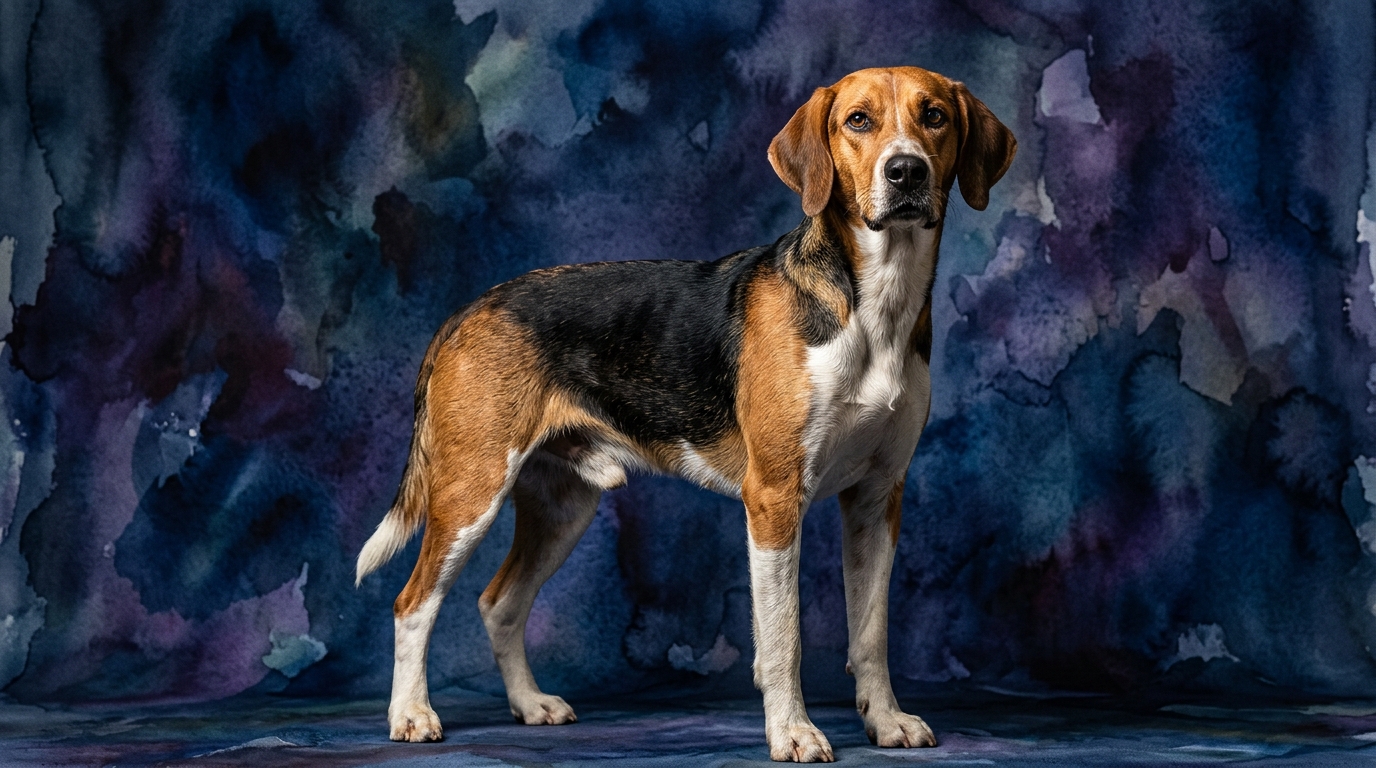

Side-by-Side IQ Profile: English Foxhound vs. Polish Lowland Sheepdog
**English Foxhound**
Problem Solving (3/5): This isn't about complex abstract reasoning, but rather the practical application of their senses to overcome environmental obstacles. A Foxhound's problem-solving shines in situations requiring them to untangle a confusing scent trail, navigate varied terrain to follow quarry, or strategize with their pack to encircle a target. Their solutions are often physical and instinct-driven, relying on an exceptional nose and sustained stamina to resolve a 'puzzle' in the field.
Training Speed (3/5): While not the quickest to grasp novel commands in a formal obedience setting, Foxhounds are perfectly capable of learning. Their 3/5 indicates a steady pace, often requiring consistent, positive reinforcement that taps into their prey drive or desire for companionship. Repetition and patience are key, acknowledging that their primary motivation isn't always human approval but the thrill of the chase or the comfort of the pack.
Social Intelligence (3/5): Living and working in a pack for generations has honed the Foxhound's ability to read canine body language and maintain harmony within a group. This translates to an understanding of social hierarchies and cooperation, extending to their human families. They can interpret human moods and intentions, often responding with an eager, if sometimes independent, spirit, valuing companionship highly.
Instinctive Drive (3/5): The Foxhound's lifeblood is its instinct to hunt by scent. This 3/5 score reflects a powerful, persistent drive to track, bay, and pursue. This isn't a casual interest; it's a deep-seated compulsion that guides their actions, providing an unwavering focus when a scent is present. This drive is so central that it often overshadows other motivations, making them single-minded in their pursuit.
Memory (3/5): A Foxhound's memory is robust for tasks pertinent to its purpose. They can recall complex scent patterns, remember successful hunting routes, and retain learned commands over time, especially when associated with positive experiences. Their memory is practical, aiding them in navigating familiar territories and anticipating routines, which contributes to their effectiveness in the field.
**Polish Lowland Sheepdog (PON)**
Problem Solving (3/5): The PON's problem-solving ability is rooted in its herding heritage, involving dynamic situations with moving animals. This 3/5 manifests as cleverness in maneuvering a flock, identifying escape routes, or navigating complex environments to keep sheep contained. They often employ independent thought to assess a situation and devise a solution, such as blocking a gap or guiding a stray, demonstrating strategic thinking in real-time.
Training Speed (3/5): Like the Foxhound, the PON learns at a moderate pace, a 3/5 indicating they are receptive but not necessarily instant learners. Their intelligence is often accompanied by a distinct willfulness, meaning they learn best with clear, consistent training that respects their independent nature. They respond well to task-oriented learning and thrive when given a job, preferring mental engagement over rote drills.
Social Intelligence (3/5): The PON's social intelligence is deeply intertwined with its role as a watchful guardian and family member. This 3/5 score highlights their capacity to form strong bonds with their human family, read their intentions, and understand household dynamics. They are perceptive of strangers and can discern threats, exhibiting a protective yet sensitive social acumen that makes them excellent companions and watchdogs.
Instinctive Drive (3/5): The PON possesses a strong herding and guarding instinct, scored at 3/5. This drive compels them to watch over their family or 'flock,' maintaining order and alerting to perceived dangers. It's a vigilant, attentive drive that makes them naturally protective and observant of their surroundings, often manifesting as a desire to keep everyone together and safe within their perceived boundaries.
Memory (3/5): A PON's memory is well-developed for routines, boundaries, and the movements of their charges or family members. They remember specific commands, the layout of their territory, and the habits of their people, allowing them to anticipate events and act proactively. This practical memory supports their role as a vigilant companion and effective herder, ensuring consistency in their duties.
Where the English Foxhound Wins Cognitively
The English Foxhound's cognitive strengths are deeply specialized, giving it an edge in tasks demanding sustained sensory focus and collaborative endurance. While both breeds score 3/5 in Problem Solving, the Foxhound excels in resolving 'scent puzzles' – interpreting complex olfactory information to follow an elusive trail over varied terrain and for extended periods. This isn't just about detecting a scent, but mentally mapping its trajectory, age, and direction, often requiring them to disregard myriad distracting odors. Their superior stamina directly translates to a cognitive advantage in persistence; they can maintain mental engagement on a single, demanding task for hours, outlasting many breeds. Furthermore, their pack heritage means they possess an innate understanding of collaborative effort, coordinating actions and communications (like baying) with fellow hounds without explicit instruction, a nuanced form of group problem-solving less emphasized in the more independent herding styles.
Where the Polish Lowland Sheepdog Wins Cognitively
The Polish Lowland Sheepdog demonstrates distinct cognitive prowess in areas demanding independent judgment and adaptable spatial reasoning. Their 3/5 in Problem Solving manifests as a talent for dynamic, real-time decision-making, particularly in managing moving objects or creatures. Unlike the Foxhound's linear pursuit, the PON must constantly assess and re-evaluate a fluid situation, such as guiding a scattering flock, anticipating their movements, and strategically positioning themselves to maintain control. This involves a high degree of visual-spatial intelligence and the ability to 'read' the behavior of animals or people, adjusting their tactics on the fly. Their historical role also fostered a strong sense of self-reliance; they are adept at making decisions without constant human direction, often observing and acting proactively to maintain order or protect their domain, showcasing a more autonomous form of cognitive application.
Which is Easier to Train and Why
Both breeds share a 3/5 rating for Training Speed, suggesting neither presents extreme challenges nor offers instant mastery. However, the *nature* of their training experience differs significantly due to their behavioral drivers. The English Foxhound's training often requires overcoming its powerful, singular focus on scent. When a compelling odor is present, their instinctive drive (3/5) can overshadow learned commands, making off-leash reliability a considerable undertaking. Training methods that successfully engage a Foxhound often involve incorporating scent work or using high-value, novel rewards to compete with their natural distractions, demanding immense patience and creativity from the handler. Conversely, the Polish Lowland Sheepdog, while also having an independent streak (a characteristic of many herding breeds), often possesses a stronger desire to work *with* their human and respond to direction, stemming from their role in managing a flock. Their social intelligence (3/5) means they are generally attentive to their family's cues. While they can be watchful and occasionally headstrong, their training benefits from clear, consistent communication and tasks that engage their problem-solving (3/5) and instinctive drive (3/5) to maintain order. Therefore, the PON might be perceived as 'easier' in a typical obedience context because their primary drive is more easily channeled towards human-directed tasks, whereas the Foxhound's drive is often directed outward, demanding more effort to redirect.
Which Suits Active Owners vs. Relaxed Owners
The English Foxhound undeniably leans towards owners who embrace an extremely active lifestyle. Their 3/5 instinctive drive for hunting and their inherent stamina demand extensive daily exercise – think long runs, vigorous hikes, or dedicated scent work sessions that span hours. A relaxed owner would quickly find themselves overwhelmed by a Foxhound's unmet physical and mental needs, which can lead to destructive behaviors born of boredom and pent-up energy. Their memory (3/5) and problem-solving (3/5) are geared towards sustained outdoor activity, not quiet contemplation. The Polish Lowland Sheepdog, while also requiring regular activity, presents a more nuanced suitability. They are certainly not for 'relaxed' owners in the sense of minimal engagement; their herding instincts and problem-solving (both 3/5) mean they thrive with structured activities, training, and mental challenges. However, a PON can be content with a substantial daily walk, play sessions, and interactive puzzle toys, coupled with ample family time indoors. They adapt better to a family-oriented routine once their exercise needs are met, offering a balance between activity and companionship. A PON owner should be active and committed to daily engagement, but perhaps not to the same relentless, mile-covering degree as a Foxhound owner.
The Verdict
Choose the English Foxhound if you are an avid outdoors enthusiast, eager to engage in extensive scent work or long-distance endurance activities, and value a dog with deep pack instincts.
Opt for the Polish Lowland Sheepdog if you seek a vigilant, family-integrated companion who thrives on mental engagement, structured activity, and independent problem-solving in a home environment.
🧠 Find Your Pet's IQ Score
Our Pet IQ Lab assessment covers 25+ tests across 5 cognitive dimensions — personalized to your breed.
Take the Full IQ Test →Frequently Asked Questions
Do English Foxhounds and Polish Lowland Sheepdogs require similar amounts of grooming?
No, their grooming needs are quite different. The English Foxhound has a short, dense coat requiring minimal grooming, mainly occasional brushing to remove loose hair. The Polish Lowland Sheepdog, with its long, shaggy double coat, demands significant regular grooming to prevent matting and maintain skin health.
Are these breeds suitable for apartment living?
Neither breed is ideal for apartment living without significant commitment to outdoor activity. The English Foxhound's high energy and vocal nature make it ill-suited, while the Polish Lowland Sheepdog can adapt if its substantial exercise and mental stimulation needs are consistently met outside the apartment.
How do their vocalizations differ?
The English Foxhound is known for its distinctive baying, a loud, melodious howl used to communicate during the hunt, and can be quite vocal. The Polish Lowland Sheepdog typically has a more traditional bark, used for alerting and guarding, and can be quite watchful and vocal when strangers approach.