
Side-by-Side IQ Profile: English Foxhound vs. Toy Poodle
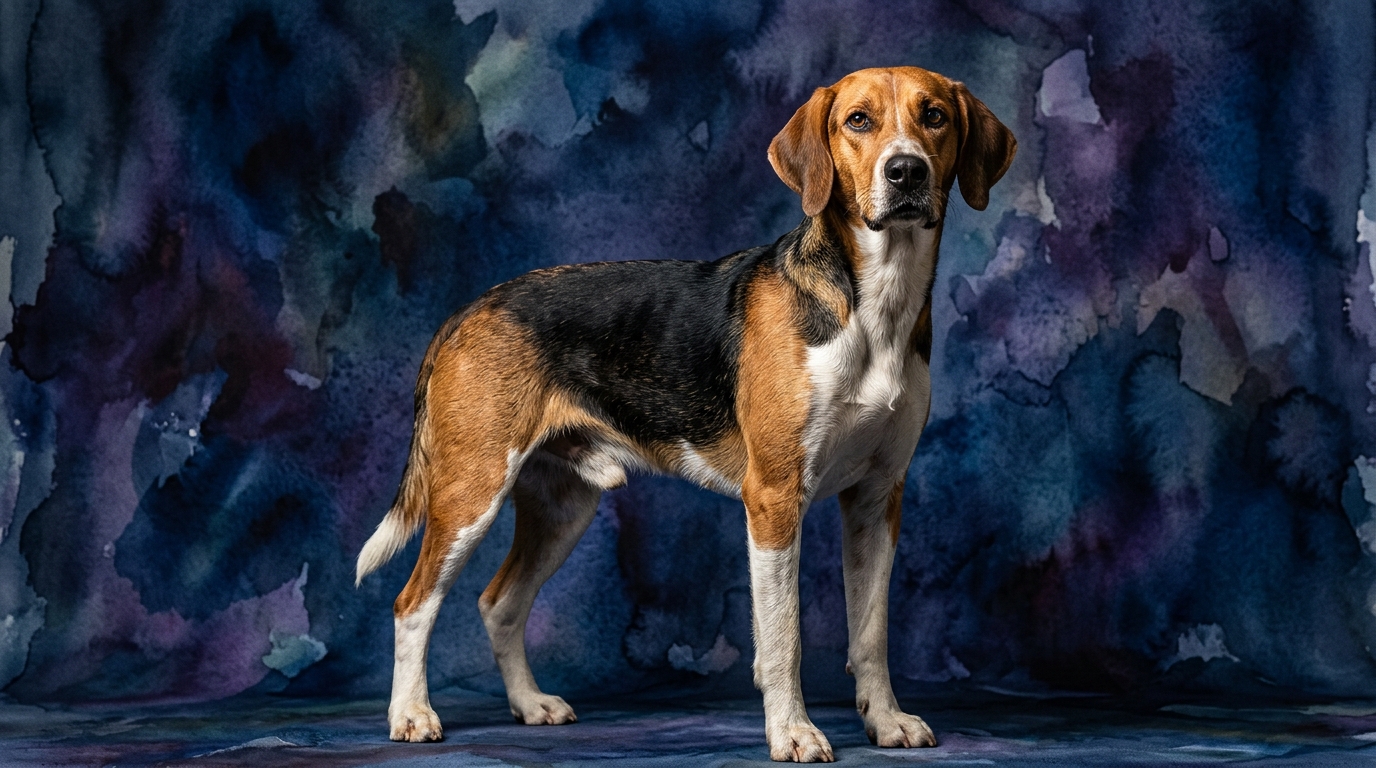
The English Foxhound, a breed purpose-bred for sustained, independent hunting, exhibits a cognitive profile tailored to its working heritage. Its Problem Solving score of 3/5 reflects a practical intelligence focused on navigating terrain and overcoming obstacles during a chase, rather than abstract puzzle-solving. They excel at finding solutions within a specific, scent-driven context. Training Speed, also at 3/5, indicates they can learn commands, but their strong, independent drive often means they process human instructions at a moderate pace, sometimes prioritizing an intriguing scent over a recall cue. Social Intelligence, rated 3/5, suggests they are generally amicable and understand basic pack dynamics, but might not be as finely attuned to the subtle emotional nuances of their human companions as breeds specifically developed for close human interaction. Their Instinctive Drive, a moderate 3/5, is powerfully channeled into scent tracking and persistent pursuit, defining much of their mental engagement. Finally, Memory, at 3/5, is proficient for remembering trails, routines, and the locations of familiar resources, yet perhaps not for retaining complex sequences of diverse commands with the same precision as other breeds.
In stark contrast, the Toy Poodle presents a cognitive architecture optimized for versatility and rapid learning, earning its high Coren rank. Its Problem Solving capability is exceptional, scoring 5/5, indicating a remarkable aptitude for strategizing, understanding complex situations, and figuring out novel challenges with enthusiasm. This translates into a dog that can often “think through” problems and adapt quickly. Training Speed, also a perfect 5/5, highlights their extraordinary ability to pick up new commands, tricks, and routines with remarkable efficiency and eagerness. They thrive on mental engagement and respond swiftly to instruction. Interestingly, their Social Intelligence mirrors the Foxhound's at 3/5, suggesting they are excellent companions, capable of strong bonds, but their primary cognitive strength isn't necessarily in hyper-sensitivity to nuanced human emotions, despite their close relationship with people. Their Instinctive Drive, a 3/5, is a general eagerness to engage and participate, often manifesting in play and interaction with their owners, rather than a singular, specialized task. Lastly, their Memory is outstanding, a 5/5, meaning they retain a vast repertoire of learned behaviors, experiences, and associations with remarkable long-term recall, making them highly reliable once a behavior is established.
Where the English Foxhound Wins Cognitively
While the Toy Poodle boasts higher raw scores in many areas, the English Foxhound's cognitive strengths lie in their specialized application and endurance. Their 3/5 in Problem Solving is not a deficit but a focused efficiency; they are masters at navigating complex outdoor environments, tracking faint scents over vast distances, and overcoming physical barriers to achieve their goal. This isn't about solving a puzzle box for a treat, but about sustained, independent decision-making in a dynamic, scent-rich landscape. Their 3/5 Instinctive Drive, though moderate overall, is intensely concentrated on their olfactory world, granting them unparalleled persistence and single-mindedness in pursuit. A Foxhound's memory, also 3/5, is highly effective for recalling intricate scent trails and mapping out routes, a critical cognitive function for its original purpose that far outstrips many breeds in that specific domain. For tasks requiring independent, persistent, and physically demanding scent-driven work, the Foxhound's cognitive makeup is uniquely superior.
Where the Toy Poodle Wins Cognitively
The Toy Poodle shines in areas demanding rapid assimilation of information, abstract reasoning, and versatile application of learned behaviors. Their 5/5 Problem Solving capability means they can quickly assess novel situations and devise effective strategies, whether it's figuring out how to open a cabinet or understanding the rules of a new game. This cognitive agility allows them to excel in complex training scenarios and adapt seamlessly to various environments. The 5/5 Training Speed is a significant advantage, enabling them to learn new commands and multi-step routines with minimal repetition, making them a joy for owners interested in dog sports or advanced obedience. Furthermore, their 5/5 Memory ensures that once a lesson is learned, it is deeply ingrained, leading to consistent performance and reliability. This combination makes the Toy Poodle exceptionally amenable to a wide array of human-directed activities, from agility to therapy work, far beyond the scope of a specialized hunting hound.
Which Is Easier to Train and Why
The Toy Poodle is unequivocally easier to train compared to the English Foxhound, a difference rooted in their fundamental cognitive architectures and motivational drives. The Toy Poodle's perfect 5/5 scores in Training Speed, Problem Solving, and Memory mean they not only grasp new concepts almost instantly but also actively enjoy the mental challenge of learning. They are eager to please and find intrinsic reward in engaging with their human trainers, making positive reinforcement highly effective. A Toy Poodle will quickly connect a command to an action and retain that association. In contrast, the English Foxhound’s 3/5 scores in these same dimensions, coupled with their powerful, independent Instinctive Drive (3/5 focused on scent), means training requires significantly more patience and consistency. A Foxhound's primary motivation is often the allure of a scent trail, making it challenging to maintain focus on human-initiated commands when environmental distractions are present. Their independence, while valuable in the field, can be perceived as stubbornness in a training setting, as they are less inclined to prioritize human instruction over their own instincts. While trainable, it requires understanding their inherent nature and finding ways to work with, rather than against, their deep-seated drives.
Which Suits Active Owners vs. Relaxed Owners
The distinction between these breeds for different owner lifestyles is stark. The English Foxhound is an ideal match for exceptionally active and dedicated owners. Their heritage demands extensive physical exertion, often miles of sustained running daily, coupled with mental stimulation that engages their powerful sense of smell. They are not content with short walks around the block; they thrive in environments where they can explore vast spaces, preferably off-leash in secure areas, or participate in activities like canicross or scent work. A truly “relaxed” owner, in the sense of a sedentary lifestyle, would find themselves overwhelmed by a Foxhound's boundless energy and potential for destructive behaviors if not adequately exercised. The Toy Poodle, while also benefiting from regular activity, offers far greater flexibility for owners. Their moderate Instinctive Drive and adaptability mean they can thrive with a combination of daily walks, engaging playtime, and consistent mental challenges like puzzle toys or learning new tricks. While they appreciate activity, they are equally content to settle indoors with their family, making them suitable for owners who might have a more varied activity level, or those living in smaller spaces, as long as their mental needs are consistently met. They are adaptable companions, not requiring the same specialized outdoor commitment as the Foxhound.
The Verdict
Opt for an English Foxhound if you are an exceptionally active individual or family, capable of providing hours of daily, vigorous exercise, particularly involving scent work or long-distance running, and you appreciate a persistent, independent companion whose intelligence shines brightest in outdoor, exploratory pursuits.
Select a Toy Poodle if you seek a highly adaptable, rapidly trainable, and mentally agile companion who thrives on learning, engagement, and can excel in various dog sports or advanced obedience, fitting well into diverse living situations as long as their significant mental and moderate physical needs are consistently addressed.
🧠 Find Your Pet's IQ Score
Our Pet IQ Lab assessment covers 25+ tests across 5 cognitive dimensions — personalized to your breed.
Take the Full IQ Test →Frequently Asked Questions
Are English Foxhounds difficult to train because of their intelligence?
English Foxhounds possess a focused intelligence suited for independent scent work, rather than difficulty. Their 3/5 training speed and strong instinctive drive mean they require patient, consistent training methods that account for their independent nature and potential distraction by scents, but they are certainly trainable.
Does the Toy Poodle's high IQ mean it needs constant complex mental stimulation?
While Toy Poodles thrive on mental engagement due to their high problem-solving and memory scores, "constant" isn't the right term. They benefit from daily puzzle toys, training sessions, and interactive play, but can also relax, adapting their mental energy to the situation and not necessarily requiring non-stop complex tasks.
How does a dog's "Instinctive Drive" score impact daily life for owners?
Instinctive Drive indicates a dog's innate motivation for specific behaviors like hunting, herding, or retrieving. A higher, focused drive (like the Foxhound's for scent) means these urges will be prominent and need appropriate outlets, influencing exercise requirements and potential behavioral challenges if not managed. A more moderate, generalized drive (like the Poodle's) allows for greater adaptability in channeling that energy into various activities.