
Side-by-Side Cognitive Profiles: FCR vs. Min Pin
The Cosmic Pet Pet IQ Lab employs a comprehensive five-dimensional framework to assess canine intelligence, offering a nuanced view beyond simplistic 'smart' labels. For the Flat-Coated Retriever, ranked #17 in Coren's intelligence study for working and obedience, its profile reflects a breed historically bred for active partnership. Its Problem Solving score of 4/5 indicates a capacity for understanding multi-step tasks and adapting to new situations, such as figuring out how to retrieve an object from a complex environment or navigating obstacles efficiently. Training Speed, also at 4/5, points to a rapid grasp of new commands and routines, often requiring fewer repetitions than many other breeds. Social Intelligence is rated 3/5, suggesting a reasonable ability to interpret human cues and adjust behavior in social contexts, though perhaps not with the extreme sensitivity of some companion breeds. Its Instinctive Drive, at 3/5, is largely channeled towards retrieving and working alongside a handler, demonstrating a focused purpose. Crucially, its Memory stands out at an impressive 5/5, signifying an exceptional ability to recall commands, learned behaviors, and past experiences over long periods, making it highly reliable in sequential tasks.
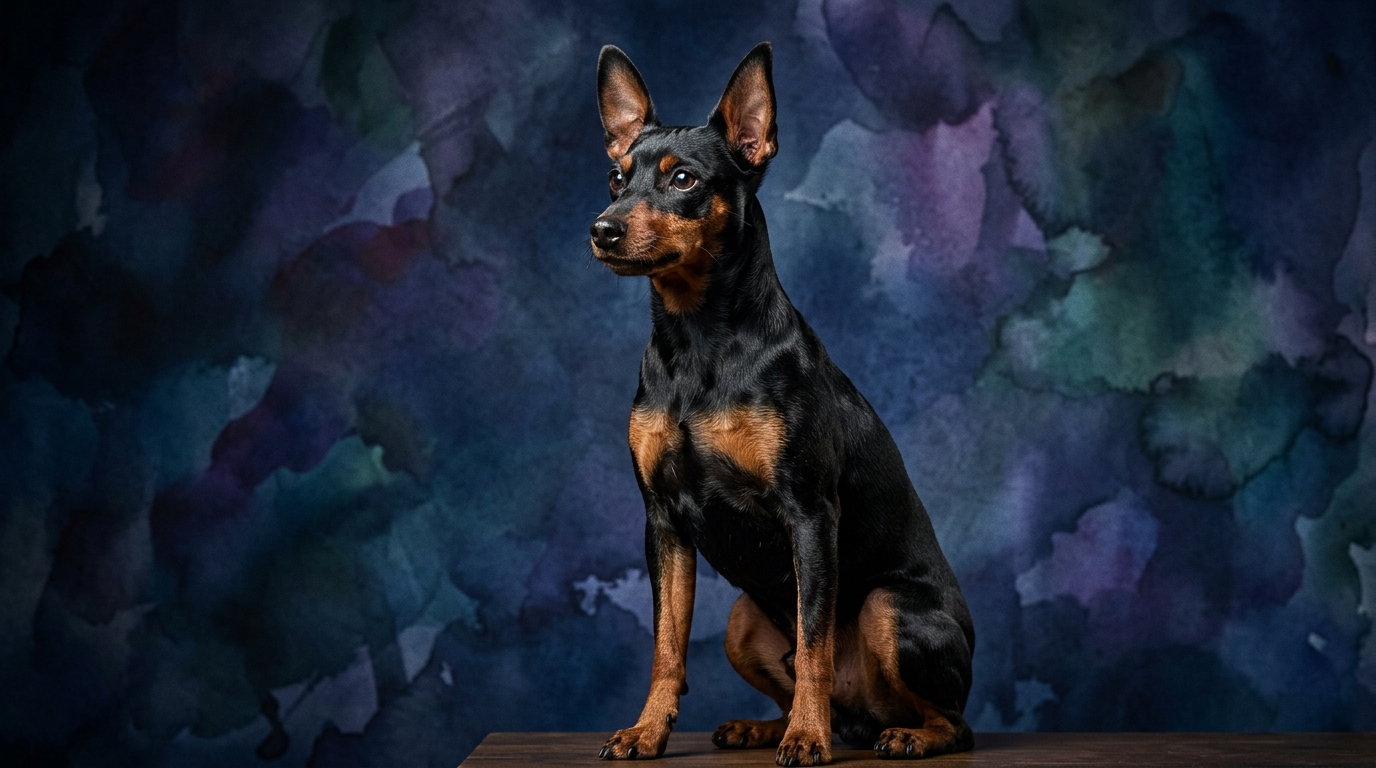
In contrast, the Miniature Pinscher, a Toy group member not listed in Coren's ranking, presents a different set of cognitive strengths tailored to its role as a vigilant companion. Its Problem Solving score of 3/5 indicates an ability to navigate familiar challenges and learn through experience, though perhaps with less spontaneous innovation than the Flat-Coat. Training Speed, also 3/5, means the Min Pin is certainly trainable, but typically requires more consistent and patient repetition to solidify new commands. Similar to the Flat-Coat, its Social Intelligence is 3/5, allowing it to interact effectively within its human family, reading basic emotional states and intentions. The Miniature Pinscher’s Instinctive Drive, also 3/5, is predominantly expressed through its natural alertness, territoriality, and a strong prey drive for small vermin, reflecting its heritage as a 'King of Toys' with a watchful demeanor. Its Memory score of 3/5 suggests a functional recall for routine commands and familiar faces, but it may not retain complex sequences or less frequently practiced skills with the same tenacity as the Flat-Coat.
Where the Flat-Coated Retriever Excels Cognitively
The Flat-Coated Retriever's cognitive prowess shines brightest in areas demanding sustained focus, sequential learning, and robust recall. Its 5/5 Memory score means it can retain an extensive repertoire of commands, remember the location of retrieves even after distractions, and recall complex scent trails with remarkable accuracy. This superior memory is a cornerstone of its working ability, enabling it to perform intricate field tasks reliably over time. For instance, a Flat-Coat can be taught a series of retrieve commands, remembering which specific item to fetch from a group, or recalling a multi-stage agility course after only a few run-throughs. This memory also contributes to its consistency in obedience, as once a behavior is learned, it is deeply ingrained.
Furthermore, the Flat-Coat's 4/5 Problem Solving and 4/5 Training Speed work synergistically to make it an adept learner in dynamic environments. It doesn't just learn quickly; it applies that learning to novel situations. If faced with a new barrier during a retrieve, a Flat-Coat is more likely to assess the situation and attempt different solutions, such as finding a path around or a way to manipulate the obstacle, rather than simply giving up or repeating an ineffective action. Its cooperative nature, stemming from its gundog heritage, means it is predisposed to engaging with human instruction to solve these problems, further enhancing its cognitive advantage in collaborative tasks.
Where the Miniature Pinscher Demonstrates Unique Cognitive Strengths
While the Miniature Pinscher's overall IQ scores are generally lower than the Flat-Coated Retriever's, its cognitive profile is perfectly adapted to its specific purpose and environment, highlighting unique strengths. Its 3/5 Instinctive Drive, though numerically equal, manifests differently, emphasizing vigilance and quick reaction. This translates into an acute awareness of its surroundings, allowing it to register subtle changes in its environment, such as unfamiliar sounds or movements, with remarkable speed. This rapid detection and response, often expressed as barking or a sudden burst of energy, is a form of cognitive processing tailored for its 'watchdog' role, demonstrating a focused attention on its immediate territory.
The Miniature Pinscher's Problem Solving at 3/5, combined with its tenacious spirit, often manifests as resourcefulness in achieving its goals, especially those related to comfort, attention, or accessing forbidden areas. While it may not solve complex puzzles designed for retrievers, it excels at finding creative ways to get what it wants within its domestic sphere—whether it's manipulating its owner for extra treats or discovering a weakness in a baby gate. This persistent, goal-oriented problem-solving, though sometimes perceived as stubbornness, is a cognitive advantage in navigating its human-centric world and asserting its desires. Its smaller size also means it excels at navigating tight spaces and utilizing its physical agility in ways a larger breed cannot, requiring specific spatial awareness and planning.
Training Dynamics: Flat-Coat’s Eagerness vs. Min Pin’s Tenacity
When it comes to training, the Flat-Coated Retriever generally presents a smoother, more rapid learning curve due to its 4/5 Training Speed and exceptional 5/5 Memory. These traits, coupled with its historical breeding for cooperative work, mean Flat-Coats typically pick up new commands with enthusiasm and retain them reliably. They thrive on positive reinforcement and enjoy the mental stimulation of learning, often eager to please their handlers. Behavioral differences manifest in their focus; a Flat-Coat is less likely to be distracted by environmental stimuli during a training session, preferring to engage with its human partner and the task at hand. This makes teaching complex sequences or advanced obedience skills a more fluid process, as they build upon previous lessons with strong recall.
The Miniature Pinscher, with a 3/5 Training Speed and 3/5 Memory, requires a different approach. While capable of learning, their training often demands more patience, consistency, and creative methods to maintain engagement. Their strong instinctive drive towards alertness and independence means they can be more easily diverted by a passing squirrel or an unfamiliar sound, making focus a key challenge. Their resourcefulness, while a cognitive strength in some contexts, can manifest as a tendency to 'think for themselves' rather than blindly follow commands, especially if they perceive a task as unrewarding. Successful training with a Min Pin often involves short, engaging sessions, high-value rewards, and a clear understanding of their motivations. They are not less capable of learning, but their learning style is less about rapid absorption and more about consistent reinforcement overcoming their natural independence and environmental awareness.
Matching Canine Minds to Lifestyles: Active vs. Relaxed Owners
The distinct cognitive profiles of these breeds strongly dictate their suitability for different owner lifestyles. The Flat-Coated Retriever, with its high Problem Solving, Training Speed, and outstanding Memory, thrives with active owners who can provide consistent mental and physical engagement. Owners who enjoy dog sports like agility, obedience, rally, or field trials will find a Flat-Coat's mind eager to learn and excel. Their need for intellectual stimulation means that a relaxed owner who offers only minimal interaction might find their Flat-Coat becoming bored, potentially leading to undesirable behaviors as the dog seeks to entertain itself. They need daily opportunities to use their retrieving instincts, problem-solving skills, and memory, whether through training sessions, complex games, or structured walks with purpose.
The Miniature Pinscher, while energetic and spirited, can suit a broader range of owners, including those with a more relaxed lifestyle, provided their cognitive needs are met differently. Their 3/5 scores across most dimensions mean they benefit from routine and clear expectations rather than constant novelty in complex tasks. Owners who appreciate a vigilant, lively companion that enjoys interactive play and consistent, positive reinforcement will find a Min Pin rewarding. While they still require regular exercise and mental engagement to prevent boredom, this engagement often centers around their alert nature—training them to respond to specific sounds, teaching them tricks, or engaging in short bursts of chase and play. They are excellent for owners who can provide consistent companionship and integrate their cognitive stimulation into daily interactions without needing extensive, high-intensity training regimens.
The Verdict
Choose the Flat-Coated Retriever if you are an active owner seeking a highly cooperative, intelligent partner for advanced training, dog sports, or a working role, valuing exceptional memory and rapid learning.
Opt for the Miniature Pinscher if you desire a spirited, vigilant companion who thrives on consistent routine, engaging play, and a firm yet patient training approach, appreciating their sharp awareness of their immediate surroundings.
🧠 Find Your Pet's IQ Score
Our Pet IQ Lab assessment covers 25+ tests across 5 cognitive dimensions — personalized to your breed.
Take the Full IQ Test →Frequently Asked Questions
Is the Flat-Coated Retriever easy for first-time dog owners?
With a 4/5 Training Speed and 5/5 Memory, Flat-Coated Retrievers are generally amenable to training, making them a good choice for first-time owners committed to providing consistent mental and physical exercise. Their cooperative nature helps them bond quickly with their human companions, facilitating the learning process.
Do Miniature Pinschers learn tricks easily?
Miniature Pinschers can certainly learn tricks, though their 3/5 Training Speed means it might take more repetitions and patience compared to breeds with higher scores. Their drive for attention and food motivation can be leveraged effectively, making short, fun, and highly rewarding training sessions ideal for teaching new tricks.
Which breed needs more mental stimulation?
The Flat-Coated Retriever generally requires more intense and varied mental stimulation due to its higher problem-solving and memory capabilities, thriving on complex tasks and learning new skills. While Miniature Pinschers also need mental engagement, their needs are often met with consistent routines, basic obedience, and interactive play that taps into their alert and tenacious nature.