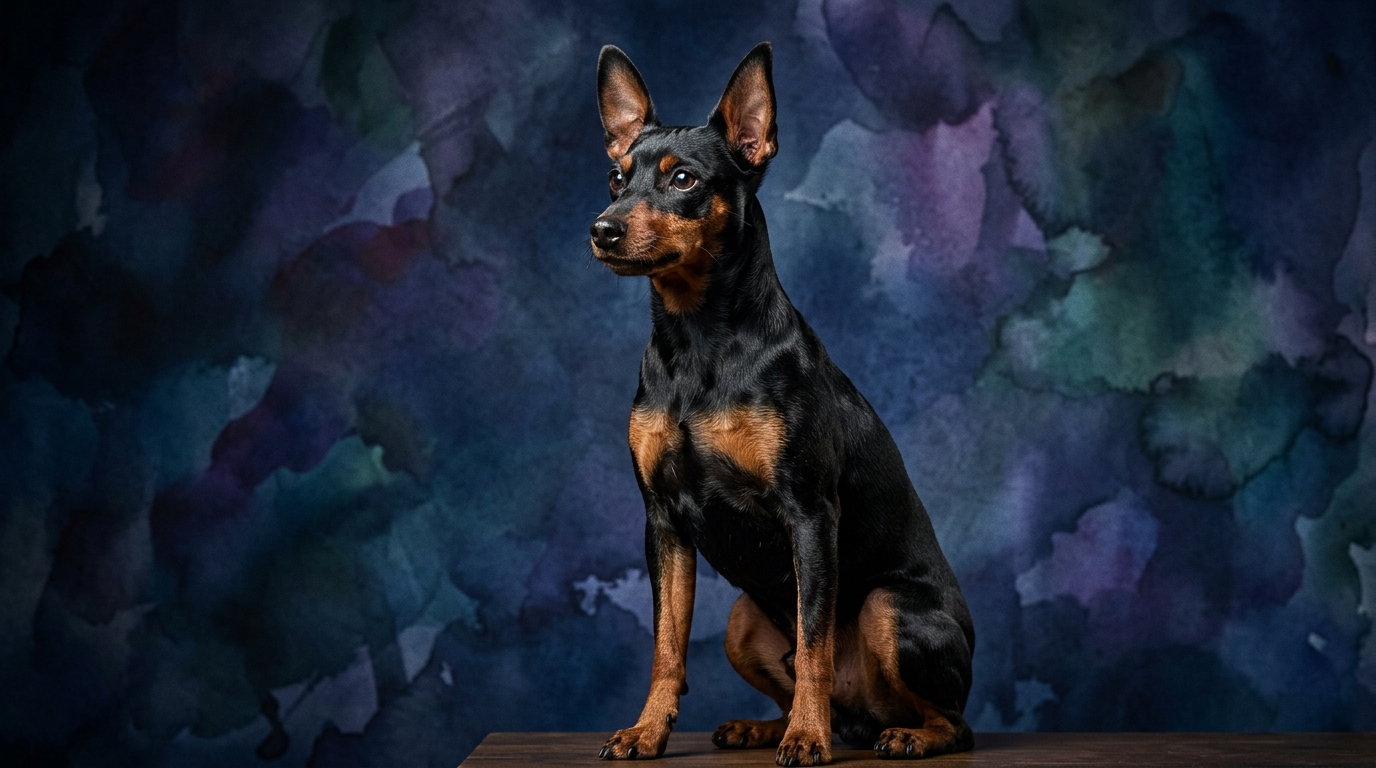
Miniature Pinscher at a glance
| IQ Rank / Score | 12/25 |
|---|---|
| Trainability | ★★★☆☆ (3/5) |
| Social Intelligence | ★★★☆☆ (3/5) |
| Lifespan | 12-16 years |
| Shedding | Low to moderate |
| Exercise Needs | Moderate (30-45 min/day) |
| Origin | Germany |
The Min Pin Mind: Primary Intelligence Angle
The Miniature Pinscher's intelligence is primarily defined by its proactive, independent problem-solving coupled with exceptional situational awareness. Unlike breeds that might wait for cues, the Min Pin's mind is constantly scanning, assessing, and often anticipating, leading to decisions that are self-initiated and goal-oriented. This isn't just intelligence; it's a cunning, strategic form of cognition that allows them to quickly evaluate their environment for opportunities, resources, or perceived challenges, often making them seem like they're always a step ahead. Their historical role as efficient ratters demanded dogs capable of rapid, autonomous judgments in dynamic environments, a trait deeply embedded in their cognitive makeup today. This means a Min Pin will not just react to a closed door; they will often meticulously observe human interaction with it, try various methods to open it themselves, or even 'recruit' a human to assist them, all stemming from their self-reliant ingenuity. They are masters of adapting their tactics, demonstrating remarkable cognitive flexibility when faced with obstacles, preferring to find their own solutions rather than waiting for direction.
This acute perceptual intelligence extends beyond physical challenges to social dynamics. A Min Pin can be surprisingly adept at reading human emotions and intentions, using this understanding to their advantage. They learn what behaviors elicit desired responses, be it attention, treats, or access to forbidden areas. Their assertive nature means they're not afraid to 'test the waters' or push boundaries, constantly learning from the outcomes. This independent thought process, while making them incredibly capable, also means that training a Min Pin requires a handler who can consistently engage their clever mind and provide compelling reasons for cooperation. Merely repetitive commands often fail to capture the attention of a dog whose brain is always seeking a more engaging puzzle to solve or a new corner of their world to explore.
A Glimpse into History: The Min Pin's Cognitive Roots
The Miniature Pinscher's distinctive intelligence is intrinsically linked to its surprising and often misunderstood origins. While frequently mistaken as a miniature Doberman Pinscher, the Min Pin is, in fact, an older and entirely distinct breed. Originating in Germany several centuries before the Doberman's development, the Miniature Pinscher was bred specifically for ratting in homes and barns. This demanding historical role required an exceptionally keen, fearless, and agile intellect in a compact package. These dogs weren't simply cute companions; they were vital working animals whose survival and effectiveness depended on their sharp wits and tenacious spirit.
Their daily tasks involved independently navigating complex, often dangerous environments, making split-second decisions to outsmart and eliminate vermin. This wasn't a job for a dog that relied solely on human command; it required a dog capable of autonomous thought, spatial reasoning, and unwavering focus. The cognitive legacy of these ratting ancestors is evident in today's Min Pins: their extraordinary alertness, their seemingly endless energy, their innate curiosity, and their fierce determination to explore and master their surroundings. Their 'King of Toys' moniker isn't just about their regal appearance; it's a nod to their self-assured temperament and formidable cognitive capabilities, honed by generations of independent problem-solving on German farms.
Unpacking the Min Pin's IQ Scores
The Miniature Pinscher's intelligence is a multifaceted jewel, reflected in their unique IQ profile developed by The Cosmic Pet's Pet IQ Lab. These scores, ranging from 1 to 5, provide a snapshot of their inherent cognitive strengths and areas where their distinct personality influences their performance.
Problem-solving: 4/5. Min Pins excel at figuring things out on their own. Whether it's navigating a tricky gate, opening a cabinet, or devising a strategy to get a hidden toy, their independent nature fuels a cleverness that drives them to persistent, often creative solutions. They won't just wait for you to fix a problem; they'll try to solve it themselves, demonstrating a significant capacity for strategic thinking and adaptability.
Training Speed: 3/5. While highly intelligent, the Min Pin's training speed is often perceived as moderate due to their independent and sometimes selective nature. They *can* grasp commands quickly, often with just a few repetitions, but their willingness to *comply* consistently depends heavily on motivation, perceived value, and the handler's ability to maintain their focus. If they deem a task boring or less rewarding than another activity, they may choose to appear 'stubborn' rather than genuinely slow to learn.
Social Intelligence: 3/5. Min Pins are highly observant of their environment and the people within it, capable of reading nuanced social cues. However, their social intelligence is often directed towards understanding their personal advantage or assessing potential threats, rather than pure social bonding. They can be discerning, sometimes aloof, with strangers, and selective in their interactions, preferring to engage on their own terms. They excel at understanding pack dynamics within their family unit but may not always be eager to please or highly empathetic outside of it.
Instinctive Drive: 4/5. The Miniature Pinscher possesses a powerful instinctive drive, a direct inheritance from their ratting lineage. This manifests as a strong prey drive, making them keenly interested in small, fast-moving objects. They also exhibit notable territoriality and an acute alert system, often being quick to bark at perceived intruders or unusual sounds. This high drive means they are perpetually engaged with their environment, requiring ample outlets for their mental and physical energy.
Memory: 4/5. Min Pins boast an excellent memory, particularly for routines, established rules (and loopholes!), and significant experiences. They quickly learn the daily schedule, remember specific commands, and recall places where they've had positive or negative encounters. This strong memory contributes to their quick learning ability but also means that negative training experiences or inconsistent boundaries can be deeply ingrained and difficult to undo.
Cognitive Strengths: More Than Just a Pretty Face
Beyond their charming looks, Miniature Pinschers possess several cognitive strengths that make them truly unique. Their **exceptional observational learning** is paramount; they watch everything, often learning by simply observing human actions or other animals. This means they can pick up complex behaviors, both desirable and undesirable, with surprising speed, making consistency in training and environment crucial. For instance, a Min Pin might learn to open a cupboard not by being taught, but by meticulously watching their human do it multiple times.
Another key strength is their **environmental adaptability and resourcefulness**. Their intelligence is not static; it's an active process of problem-solving within their surroundings. They are adept at using tools (or turning everyday objects into tools) to achieve goals, whether it’s pushing a stool to reach a counter or nudging a door open with their nose. This resourcefulness stems from their independent ratting past, where quick thinking and innovative approaches were essential for survival. Their small size often belies a strategic mind capable of outwitting much larger challenges, a testament to their dynamic cognitive approach to life.
Common Cognitive Challenges & How to Address Them
The very traits that make Miniature Pinschers so intelligent can also present cognitive challenges for owners. Their **independent thinking** can manifest as 'selective hearing,' where they may understand a command but choose not to obey if it doesn't align with their current interests or if the perceived reward is insufficient. This isn't a lack of intelligence but rather an exercise of their autonomous will. To address this, training must be highly engaging, high-value, and consistent, always making compliance more rewarding than defiance.
Another challenge is their potential for **boredom and destructive behavior** if not adequately mentally stimulated. A clever Min Pin with nothing to do will invent its own entertainment, which can include chewing, digging, or escaping. Their sharp minds need regular puzzles, training sessions, and interactive play to prevent them from becoming 'masterminds of mischief.' Owners must understand that a tired Min Pin is often a well-behaved Min Pin, and 'tired' for this breed means mentally engaged, not just physically exercised.
Training with the 'King of Toys': Harnessing Min Pin Brainpower
Training a Miniature Pinscher is a deeply rewarding experience that requires a nuanced approach, acknowledging their unique cognitive profile. Forget rote repetition; Min Pins thrive on engagement and mental challenge. Positive reinforcement is paramount; these sensitive yet assertive dogs respond best to rewards-based training that makes learning fun and worthwhile. High-value treats, exciting toys, and enthusiastic praise will go much further than harsh corrections, which can quickly shut down their willing participation and create resistance.
Consistency and clear boundaries are also non-negotiable. A Min Pin's intelligence allows them to quickly identify inconsistencies in rules, and they will exploit any perceived loopholes. Establish routines early, apply rules universally, and ensure all family members are on the same page. Incorporating 'brain games' into daily training sessions, such as teaching complex tricks, playing hide-and-seek with toys, or engaging in scent work, will not only strengthen your bond but also fulfill their deep-seated need for mental stimulation. Remember, for a Min Pin, every command is an invitation to a puzzle; present it as an interesting challenge, and they are much more likely to participate enthusiastically.
Enrichment for the Miniature Pinscher Intellect
To keep the Miniature Pinscher's sharp mind engaged and prevent boredom-induced behaviors, a robust enrichment program is essential. Puzzle feeders are a fantastic way to make mealtime a mental workout, requiring them to think and strategize to access their food rather than simply gobbling it down. Interactive toys that dispense treats or require manipulation can provide hours of solo entertainment, tapping into their independent problem-solving skills.
Beyond toys, engaging in dog sports like agility, rally obedience, or even advanced trick training can harness their physical prowess and mental agility. Their historical scenting abilities can be further developed through nose work classes, allowing them to utilize their keen sense of smell in a structured, rewarding way. Regular rotation of toys and introduction of new challenges will prevent stagnation, ensuring your Min Pin's bright mind remains stimulated and happy.
3 At-Home Tests to Measure Your Miniature Pinscher's IQ
These tests are adapted from peer-reviewed ethology research. No equipment is needed beyond items you have at home. Run each test 5–10 times for reliable results.
The Myth: "Miniature Pinschers are stubborn and untrainable, especially when it comes to obedience."
✅ Miniature Pinschers are highly intelligent and very trainable, but they require consistent, positive reinforcement training that engages their clever minds and strong drives. They thrive on clear boundaries, mental challenges, and handlers who can earn their respect through fair leadership, not just repetition. Their 'stubbornness' is often a manifestation of their independent problem-solving and an evaluation of whether a command is truly worth their effort and attention.
Miniature Pinscher vs. Similar Breeds
🧠 What's Your Dog's IQ Score?
Our full Pet IQ Lab assessment includes 12+ tests across 5 cognitive dimensions, calibrated for Miniature Pinschers specifically.
Take the Full IQ Test →Frequently Asked Questions
How smart is a Miniature Pinscher?
Our Pet IQ Lab framework scores cognition across five dimensions (max 25). The Miniature Pinscher totals 12/25 — average for a domestic dog. The full article breaks down each dimension with at-home tests.
Are Miniature Pinschers easy to train?
Miniature Pinschers can learn most cues, but expect to repeat lessons and keep sessions short. They score 3/5 on Training Speed in our breed profile.
Are Miniature Pinschers good with children and other pets?
Miniature Pinschers can live well with families when socialized early. Their Social Intelligence scores 3/5, so supervise interactions with small children and introduce new pets gradually.
Do Miniature Pinschers need a lot of mental stimulation?
Miniature Pinschers benefit from 10-15 minutes of focused enrichment a day: food puzzles, short training drills, or novel toys rotated weekly.
How much exercise does a Miniature Pinscher need?
Miniature Pinschers do well with 20-40 minutes of daily walks and play plus a few short training moments.
How good is a Miniature Pinscher's memory?
Miniature Pinschers score 3/5 on memory. They remember high-value associations well; less-used cues fade without refresher sessions.
What is the typical lifespan of a Miniature Pinscher?
Miniature Pinschers commonly live 12-16 years when kept at a healthy weight.
The Miniature Pinscher's intelligence is a vibrant tapestry of assertive independence, sharp instincts, and clever problem-solving, proving that cognitive prowess comes in all sizes. Understanding their unique mental landscape is key to unlocking their full potential and fostering a truly enriching bond with these remarkable 'King of Toys'.