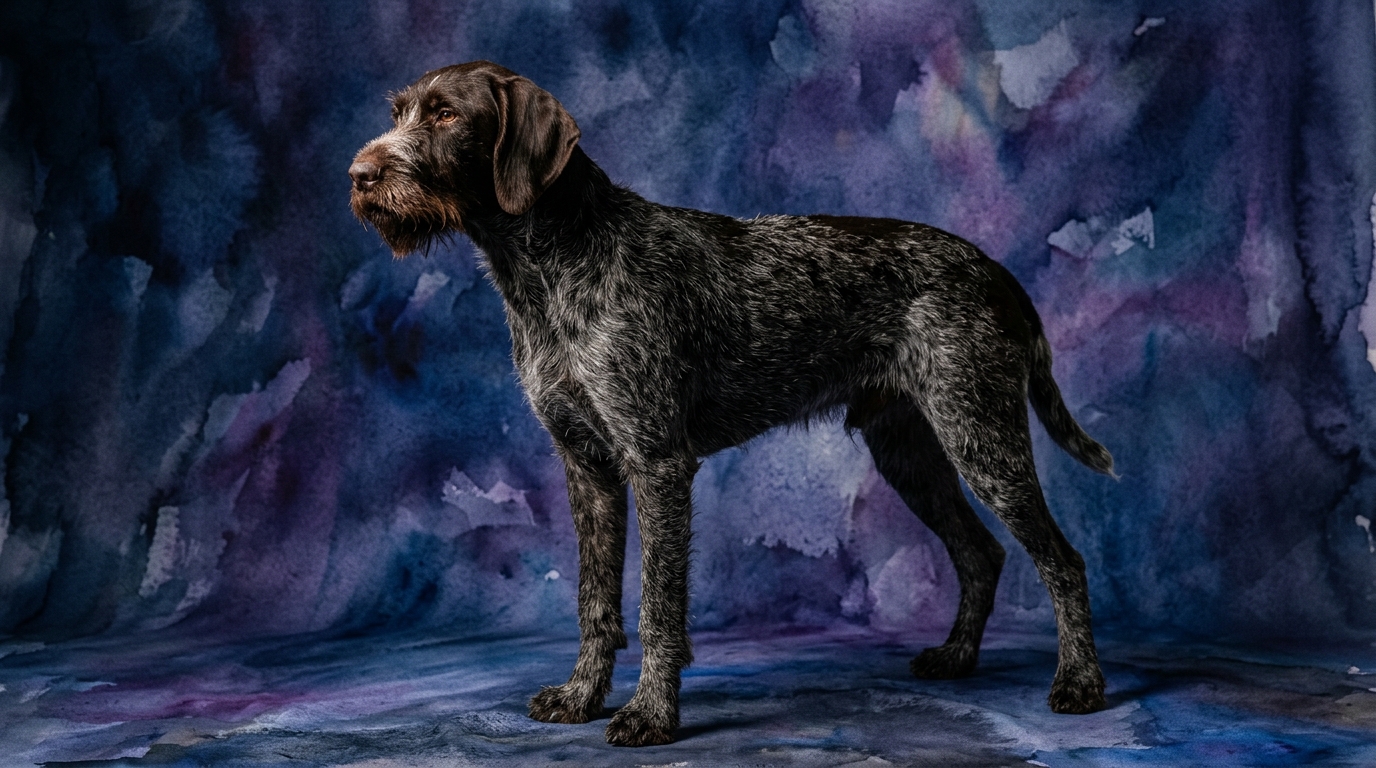
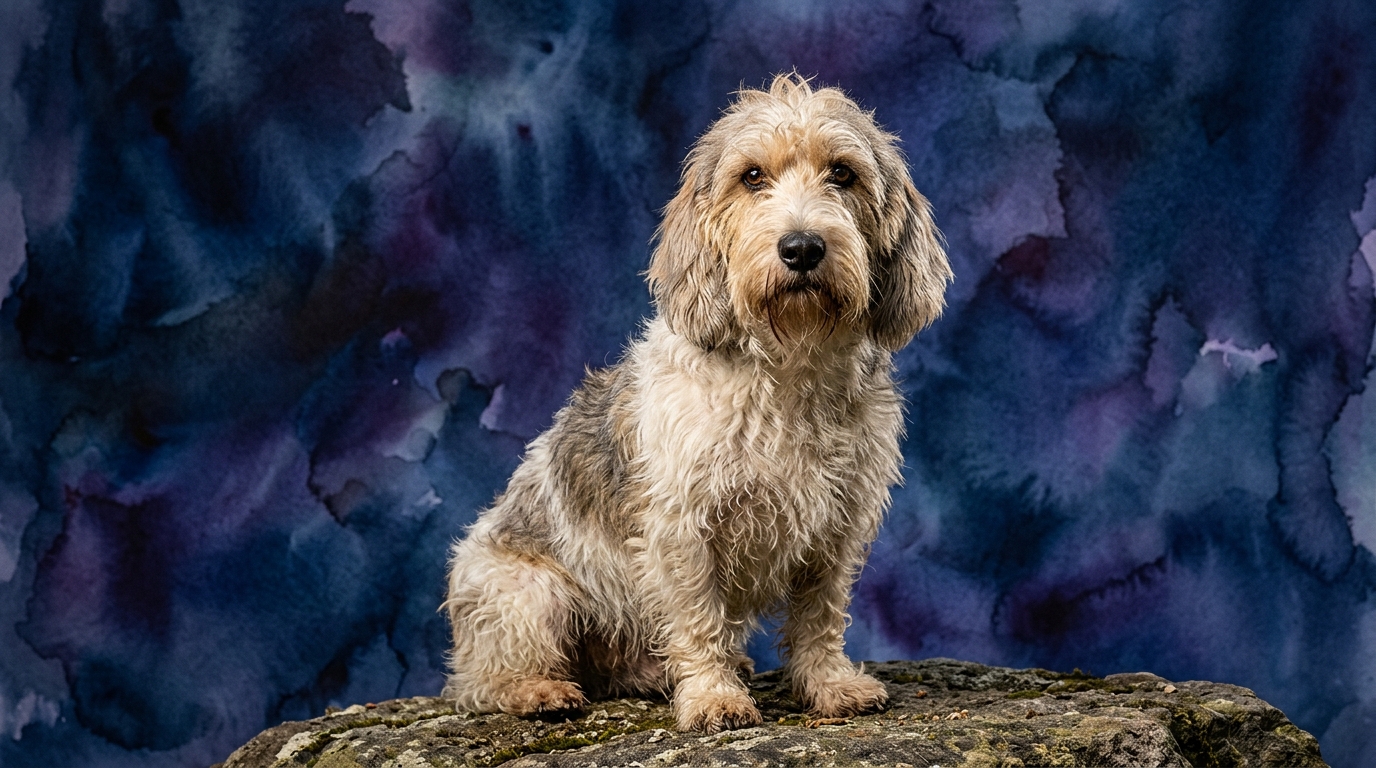
Side-by-Side IQ Profile: German Wirehaired Pointer vs. Petit Basset Griffon Vendéen
The German Wirehaired Pointer (GWP), a Sporting group member, ranks #28 on the Coren scale, indicating a strong capacity for understanding new commands quickly. Our Cosmic Pet IQ Lab assessment scores the GWP's Problem Solving at 4/5, reflecting its adeptness at navigating complex field scenarios, such as locating downed game in varied terrain or adapting to changing hunting conditions. Its Training Speed is also 4/5, signifying a keen willingness and ability to grasp new instructions efficiently, often within a few repetitions. Social Intelligence stands at 3/5, suggesting a capacity for forming strong bonds and interpreting human cues, though it can be focused on its primary handler. The GWP's Instinctive Drive is 3/5, primarily channeled into pointing, retrieving, and water work, demonstrating a controlled and purposeful application of its innate urges. Finally, its Memory is rated 4/5, enabling it to retain intricate command sequences, recall scent patterns, and remember hunting locations over time, crucial for a versatile working dog.
In contrast, the Petit Basset Griffon Vendéen (PBGV), a member of the Hound group, is not Coren-ranked, which is typical for breeds whose intelligence is specialized rather than generalized for obedience. Our IQ Lab assessment places the PBGV's Problem Solving at 3/5, which, for this breed, represents a specialized prowess in deciphering complex scent trails and independently navigating challenging environments to pursue quarry. Its Training Speed is 3/5, indicating a steady learning pace but one that can be influenced by its strong independent streak and environmental distractions. Social Intelligence scores 3/5, highlighting its sociable nature within a pack or family unit, though its interactions with humans might be less about strict compliance and more about charming independence. The PBGV's Instinctive Drive is also 3/5, but this score predominantly reflects an intense, unwavering focus on scent, often overriding other directives when a compelling trail is detected. Its Memory, at 3/5, is sufficient for recalling complex scent patterns and tracking routes, allowing for sustained pursuit, though it might not retain human-centric commands with the same fidelity as a GWP.
Where the German Wirehaired Pointer Wins Cognitively
The German Wirehaired Pointer clearly demonstrates cognitive advantages in areas requiring broad adaptability and close partnership with a human handler. Its superior Problem Solving score of 4/5 signifies an impressive ability to analyze and resolve challenges across diverse situations, from strategizing how to flush game to navigating complex agility courses. This isn't merely about following directions; it involves an intrinsic capacity to interpret environmental cues and apply learned solutions creatively.
Furthermore, the GWP’s higher Training Speed (4/5) and Memory (4/5) are significant assets for owners seeking a highly responsive and versatile canine companion. GWPs typically internalize new commands and multi-step routines rapidly, recalling them reliably even after periods of inactivity. This cognitive architecture makes them exceptional candidates for advanced obedience, competitive dog sports, and demanding field trials, where consistent human direction and quick adjustments are paramount. Their eagerness to engage in structured learning and their strong desire for collaborative work foster a more efficient and rewarding training experience for complex tasks.
Where the Petit Basset Griffon Vendéen Wins Cognitively
While the PBGV's numerical scores might not surpass the GWP's in generalized cognitive categories, its true cognitive triumphs lie in its specialized application of intelligence, particularly its Instinctive Drive (3/5) and Problem Solving (3/5) dedicated to scent work. A PBGV's intelligence 'wins' in its profound and unwavering focus when on a trail, exhibiting a singular mental tenacity that is remarkably difficult to disrupt. This specialized drive is a powerful cognitive engine, allowing it to commit fully to a task that requires sustained attention and physical endurance.
Its problem-solving ability, though rated 3/5, is acutely tuned to the intricate puzzle of a scent trail. This involves sophisticated discrimination of subtle odors, independent decision-making to follow a path even when it becomes faint or convoluted, and an innate ability to 'read' the environment through scent. This highly specialized cognitive function, while not always translating to high scores in generalized obedience tests, represents a profound evolutionary adaptation for its purpose. The PBGV's social intelligence (3/5), numerically matching the GWP, manifests differently; it excels as a cooperative pack member, skilled at reading other dogs and working in concert during a hunt, reflecting a distinct social dynamic compared to the GWP's more handler-focused partnership. This ability to integrate and cooperate within a canine group is a unique cognitive strength for the PBGV.
Which Is Easier to Train and Why
Based on our IQ Lab metrics, the German Wirehaired Pointer is generally considered easier to train for generalized obedience and complex tasks. Its higher Training Speed (4/5) and Memory (4/5) mean that GWPs acquire and retain commands more quickly and reliably. They possess a strong inherent desire to collaborate and please their handler, making them highly receptive to positive reinforcement training methods. Their focus is typically directed towards human instruction, facilitating a smoother, more efficient training process for a wide array of activities, from basic manners to advanced field work.
The Petit Basset Griffon Vendéen, conversely, presents a more unique training challenge, requiring a different approach. Its slightly lower Training Speed (3/5) and Memory (3/5), coupled with a potent Instinctive Drive (3/5) for scent, mean PBGVs can be easily sidetracked by environmental smells. Training a PBGV demands immense patience, unwavering consistency, and a deep understanding of their independent, scent-driven nature. They learn effectively, but their internal motivation to follow a compelling scent can frequently override a desire to comply with a human command. Owners must make training highly engaging and manage their environment carefully to capture and maintain a PBGV's attention. They are not 'stubborn' in a defiant sense, but rather intensely 'focused on their own olfactory agenda,' which requires a creative and understanding trainer.
Which Suits Active Owners vs. Relaxed Owners
The German Wirehaired Pointer is unequivocally suited for active owners. Their heritage as versatile hunting dogs means they possess significant stamina, requiring substantial physical exertion daily, often multiple hours of vigorous activity. Beyond physical demands, their high cognitive scores in Problem Solving (4/5) and Memory (4/5) necessitate consistent mental challenges through training, dog sports, or complex working tasks. Owners who actively enjoy hiking, running, hunting, competitive dog sports, or extensive outdoor adventures will find the GWP an incredibly rewarding and enthusiastic partner. A GWP with insufficient outlets for its energy and intellect can become restless, bored, and potentially develop destructive behaviors.
The Petit Basset Griffon Vendéen also requires active owners, though with a different emphasis on activity. While perhaps not as intensely demanding of structured, high-impact exercise as a GWP, PBGVs need daily opportunities to engage their powerful scent drive through long walks, 'sniffaris,' or dedicated scent games. Their moderate Instinctive Drive (3/5) means they thrive on exploring and following their nose, which can lead to independent adventures if not properly contained or managed. Owners should be prepared for regular, leashed excursions and mental stimulation that genuinely taps into their natural hound behaviors. They are not suited for purely relaxed owners who cannot commit to providing consistent and appropriate outlets for their investigative and independent nature, though they can be content indoors after sufficient exercise and mental engagement.
The Verdict: When to Choose Each Breed
The Verdict
Choose the German Wirehaired Pointer if you seek a highly trainable, intelligent, and versatile working partner for advanced obedience, complex dog sports, or active field work, valuing a close, collaborative relationship.
Opt for the Petit Basset Griffon Vendéen if you appreciate an independent, charming companion primarily driven by its nose, are prepared for patient, consistent training focused on scent work, and enjoy a dog with a distinctive, spirited personality.
🧠 Find Your Pet's IQ Score
Our Pet IQ Lab assessment covers 25+ tests across 5 cognitive dimensions — personalized to your breed.
Take the Full IQ Test →Frequently Asked Questions
Is the German Wirehaired Pointer truly more intelligent than the Petit Basset Griffon Vendéen?
In terms of generalized problem-solving, training speed, and memory for human-directed tasks, the GWP scores higher, indicating a broader cognitive adaptability. The PBGV's intelligence is highly specialized for scent work, excelling profoundly within that specific domain, which is a different measure of cognitive strength and purpose.
Can a Petit Basset Griffon Vendéen be trained for advanced obedience?
Yes, a PBGV can learn advanced obedience, but it will require more consistent effort, patience, and creative motivation than a GWP due to its independent nature. Their strong scent drive means training must be highly engaging to compete with environmental distractions, and owners should appreciate their unique learning style.
Which breed is better for a first-time dog owner?
The GWP's higher training speed and desire to please might make it a more straightforward choice for a dedicated first-time owner willing to provide ample exercise and mental stimulation. The PBGV's independent nature and potent scent drive can be more challenging for a novice, requiring a deeper understanding of hound behavior and consistent management from the outset.