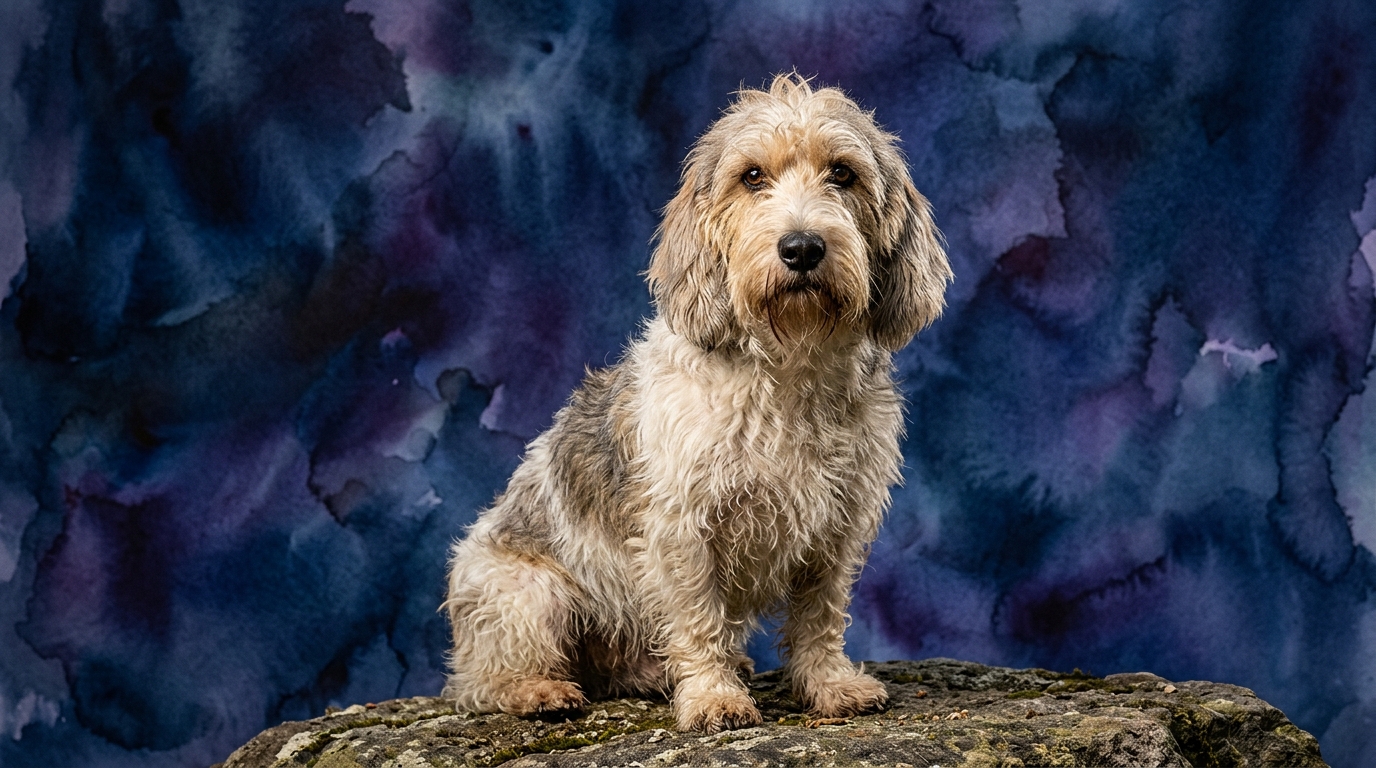
Petit Basset Griffon Vendéen at a glance
| IQ Rank / Score | 17/25 |
|---|---|
| Trainability | ★★★☆☆ (3/5) |
| Social Intelligence | ★★★★☆ (4/5) |
| Lifespan | 12-16 years |
| Shedding | Low to moderate |
| Exercise Needs | High (60+ min/day + training) |
| Origin | France |
The PBGV's Primary Cognitive Angle: Scent-Driven Independence & Spirited Problem-Solving
The Petit Basset Griffon Vendéen (PBGV) is defined by its exceptional olfactory intelligence and a resilient, independent problem-solving spirit. Unlike many breeds whose cognitive strengths lie primarily in obedience or complex verbal comprehension, the PBGV's brain is finely tuned to interpret the intricate tapestry of the scent world. This isn't merely about following a trail; it's about sophisticated information processing, pattern recognition, and decision-making in real-time, often without direct human instruction. Their 'happy-go-lucky' demeanor belies a deeply focused and persistent mind, capable of navigating challenging terrains and overcoming obstacles through sheer determination and an unwavering commitment to a scent.
Originating in the rugged Vendée region of France, where they were bred to hunt rabbits and hare in dense, thorny undergrowth, the PBGV developed a unique blend of self-reliance and cooperative intelligence. They had to be smart enough to work a trail independently through difficult cover, yet also possess the social cognition to understand their role within a pack and communicate their findings through their distinctive vocalizations. This blend of individual initiative and communal awareness forms the bedrock of their cognitive uniqueness, setting them apart as intelligent dogs who excel at tasks requiring both keen sensory perception and robust mental fortitude.
A Deep Dive into PBGV Intelligence: Unraveling the Happy-Go-Lucky Hound Mind
Beyond their primary scent-driven angle, PBGVs exhibit a multifaceted intelligence. Their problem-solving capabilities extend to novel situations, where they often employ a trial-and-error approach, utilizing their paws, nose, and vocalizations to achieve their goals, whether it's opening a cupboard or reaching a prized toy. This intrinsic curiosity fuels their continuous learning and adaptation.
Socially, PBGVs are highly attuned to their human companions and pack members. They are observant, quickly picking up on routines, moods, and social cues. Their renowned 'voice' isn't just for the hunt; it's a significant part of their communication repertoire, used to express excitement, announce arrivals, or even 'discuss' their day. This strong vocal component reflects a sophisticated understanding of their environment and social dynamics, allowing them to engage in complex interactions with both humans and other animals.
When it comes to training, their intelligence is evident in their capacity to learn a wide array of commands and tricks. However, their independent hound nature means they often prioritize an interesting scent over a human command. This isn't a lack of intelligence, but rather a strong channeling of it towards their ancestral purpose. Effective training for a PBGV hinges on positive reinforcement, engagement, and making the 'human' task more rewarding than the competing environmental distractions. Their memory for places, people, and especially specific scents is outstanding, enabling them to recall information relevant to past experiences and apply it to new situations.
The Instinctive Genius: How Breeding Shaped the PBGV Brain
The PBGV's cognitive architecture is a direct reflection of its historical purpose. Bred for hunting small game in dense underbrush, their physical characteristics – the coarse, 'barbarous' coat for protection, the long ears to funnel scent, and the sturdy, short legs for navigating rough terrain – are perfectly matched by their mental attributes. Their instinctive drive to follow a scent, no matter the difficulty, is paramount. This deep-seated drive translates into incredible persistence and focus when 'on the job,' requiring a brain capable of filtering myriad environmental stimuli to home in on a singular, fleeting olfactory target.
A surprising aspect of the PBGV's cognition lies in their evolved communication for cooperative hunting. Their distinct array of barks, howls, and bays serves as a sophisticated auditory signaling system, informing hunters and fellow hounds of a successful find or a change in the trail. This intricate vocalization is not random noise; it's a vital cognitive tool for coordinating efforts across distances and through dense cover. This historical necessity developed their ability to interpret and respond to complex auditory cues, fostering both individual initiative and pack cohesion, a unique cognitive blend not commonly highlighted.
Their memory for intricate routes and scent patterns over vast and varied landscapes is a testament to their spatial intelligence combined with their olfactory prowess. They remember where they’ve been, what they’ve smelled, and where potential prey might be, allowing them to build an internal map of their environment that guides their hunting strategy. This deep-rooted instinctive genius continues to thrive in modern PBGVs, making them engaging, if sometimes challenging, companions.
PBGV Cognitive Traits: More Than Just a Cute Face
The PBGV's intelligence is characterized by several key traits: **Persistence** – once a PBGV latches onto an idea or a scent, they are remarkably tenacious, demonstrating an unwavering commitment to seeing it through. This can manifest as adorable determination or a 'stubborn streak,' depending on the context. **Curiosity** – they are naturally inquisitive, always eager to explore new environments, objects, and smells, which drives their learning and adaptability. This makes them excellent candidates for puzzle toys and scent games.
**Adaptability** – despite their strong instincts, PBGVs are quite adaptable to various living situations, provided their core needs for mental and physical stimulation are met. They can thrive in both rural and suburban environments, adjusting their behavior to suit their surroundings. **Communication** – as previously mentioned, their vocal range is extensive, but they also use clear body language to express themselves, making them relatively easy to 'read' for attentive owners. **Emotional Intelligence** – PBGVs are known for their cheerful and affectionate nature. They are often deeply bonded with their families, demonstrating an awareness of human emotions and responding with comfort or playfulness as appropriate. Their 'joie de vivre' is not just a personality quirk; it's a cognitive asset that contributes to their resilience and willingness to engage with the world around them, even in the face of setbacks.
Elevating PBGV Intelligence: Training, Enrichment, and Understanding
For PBGV owners, understanding their breed's unique cognitive profile is key to a harmonious relationship. Training should focus on positive reinforcement, making learning fun and engaging to capture their attention amidst their strong instinctual distractions. Scent games and nose work are invaluable for channeling their primary intelligence, providing immense mental satisfaction and reducing the likelihood of boredom-driven behaviors. Puzzle feeders and interactive toys are also excellent tools to challenge their problem-solving skills independently, catering to their resourceful nature.
Consistency is crucial, but so is patience and a sense of humor, as a PBGV's intelligence often comes with a strong will. Instead of battling their instincts, smart owners learn to incorporate them into training and daily life. For instance, teaching a solid 'recall' is paramount, but understanding that a PBGV will often need to 'finish' their sniff before responding can save frustration. Providing ample opportunities for safe, off-leash exploration in secure areas allows them to exercise their innate tracking abilities, which is as mentally stimulating as any complex trick. By embracing their unique blend of scent-driven genius, independent spirit, and cheerful sociability, owners can truly unlock the full, vibrant intelligence of the Petit Basset Griffon Vendéen.
3 At-Home Tests to Measure Your Petit Basset Griffon Vendéen's IQ
These tests are adapted from peer-reviewed ethology research. No equipment is needed beyond items you have at home. Run each test 5–10 times for reliable results.
The Myth: "Petit Basset Griffon Vendéens are stubborn and difficult to train."
✅ PBGVs are highly intelligent and eager to please, but their intelligence is channeled differently than some other breeds. They respond exceptionally well to positive reinforcement, engaging training methods, and activities that integrate their natural hound instincts, such as scent work. They learn quickly when motivated, but require consistent, patient guidance that respects their independent, scent-driven nature rather than attempting to suppress it.
Petit Basset Griffon Vendéen vs. Similar Breeds
🧠 What's Your Dog's IQ Score?
Our full Pet IQ Lab assessment includes 12+ tests across 5 cognitive dimensions, calibrated for Petit Basset Griffon Vendéens specifically.
Take the Full IQ Test →Frequently Asked Questions
How smart is a Petit Basset Griffon Vendéen?
Our Pet IQ Lab framework scores cognition across five dimensions (max 25). The Petit Basset Griffon Vendéen totals 17/25 — high for a domestic dog. The full article breaks down each dimension with at-home tests.
Are Petit Basset Griffon Vendéens easy to train?
Petit Basset Griffon Vendéens can learn most cues, but expect to repeat lessons and keep sessions short. They score 3/5 on Training Speed in our breed profile.
Are Petit Basset Griffon Vendéens good with children and other pets?
Yes — their Social Intelligence rates 4/5 in our Pet IQ Lab framework. With early socialization and supervised play, most Petit Basset Griffon Vendéens integrate well into families with respectful children and other pets.
Do Petit Basset Griffon Vendéens need a lot of mental stimulation?
Absolutely. With Problem Solving 3/5 and Instinctive Drive 4/5, Petit Basset Griffon Vendéens need daily mental work — puzzle feeders, scent games, training sessions, or nose-work — to avoid boredom.
How much exercise does a Petit Basset Griffon Vendéen need?
Petit Basset Griffon Vendéens need active engagement. Plan for 45-60 minutes of exercise and training per day, plus mental stimulation.
How good is a Petit Basset Griffon Vendéen's memory?
Petit Basset Griffon Vendéens score 3/5 on memory. They remember high-value associations well; less-used cues fade without refresher sessions.
What is the typical lifespan of a Petit Basset Griffon Vendéen?
Petit Basset Griffon Vendéens commonly live 12-16 years when kept at a healthy weight.
The Petit Basset Griffon Vendéen stands as a testament to the specialized intelligence of purpose-bred hounds, blending an unparalleled olfactory prowess with a joyful, independent spirit. Understanding their unique cognitive makeup allows owners to celebrate their distinct charm and unlock their full potential as cherished, intelligent companions.