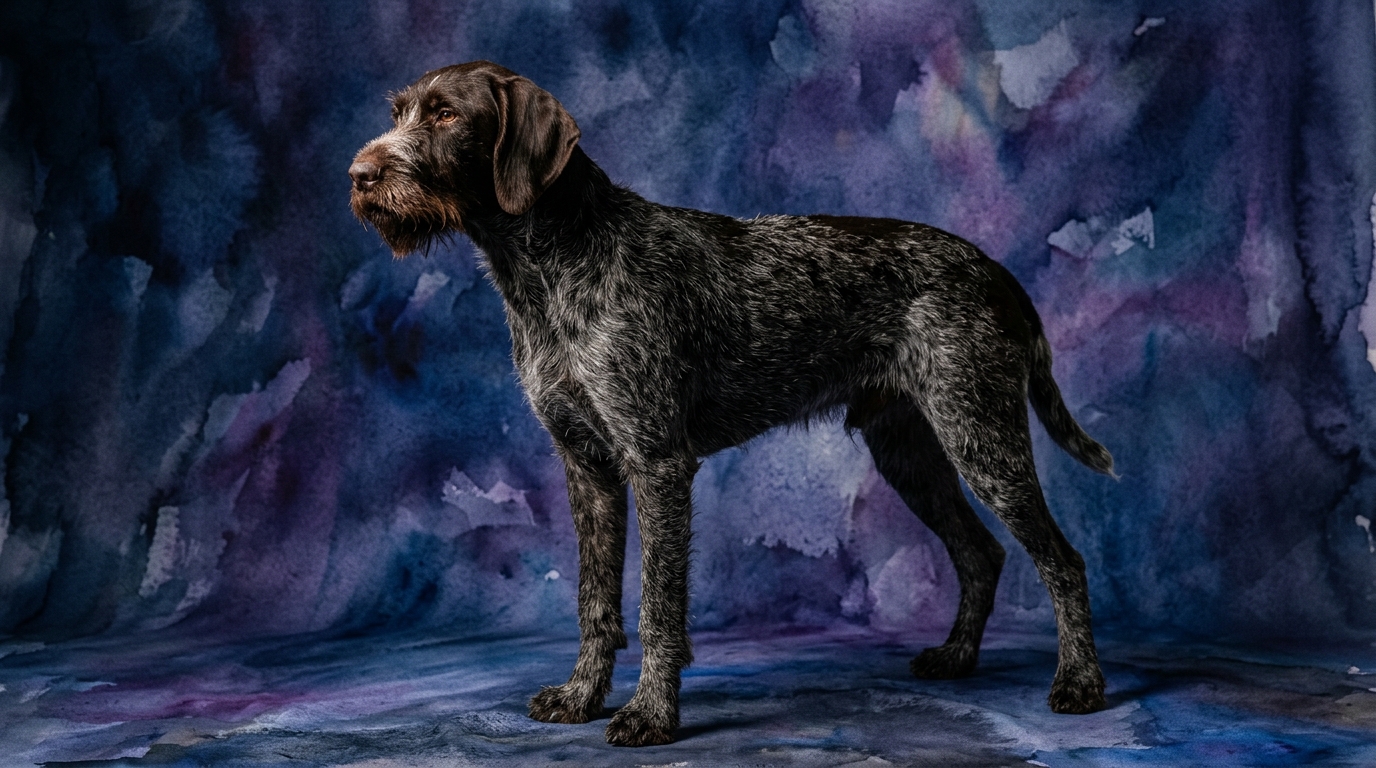

Side-by-Side IQ Profile: GWP vs. PON
The Cosmic Pet Pet IQ Lab employs five key dimensions to evaluate canine intelligence, offering a nuanced understanding beyond simple obedience. For the German Wirehaired Pointer (GWP), a Sporting breed ranked #28 by Coren, and the Polish Lowland Sheepdog (PON), a Herding breed without a specific Coren ranking, these dimensions reveal distinct cognitive landscapes.
The German Wirehaired Pointer's profile highlights its robust capabilities as a versatile hunting companion. Its Problem Solving is rated at 4/5, indicating a strong capacity for navigating complex scenarios, typical for a breed required to independently locate, track, and retrieve game in varied terrain. This reflects an ability to adapt strategies and overcome obstacles without constant human direction during a hunt. Training Speed is also 4/5, showing a high eagerness and aptitude for learning new commands and routines swiftly, a critical trait for a hunting partner needing to master diverse tasks like pointing, retrieving, and remaining steady. Social Intelligence stands at 3/5, reflecting a moderate understanding of human cues and social dynamics, sufficient for forming a strong working bond and interpreting handler signals effectively during a hunt. Its Instinctive Drive is 3/5, rooted in a foundational hunting instinct encompassing strong scenting abilities, prey drive, and a desire to work, channeled and refined through training. Finally, Memory is 4/5, demonstrating strong retention of learned commands, routes, and experiences, essential for reliability in the field.
The Polish Lowland Sheepdog's cognitive profile, while different, showcases strengths tailored to its role as an independent flock manager. Its Problem Solving is 3/5, displaying competent abilities particularly in contexts related to flock management, such as identifying stray sheep or navigating obstacles to keep the herd together; their solutions are often practical and independent. Training Speed is 3/5, indicating they learn at a moderate pace, capable of acquiring commands and routines with consistent, patient instruction, often driven by a sense of purpose. Social Intelligence is 3/5, exhibiting a moderate level of social awareness, capable of bonding deeply with their family and understanding household dynamics, needing to interpret subtle cues from sheep and other dogs in their traditional role. Their Instinctive Drive is 3/5, a core herding drive manifested in their inclination to gather, control, and protect, influencing their interactions with family and other animals through a watchful demeanor. Memory is also 3/5, demonstrating a solid capacity for remembering routines, boundaries, and past experiences, crucial for managing a flock and recalling specific tasks or threats.
Where the German Wirehaired Pointer Wins Cognitively
The German Wirehaired Pointer clearly excels in areas directly tied to its demanding sporting heritage. Its Problem Solving score of 4/5 indicates a superior ability to devise and execute strategies in dynamic environments, a necessity for tracking elusive game through varied cover and retrieving it from challenging terrains like dense brush or water. This cognitive flexibility means a GWP is more likely to independently figure out how to navigate a novel obstacle course or retrieve a toy from an unusual hiding spot without explicit step-by-step guidance. Coupled with a Training Speed of 4/5, the GWP absorbs new commands and complex sequences with remarkable alacrity. This swift acquisition is not merely about rote memorization; it reflects a keen understanding of cause and effect and a strong desire to engage with their handler in purposeful activities. For an owner, this translates into fewer repetitions needed to solidify a behavior and a greater capacity for advanced obedience, field trials, or intricate dog sports where rapid learning and precise execution are paramount. Furthermore, the GWP’s Memory score of 4/5 means they retain these learned behaviors and environmental lessons over extended periods, making them consistently reliable partners for tasks that require recall of specific locations, scents, or complex multi-step routines. This robust memory ensures that once a GWP learns a task, it's deeply ingrained, contributing significantly to their dependability in a working or competitive context.
Where the Polish Lowland Sheepdog Wins Cognitively
While the Polish Lowland Sheepdog's numerical scores might appear lower than the GWP's in some categories, their cognitive strengths are uniquely tailored to their role as an independent herder, making them “win” in dimensions of self-reliance and environmental assessment. Their Problem Solving at 3/5, though not as high as the GWP's, reflects an ability to make autonomous decisions crucial for managing a flock without constant human intervention. A PON might not solve complex agility sequences as quickly, but they excel at practical, real-world problems like identifying a lost lamb or determining the best path to move sheep, often relying on their own judgment rather than waiting for a command. This manifests as a thoughtful, observant nature, where they process their surroundings and react judiciously. Their Social Intelligence at 3/5, while matching the GWP, is expressed differently; it's less about eager compliance and more about discerning intent and maintaining order within their perceived “flock” – be it sheep or their human family. This means they are adept at reading subtle shifts in group dynamics and can be proactive in mediating or protecting, showcasing a nuanced understanding of social roles. The PON’s Instinctive Drive at 3/5 is a powerful motivator for guarding and herding, which, while not a “win” in score, provides a strong internal compass for purpose. This drive means they possess an innate sense of responsibility and territory, channeling their intelligence into watchful vigilance and a deep commitment to their assigned duties, a cognitive advantage for owners seeking a dedicated guardian with a strong internal sense of purpose.
Which is Easier to Train and Why
When considering ease of training, the German Wirehaired Pointer holds a distinct advantage, primarily due to its Training Speed score of 4/5 compared to the Polish Lowland Sheepdog's 3/5. The GWP's history as a versatile hunting dog means it was selectively bred for a high degree of biddability and a strong desire to work cooperatively with a human handler. Their cognitive profile reflects a natural inclination to quickly grasp new concepts and respond to commands, driven by an eagerness to please and a clear understanding of rewards. This translates into fewer repetitions needed during training sessions and a quicker progression through various levels of obedience or specialized tasks. Conversely, the Polish Lowland Sheepdog, while certainly trainable, approaches learning with a more independent mindset. Their Training Speed of 3/5 indicates they will learn, but often at a more deliberate pace, and may require more patience and consistency from their owner. This isn't a deficit in intelligence, but rather a reflection of their historical role as autonomous herders who needed to make decisions independently, sometimes overriding human commands if they perceived a threat to their flock. Therefore, while a GWP is often a willing and quick student eager for direction, a PON might require more effort in convincing them a command is worthwhile or necessary, making the GWP generally perceived as easier to train for a broader range of activities.
Which Suits Active Owners vs. Relaxed Owners
The cognitive profiles of these two breeds clearly delineate their suitability for different owner lifestyles. The German Wirehaired Pointer, with its high Problem Solving (4/5) and Instinctive Drive (3/5) geared towards hunting, thrives with active owners who can provide consistent mental and physical stimulation. Their sharp intellect and robust memory demand engaging activities like field work, advanced obedience, agility, or extensive hiking and running. A GWP needs a job, and without sufficient outlets for their cognitive and physical energy, they can become bored and potentially destructive. They are best suited for individuals or families who embrace an active outdoor lifestyle and are prepared to dedicate significant time to training and interactive play. In contrast, the Polish Lowland Sheepdog, while requiring regular exercise, is not built for the same intensity of sustained physical exertion as a GWP. Their Instinctive Drive (3/5) focuses more on patrolling and guarding, and their Problem Solving (3/5) is geared towards independent assessment rather than high-speed cooperation. They suit owners who appreciate a thoughtful, observant companion and can provide regular, moderate exercise, alongside mental challenges like puzzle toys, scent work, or consistent training that appeals to their independent nature. While not a “relaxed” couch potato, the PON is a better fit for owners who prefer structured walks and yard play over competitive sports or demanding hunting expeditions, and who value a watchful presence over a constant need for engagement.
The Verdict
Select a German Wirehaired Pointer if you seek a highly trainable, energetic partner for demanding outdoor activities, dog sports, or hunting, valuing quick learning and enthusiastic cooperation.
Opt for a Polish Lowland Sheepdog if you appreciate an independent, observant companion with a strong sense of purpose, suitable for moderate activity and patient, consistent training.
🧠 Find Your Pet's IQ Score
Our Pet IQ Lab assessment covers 25+ tests across 5 cognitive dimensions — personalized to your breed.
Take the Full IQ Test →Frequently Asked Questions
Is the German Wirehaired Pointer suitable for first-time dog owners?
While intelligent and trainable, the GWP's high energy, strong drives, and need for consistent mental and physical stimulation can be challenging for inexperienced owners. They thrive with confident, knowledgeable handlers who can channel their abilities effectively.
Do Polish Lowland Sheepdogs bark a lot due to their guarding instincts?
Yes, Polish Lowland Sheepdogs tend to be vocal, using their bark as a primary tool for alerting and guarding their territory or “flock.” Early socialization and consistent training can help manage excessive barking, but it's an inherent part of their nature.
How do their grooming needs compare, given their different coat types?
The German Wirehaired Pointer requires weekly brushing to manage its wiry coat and occasional hand-stripping to maintain coat texture. The Polish Lowland Sheepdog, with its long, shaggy double coat, demands more intensive grooming, including daily brushing to prevent mats and tangles, often requiring professional grooming every few months.