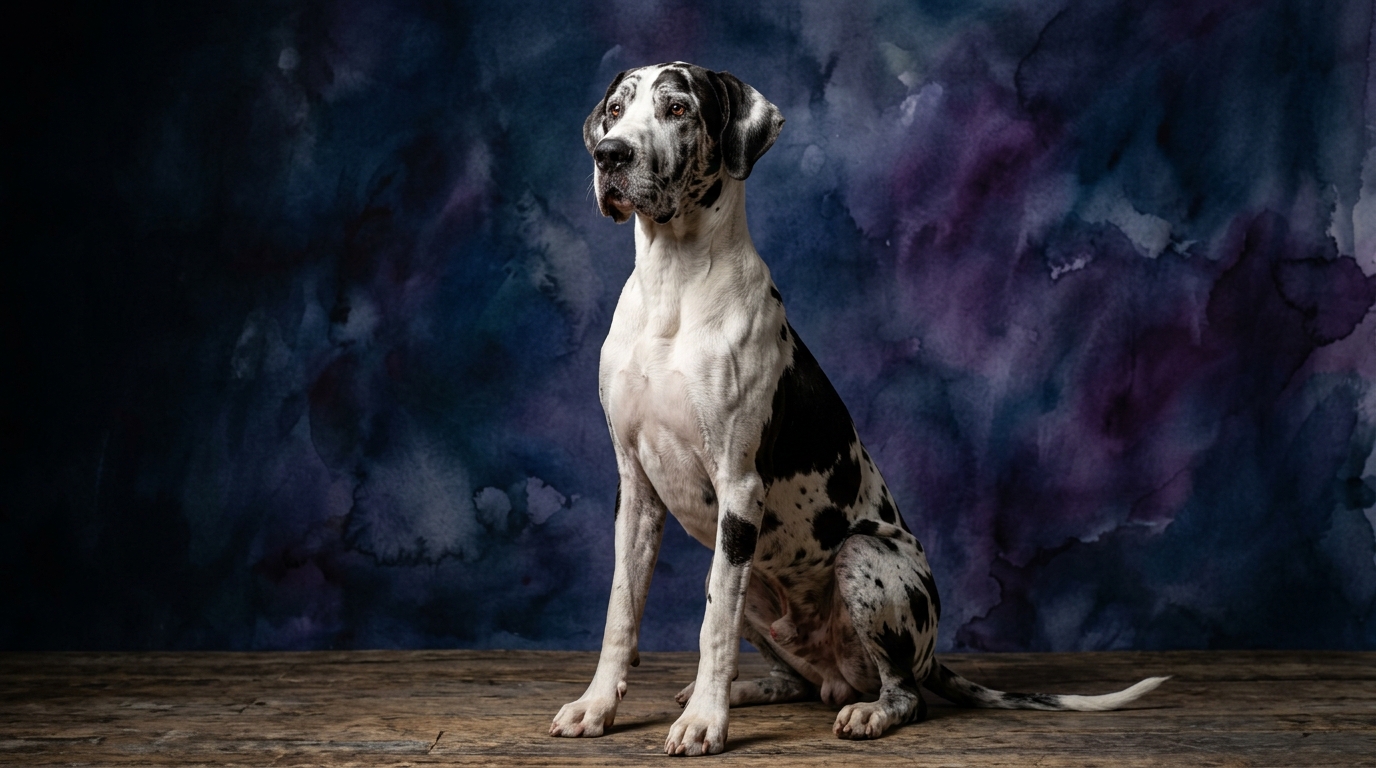
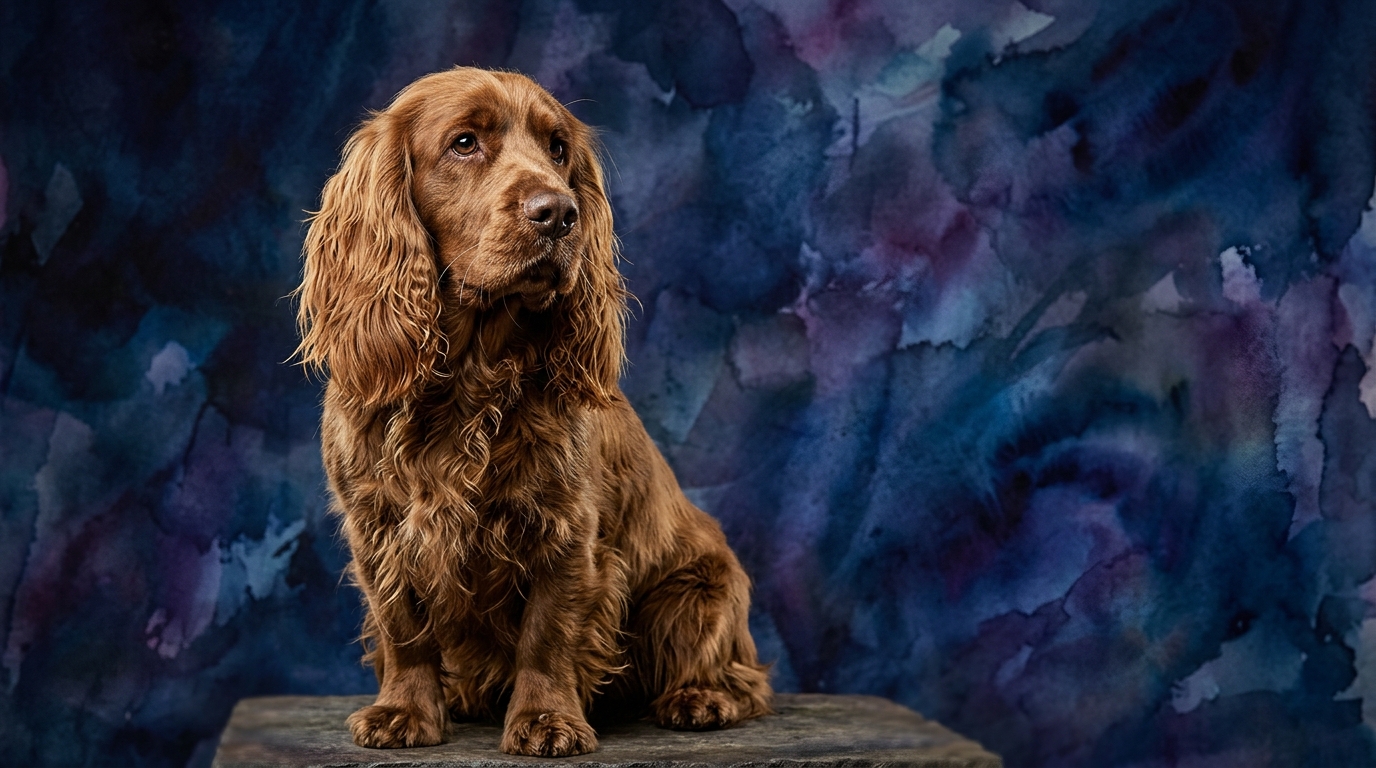
Side-by-Side Cognitive Profiles: Great Dane vs. Sussex Spaniel
Our Cosmic Pet Pet IQ Lab assessment provides a detailed look into the cognitive dimensions of these distinct breeds. The Great Dane, a Working group dog with a Coren rank of #48, exhibits a Problem Solving ability of 3/5, meaning they can navigate moderate challenges. Their Training Speed is 3/5, indicating a steady learning pace for new commands. Where they truly shine is Social Intelligence, scoring 4/5, showing a strong attunement to human cues. Their Instinctive Drive and Memory both stand at 3/5, reflecting moderate inherent drives and reasonable retention of experiences.
The Sussex Spaniel, a Sporting group dog with a Coren rank of #62, mirrors the Great Dane in several cognitive aspects. They also score 3/5 for Problem Solving, demonstrating comparable abilities to tackle moderate puzzles. Their Training Speed is 3/5, suggesting a similar, deliberate learning curve. Social Intelligence for the Sussex Spaniel is 3/5, indicating strong bonds but perhaps less overt expressiveness than the Great Dane. Like their larger counterpart, their Instinctive Drive and Memory are both rated 3/5, reflecting a moderate, purpose-driven nature and good recall of information.
Where the Great Dane Wins Cognitively
The Great Dane’s primary cognitive advantage lies in its superior Social Intelligence, rated 4/5 compared to the Sussex Spaniel's 3/5. This means a Great Dane is generally more adept at reading and responding to human emotions, body language, and the subtle social dynamics within a household. Their ability to connect on an emotional level and anticipate human needs can make them exceptionally intuitive companions, often seeming to understand subtle cues without explicit commands. This heightened social awareness contributes to their reputation as "velcro dogs" and allows them to integrate seamlessly into family life, often acting as sensitive barometers for the household’s mood. For owners seeking a dog that truly “gets” them and offers profound emotional reciprocity, the Great Dane’s nuanced social cognition stands out, fostering a deeply empathetic bond that transcends basic command-response interactions.
Where the Sussex Spaniel Wins Cognitively
While the Great Dane excels in social understanding, the Sussex Spaniel holds a subtle edge in areas related to its sporting heritage, particularly in its specific application of Instinctive Drive. Although both breeds score 3/5 in this dimension, the Sussex’s drive is inherently geared towards independent scent work, flushing game, and sustained activity in challenging terrain. This manifests as a tenacious focus on a task, a deep engagement with environmental stimuli, and a persistence that might be less pronounced in the more socially-oriented Great Dane. Their robust build and low-to-the-ground stature allow them to methodically work through dense cover, requiring a specific type of cognitive resilience to maintain focus amidst distractions. While not a “win” in raw score, the practical application of their instincts for purposeful work, often requiring sustained concentration and problem-solving within a scent-driven context, gives them a unique cognitive strength in field environments. Their determination to follow a scent trail, even when distractions are present, highlights a specific type of cognitive resilience essential for their original purpose.
Which Is Easier to Train and Why
Both the Great Dane and the Sussex Spaniel share a Training Speed score of 3/5, suggesting they learn new commands at a moderate pace. However, the *ease* of training can differ due to their other cognitive dimensions and inherent breed traits. The Great Dane’s higher Social Intelligence (4/5) can make them appear easier to train for obedience and manners within a family context. Their strong desire to please and their sensitivity to human feedback mean they are often highly motivated by positive reinforcement and respond well to gentle, consistent guidance. They thrive on human connection, making training an opportunity for bonding and mutual understanding.
In contrast, the Sussex Spaniel, while equally capable of learning, might require a more patient and persistent approach. Their Instinctive Drive, geared towards independent scent work, can sometimes lead to distraction, especially in outdoor environments where fascinating smells abound. While they are eager to work, their focus might be on a compelling scent rather than the handler’s command, demanding more consistent recall training and engaging methods to keep their attention. Therefore, while both breeds learn at a similar pace, the Great Dane’s social nature often translates to a smoother, more responsive training experience in a typical home setting, whereas the Sussex requires more dedication to channel its sporting instincts effectively during training sessions, particularly outside.
Which Suits Active Owners vs. Relaxed Owners
The choice between these two breeds for active versus relaxed owners hinges on the *type* of activity sought. Great Danes, despite their imposing size, often suit relaxed owners who appreciate moderate, consistent activity. While they need daily walks and play, they are not typically high-energy dogs requiring marathon runs or intense agility sessions. Their 3/5 Instinctive Drive is moderate, and their ideal activity often involves leisurely strolls, supervised play in a secure yard, and ample couch time with their human family. Their strong social intelligence means they thrive on companionship and mental engagement through interaction rather than solely physical exertion; a long walk followed by quality cuddle time is often their ideal.
Conversely, the Sussex Spaniel, with its Sporting group heritage and 3/5 Instinctive Drive, is better suited for owners who enjoy consistent, purposeful activity. While they aren't hyperactive, they benefit significantly from regular opportunities to engage their scent drive and explore. Long walks, hikes, or even participation in scent work or field trials would satisfy their innate needs more effectively than a sedentary lifestyle. Their robust build and love for outdoor exploration make them excellent companions for owners who appreciate a dog that enjoys working and engaging with its environment in a more active, exploratory manner, often demonstrating a cheerful endurance that belies their somewhat serious expression.
The Verdict
Opt for a Great Dane if you prioritize a deeply socially intelligent companion, one that is highly attuned to your emotions and thrives on close human interaction, fitting well into a moderately active family lifestyle.
Select a Sussex Spaniel if you appreciate a robust, tenacious companion with a moderate drive for outdoor exploration and scent work, ideal for owners who enjoy consistent, purposeful activity and a dog with a charmingly independent spirit.
🧠 Find Your Pet's IQ Score
Our Pet IQ Lab assessment covers 25+ tests across 5 cognitive dimensions — personalized to your breed.
Take the Full IQ Test →Frequently Asked Questions
Do Great Danes and Sussex Spaniels have similar problem-solving abilities?
Yes, both breeds are rated 3/5 for Problem Solving, indicating they are capable of figuring out moderately complex challenges. This suggests they can learn puzzle toys and navigate common household situations with similar cognitive effort and success.
Which breed is more likely to form a strong bond with its family?
While both breeds form strong bonds, the Great Dane, with its 4/5 Social Intelligence, is generally more attuned to human emotions and family dynamics, often seeking close companionship and responding intuitively to their owners' moods. The Sussex Spaniel, at 3/5, also bonds deeply but may express it with a bit more independence.
Are there significant differences in their memory retention?
Both Great Danes and Sussex Spaniels are rated 3/5 for Memory, meaning they retain learned information and experiences reasonably well. Owners can expect both breeds to remember commands, routines, and past interactions with similar reliability over time, making consistent training effective for either.