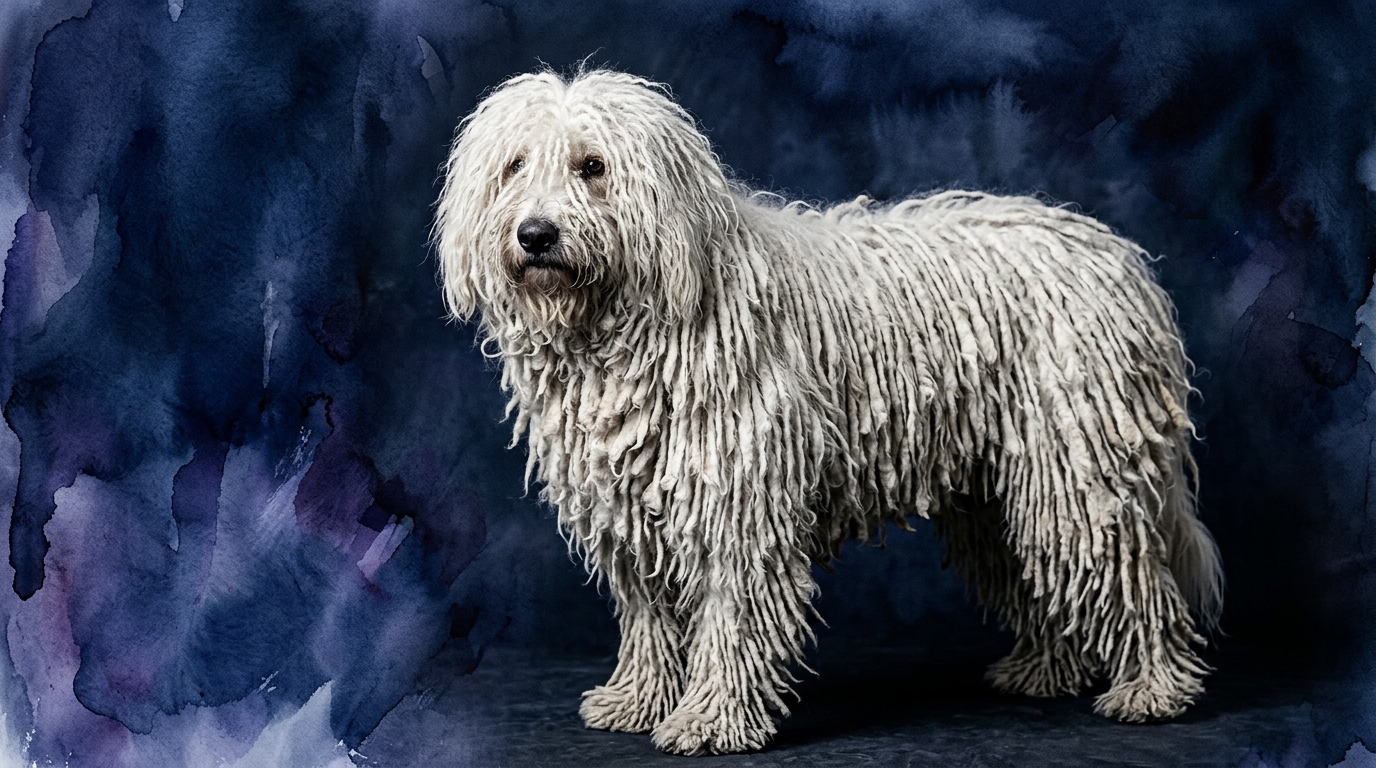

Side-by-Side Cognitive Profiles: Komondor vs. Petit Basset Griffon Vendéen
At first glance, the shared 3/5 scores across five key cognitive dimensions for both the Komondor and the Petit Basset Griffon Vendéen might suggest a similar underlying intelligence, yet the application and manifestation of these scores are profoundly shaped by their distinct breed histories and purposes. For the Komondor, a formidable livestock guardian with a Coren rank of #67, its intelligence is finely tuned for autonomous protection. Its Problem Solving at 3/5 is not about learning tricks, but about strategically assessing threats to its flock or family, making independent decisions on how to deter or engage. This might involve complex spatial reasoning to patrol a territory effectively or discerning genuine danger from benign activity without human direction.
The Komondor’s Training Speed, also 3/5, indicates a capacity to learn, yet it often processes commands through the lens of utility and its strong independent streak; it learns what it deems necessary for its guardian role rather than for simple compliance. Its Social Intelligence, rated 3/5, manifests as deep loyalty to its inner circle, coupled with a discerning wariness towards outsiders, requiring it to differentiate friend from potential foe with acute perception. Its Instinctive Drive, a robust 3/5, is almost entirely dedicated to vigilance and protection, fueling its territorial awareness and unwavering commitment to its charges. Finally, its Memory, also 3/5, supports its role by retaining intricate details of its environment, the routines of its charges, and the identities of those it deems safe or suspicious over long periods.
In stark contrast, the Petit Basset Griffon Vendéen (PBGV), a cheerful and tenacious scent hound, deploys its identical cognitive scores in a completely different arena: the hunt. Its Problem Solving at 3/5 is primarily dedicated to the intricate mental exercise of unraveling complex scent trails, requiring remarkable focus and deductive reasoning to follow a quarry across varied terrains and conditions. This involves processing a vast amount of olfactory information and making real-time decisions about the direction and freshness of a scent.
The PBGV’s Training Speed, also 3/5, means it is capable of learning, but its powerful nose and inherent drive for the chase often mean that engagement must be highly motivating and often scent-based; it learns best when its instincts are leveraged rather than suppressed. Its Social Intelligence, also 3/5, expresses itself through its ability to work cooperatively within a pack, communicating effectively with its characteristic vocalizations and body language during the hunt, and forming joyful bonds with its human family. The PBGV’s Instinctive Drive, a strong 3/5, is overwhelmingly focused on scenting, tracking, and vocalizing during the chase, making it a relentless pursuit specialist. Its Memory, also 3/5, is crucial for recalling specific scent profiles, complex trail patterns, and the commands associated with its hunting work, allowing it to apply learned behaviors within its highly specialized field.
Where the Komondor Excels Cognitively
The Komondor's cognitive strengths truly shine in scenarios demanding autonomous judgment and strategic defense. With a Problem Solving score of 3/5, this breed interprets its environment and responds to perceived threats to its charges (be they sheep or family members) with an impressive, self-directed logic. Unlike breeds that await human instruction, the Komondor's history as a livestock guardian has honed its ability to assess situations, determine the most effective course of action, and execute it without immediate human input, often involving nuanced deterrents before overt aggression.
This isn't merely reactivity; it's a sophisticated, pre-emptive problem-solving capacity rooted deeply in its Instinctive Drive (3/5) to protect. Its Memory (3/5) supports this by retaining knowledge of patterns, potential vulnerabilities in its territory, and the identities of both friends and persistent intruders, contributing to a consistently reliable protective presence. The Komondor's cognitive edge lies in its profound ability to manage complex, dynamic protective tasks independently, making it a living, breathing security system.
Where the Petit Basset Griffon Vendéen Excels Cognitively
The Petit Basset Griffon Vendéen demonstrates distinct cognitive advantages within its specialized domain: scent work and cooperative hunting. Its Problem Solving at 3/5 is primarily dedicated to the intricate puzzle of a scent trail, requiring exceptional analytical skills to differentiate, follow, and re-establish a lost path across varying terrains and conditions. This isn't just about following a line; it involves sophisticated deduction based on scent strength, directionality, and environmental factors.
Coupled with its robust Instinctive Drive (3/5) for the chase, the PBGV exhibits a relentless cognitive persistence, refusing to give up on a trail even when challenging. Its Social Intelligence (3/5) also shines in its traditional role, allowing it to work harmoniously within a pack, communicating findings through its characteristic 'happy' bark, and responding to handler cues during the hunt. This cooperative element, combined with its specialized sensory memory for scent, highlights a cognitive profile perfectly adapted for its ancestral purpose of tenacious pursuit.
Which is Easier to Train and Why
Despite both breeds scoring 3/5 for Training Speed, the practical experience of training a Komondor versus a Petit Basset Griffon Vendéen differs significantly due to their intrinsic motivations and breed purposes. The Komondor, a guardian breed, processes commands through the filter of its independent judgment and protective instincts. It learns quickly when it perceives the command as logical or beneficial to its role, but can be resistant to repetitive, arbitrary drills or tasks that conflict with its perceived duty.
Its training often requires a handler who respects its autonomy and can frame instructions within the context of its guardian nature, making consistency and clear communication paramount. Conversely, the Petit Basset Griffon Vendéen's training challenges stem from its powerful Instinctive Drive (3/5) for scent. While it possesses good Memory (3/5) and is eager to engage with its human, its nose often takes precedence. A captivating scent can instantly override a command, making recall and focus in distracting environments particularly demanding.
Training a PBGV requires immense patience, creativity, and often incorporates scent games to harness its natural drives, rather than fighting against them. Therefore, 'easier' is relative: the Komondor demands respect for its independence, while the PBGV demands strategies to manage its captivating olfactory world. Neither is inherently 'easy' to train in a conventional sense; both require understanding their unique cognitive filters and motivations.
Which Suits Active Owners vs. Relaxed Owners
The suitability of these breeds for 'active' versus 'relaxed' owners depends heavily on how one defines these terms in a canine context. A Komondor, while not requiring hours of high-impact physical exercise, demands an owner active in providing consistent, firm, and fair leadership, and who can engage its formidable cognitive abilities in a meaningful way. Its Social Intelligence (3/5) means it thrives on strong family bonds, but its protective Instinctive Drive (3/5) necessitates an owner who is proactive in socialization and boundary setting, especially during its formative years.
This breed suits an owner who is mentally engaged, enjoys strategic problem-solving in dog management, and appreciates a vigilant, often independent companion. They are not for the owner seeking a constantly playful or overtly demonstrative dog, but rather a steadfast protector. The Petit Basset Griffon Vendéen, on the other hand, truly embodies the 'active' owner requirement in a more traditional sense. Its powerful scent drive and boundless energy (inherent in its 3/5 Instinctive Drive) demand regular, vigorous exercise that ideally engages its nose, such as long walks, scent work, or secure off-leash exploration in safe areas.
While its Social Intelligence (3/5) makes it a cheerful, affectionate family member, a relaxed owner who cannot provide outlets for its physical and olfactory needs will quickly find themselves with a bored and potentially destructive companion. This breed is for the owner who enjoys outdoor adventures, has the energy to keep up, and delights in a dog that lives life nose-first, requiring constant engagement of its primary sensory and cognitive tool.
The Verdict
Choose a Komondor if you seek an independent, strategic guardian who thrives on purposeful work and respects a strong, consistent leader, valuing vigilant companionship over constant overt affection.
Opt for a Petit Basset Griffon Vendéen if you're an active, outdoor enthusiast who enjoys engaging a dog's keen sense of smell and can provide ample opportunities for vigorous play and scent-driven exploration.
🧠 Find Your Pet's IQ Score
Our Pet IQ Lab assessment covers 25+ tests across 5 cognitive dimensions — personalized to your breed.
Take the Full IQ Test →Frequently Asked Questions
Are Komondors good family dogs despite their independent nature?
Yes, Komondors form deep bonds with their families, viewing them as their 'flock' to protect. Their Social Intelligence (3/5) allows them to be affectionate and gentle with those they consider family, though they remain wary of strangers and require early, consistent socialization to channel their protective instincts appropriately.
Do Petit Basset Griffon Vendéens bark a lot due to their hunting instincts?
Petit Basset Griffon Vendéens are known for their vocalizations, often using their distinctive barks and 'happy' howls to communicate, especially when on a scent trail or excited. This is a manifestation of their strong Instinctive Drive (3/5) and a crucial part of their hunting heritage, requiring owners to manage this trait with training and appropriate outlets.
Can a Komondor live in an urban environment?
While adaptable, a Komondor's strong protective instincts and need for space to patrol make urban living challenging. They thrive in environments where they can survey their territory and feel useful, ideally with a secure yard. Their 3/5 Instinctive Drive for guarding means a confined urban space might lead to frustration or over-vigilance without careful management and extensive socialization.