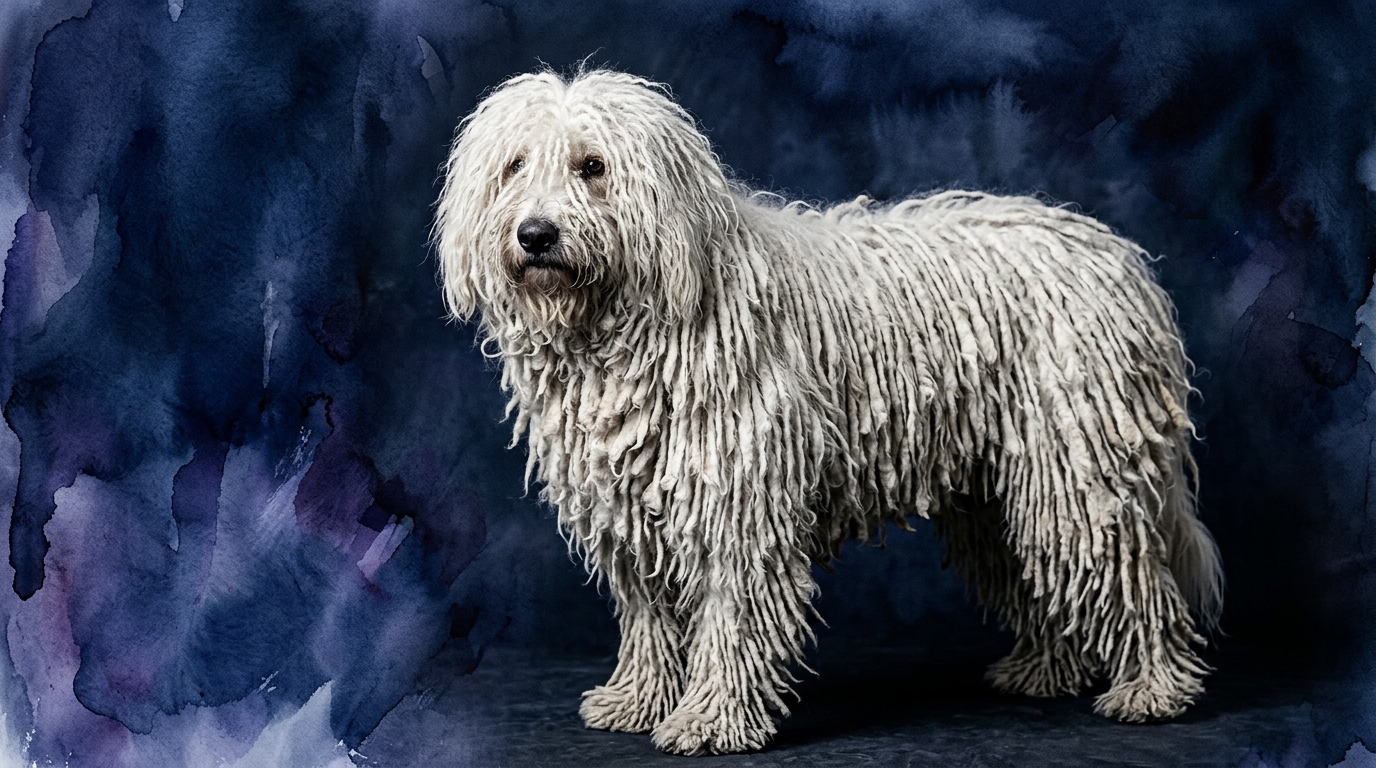

Side-by-Side Cognitive Profiles
The Komondor's cognitive profile reflects its heritage as an independent livestock guardian. Its Problem Solving (3/5) is geared towards autonomous threat assessment, where it independently strategizes defense and evaluates environmental cues to protect its charges without direct human instruction. Training Speed (3/5) indicates a solid capacity to learn and retain commands pertinent to its guardian role, though its independent nature may require more motivation for tasks not directly aligned with protection. Social Intelligence (3/5) is acutely tuned to discerning friend from foe, exhibiting wariness towards strangers but deep loyalty within its trusted circle. Instinctive Drive (3/5) is overwhelmingly focused on guardianship, manifesting as unwavering commitment to protection and innate danger assessment. Memory (3/5) is reliable, particularly for individuals, territories, and past threats, supporting consistent vigilance.
The Polish Lowland Sheepdog's cognitive profile highlights its role as an agile herding companion. Its Problem Solving (3/5) involves dynamic, real-time adjustments required for managing livestock, strategizing how to gather and move animals, and responding to unpredictable behaviors with quick, adaptive decisions. Training Speed (3/5) shows a steady pace for learning new commands and tasks, often excelling with engaging and varied training due to its biddable nature and desire to work alongside its handler. Social Intelligence (3/5) is strong in cooperative communication with humans and other animals, adept at reading cues and adjusting behavior. Instinctive Drive (3/5) is primarily herding, driving an urge to gather, control, and move livestock with natural attentiveness. Memory (3/5) is robust for commands, routes, and behavior patterns, vital for effective herding and consistent daily life.
Where the Komondor Cognitively Excels
The Komondor's cognitive strengths truly shine in scenarios demanding independent judgment and unwavering vigilance. Their problem-solving, rated 3/5, is specifically tailored for autonomous threat assessment and defense. Unlike many breeds that defer to human command, a Komondor is wired to analyze a situation, determine a threat, and act decisively to protect its charges, often without needing explicit instruction. This deep-seated independence means they excel at long-term, self-directed guardianship, making their cognitive application in this domain uniquely robust. Their social intelligence, while rated 3/5, is acutely refined for distinguishing friend from potential foe, a critical cognitive filter for a guardian breed that must constantly assess its environment for safety and security.
Where the Polish Lowland Sheepdog Cognitively Excels
The Polish Lowland Sheepdog excels in cognitive flexibility and responsiveness within a collaborative framework. Their 3/5 problem-solving ability manifests in dynamic, real-time adjustments required for effective herding, where quick thinking and adaptability to changing flock behavior are paramount. They demonstrate superior agility in mental processing, rapidly interpreting complex cues from a handler and livestock to orchestrate movement. Their social intelligence, also 3/5, is particularly strong in cooperative communication with humans, allowing them to form a tight working partnership and understand subtle directives, making them highly attuned to joint tasks and nuanced interactions. This cooperative nature is key to their success in intricate herding roles, where precise, responsive actions are crucial.
Training Aptitude: Which is More Amenable?
While the Komondor's Coren ranking at #67 suggests a solid capacity for obedience learning, its independent nature means that training often requires a different approach. A Komondor, with a 3/5 training speed, will learn commands, but its motivation stems from respect and understanding the purpose of a command within its protective worldview. They might be slower to adopt tasks that seem arbitrary or non-essential to their guarding duties. The Polish Lowland Sheepdog, also with a 3/5 training speed, often appears more straightforward to train for a wider variety of tasks due to its inherent biddability and desire to collaborate with its handler. Their herding background fosters a responsiveness and eagerness to please, making them typically more engaged and consistent in general obedience and performance sports when training is positive and stimulating. Therefore, while both learn, the PLS is generally more amenable to diverse training methods and goals, whereas Komondor training benefits from aligning with their guardian mindset.
Lifestyle Match: Active vs. Relaxed Owners
The Polish Lowland Sheepdog is better suited for active owners who enjoy engaging their dog in various activities beyond basic walks. Their herding drive and mental agility mean they thrive on structured exercise, dog sports, and consistent mental challenges like puzzle toys or advanced obedience. They need an outlet for their energy and intellect to prevent boredom and potential destructive behaviors, making them ideal for owners seeking an interactive companion. Conversely, the Komondor, while requiring regular exercise for physical health, is often a better fit for owners who appreciate a more relaxed, watchful companion once its protective needs are met. Their independent nature means they are content observing their domain, and while they need mental stimulation, it's often more about vigilance and patrolling than constant interactive play, making them suitable for owners who value a steady, self-reliant presence.
The Verdict
Choose a Komondor if you seek an independent, vigilant guardian with a profound sense of protective duty, comfortable making autonomous decisions to secure its charges.
Opt for a Polish Lowland Sheepdog if you desire an agile, cooperative companion eager for engagement, training, and dynamic activities that challenge its quick intellect.
🧠 Find Your Pet's IQ Score
Our Pet IQ Lab assessment covers 25+ tests across 5 cognitive dimensions — personalized to your breed.
Take the Full IQ Test →Frequently Asked Questions
Do Komondors need extensive socialization despite their guardian role?
Yes, Komondors absolutely benefit from early and consistent socialization. While their protective instincts are strong, proper exposure to various people, places, and sounds helps them discern true threats from everyday occurrences, preventing unwarranted suspicion and promoting appropriate guardian behavior. This foundational experience is crucial for developing a well-adjusted Komondor.
Can a Polish Lowland Sheepdog live happily in an apartment?
A Polish Lowland Sheepdog can adapt to apartment living, but it requires significant commitment from the owner. Daily, vigorous exercise, mental stimulation through training or puzzle toys, and consistent outdoor adventures are crucial to satisfy their energy and mental needs, preventing boredom and destructive behaviors in a smaller space. Without adequate outlets, their herding drive can manifest in undesirable ways.
How do these breeds typically interact with children?
Both breeds can be good with children when properly socialized and raised alongside them. Komondors are typically protective of their family children, but their large size and guarding instincts require supervision to ensure gentle interactions. Polish Lowland Sheepdogs are generally playful and affectionate with children within their family, though their herding instincts might lead to gentle nipping or nudging which needs to be managed through training.