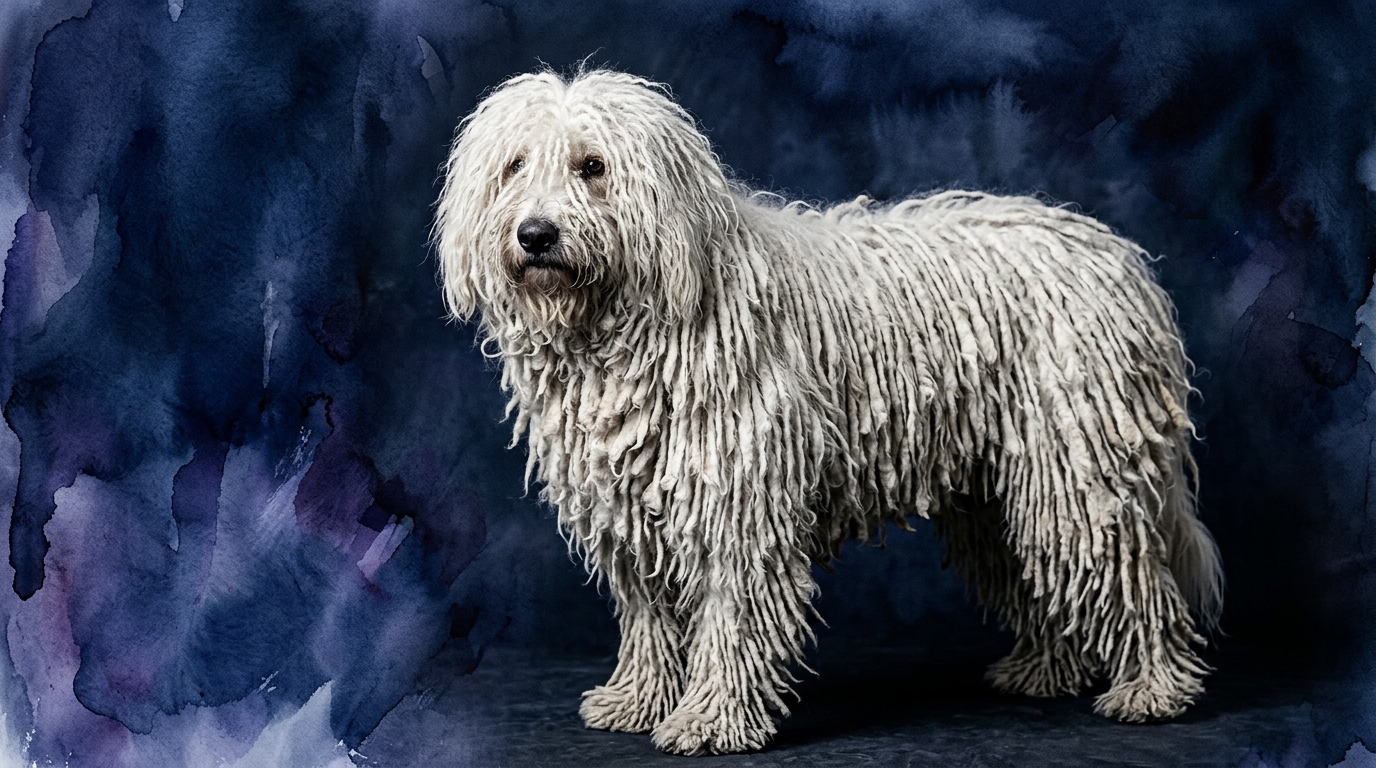
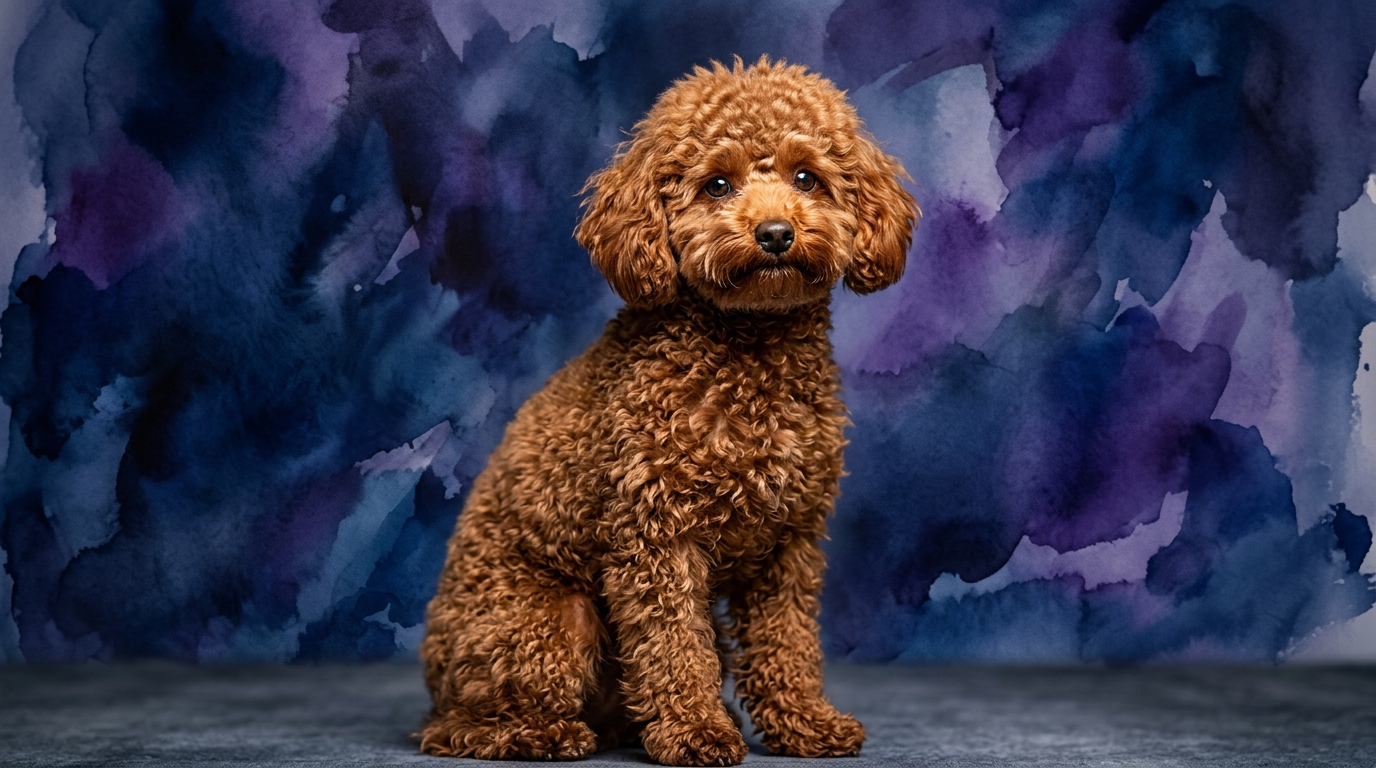
Side-by-Side IQ Profile: Komondor vs. Toy Poodle
The Cosmic Pet Pet IQ Lab employs a multi-dimensional approach to assess canine cognition, moving beyond simple obedience measures to explore five core intellectual areas. Here’s how the Komondor and Toy Poodle stack up according to our framework:
Komondor (Working Group, Coren Rank #67): This ancient Hungarian livestock guardian possesses a cognitive makeup perfectly suited to its autonomous protective duties.
Problem Solving (3/5): The Komondor exhibits a moderate capacity for problem-solving, often preferring to rely on established routines and keen observation rather than spontaneous innovation. Their solutions are typically grounded in protective instincts, evaluating threats and reacting with calculated responses to secure their charges.
Training Speed (3/5): These dogs possess a moderate training speed, indicating they can learn commands but may require consistent, patient repetition. Their independent nature, honed by centuries of solitary guardian work, means they evaluate requests and may need a clear purpose for their learning.
Social Intelligence (3/5): A Komondor’s social intelligence is moderately developed, primarily directed towards discerning friend from foe within their family unit. They form deep bonds with their inner circle but maintain a reserved, watchful demeanor with strangers, assessing intentions rather than seeking broad social interaction.
Instinctive Drive (3/5): The Komondor’s instinctive drive is moderately strong, primarily expressed through its inherent guardian role. This manifests as a consistent, unwavering commitment to protect its territory and family, rather than a frantic, high-intensity drive. Their actions are deeply rooted in their ancestral purpose, making them naturally alert and territorial, but not constantly 'on.'
Memory (3/5): Possessing a moderate memory, Komondors effectively recall important locations, routines, and individuals, especially those related to their protective duties. While not prone to learning complex sequences quickly, they retain essential information pertinent to their daily lives and perceived responsibilities.
Toy Poodle (Toy Group, Coren Rank #2): Originally a water retriever scaled down for companionship, the Toy Poodle is renowned for its mental agility and adaptability.
Problem Solving (5/5): The Toy Poodle demonstrates exceptional problem-solving abilities, readily analyzing novel situations and devising creative solutions. They enjoy mental challenges, often figuring out how to open cabinets, navigate complex puzzles, or manipulate objects to achieve a desired outcome with remarkable ingenuity.
Training Speed (5/5): With an outstanding training speed, Toy Poodles absorb new commands and behaviors with astonishing rapidity, often grasping concepts after only a few repetitions. Their eagerness to engage and inherent cognitive capacity make them highly responsive students, excelling in obedience, trick training, and even complex canine sports.
Social Intelligence (3/5): Toy Poodles have a moderate level of social intelligence, allowing them to adapt well to various social settings and bond closely with their human companions. While adaptable, they often prefer the company of their immediate family, showing a discerning nature in their broader social interactions, sometimes being reserved or particular about new acquaintances.
Instinctive Drive (3/5): The Toy Poodle's instinctive drive is moderate, typically expressed through play, retrieving, and a desire for companionship. While they may exhibit some natural hunting or herding instincts, these are generally subdued and easily redirected into interactive games or social engagement, rather than intense, singular pursuits.
Memory (5/5): The Toy Poodle’s memory is exceptional, allowing them to recall a vast repertoire of commands, tricks, and past experiences with impressive accuracy. This strong memory contributes significantly to their rapid learning, as they build upon previously learned concepts and remember complex sequences of actions with ease.
Where the Komondor Wins Cognitively
The Komondor’s cognitive strengths are deeply rooted in its ancient role as a livestock guardian, demanding a unique blend of autonomy and vigilance. Where the Komondor truly excels is in its independent problem-solving within its defined territory and its unwavering commitment to protection. Unlike breeds that require constant human direction, a Komondor is adept at assessing threats, making judgment calls, and executing protective measures without immediate human instruction. This isn't about solving abstract puzzles, but rather about the nuanced, real-world cognitive task of discerning a genuine danger from an innocent passerby, or understanding the subtle cues of distress from its flock. Its moderate social intelligence, while not geared for broad friendliness, is perfectly calibrated for its role, allowing it to remain aloof and observant, processing environmental information with a focus on security. Its cognitive processes are geared towards long-term vigilance and strategic defense, a sophisticated form of intelligence for its specific, demanding purpose.
Where the Toy Poodle Wins Cognitively
The Toy Poodle’s cognitive profile shines brightly in areas requiring adaptability, rapid acquisition of information, and the nuanced execution of complex tasks. Its exceptional problem-solving and training speed mean it can quickly grasp new concepts, analyze situations, and formulate effective solutions, often with surprising creativity. This breed isn't just about learning commands; it’s about understanding the underlying intention and context, making it proficient at learning intricate sequences, performing elaborate tricks, and even excelling in competitive obedience or agility. Its outstanding memory underpins this rapid learning, allowing it to build a vast mental library of associations and skills, making advanced training a stimulating and rewarding experience. The Toy Poodle’s cognitive strength lies in its mental agility and capacity for versatile learning, making it highly responsive to human instruction and capable of a wide array of intellectual pursuits.
Which is Easier to Train and Why
When considering ease of training, the Toy Poodle undeniably holds an advantage due to its remarkable training speed (5/5) and problem-solving ability (5/5). These dogs exhibit a strong desire to engage with their human companions, coupled with a natural aptitude for quickly associating commands with actions. Their excellent memory (5/5) means that once a concept is learned, it is retained effectively, reducing the need for constant reteaching. For instance, a Toy Poodle can often master a new trick or a complex obedience sequence in a fraction of the time it might take other breeds, thriving on the mental stimulation and positive reinforcement. Their eagerness to please and intellectual curiosity translate into a dog that actively participates in the learning process, often anticipating cues and offering behaviors.
In contrast, the Komondor, with its moderate training speed (3/5) and independent problem-solving (3/5), presents a different training dynamic. This breed was developed to make autonomous decisions in the field, guarding livestock without constant human oversight. This inherent independence means they often evaluate a command's utility before complying, rather than simply obeying for the sake of it. For example, while a Komondor can learn 'sit' or 'stay,' it might take more repetitions and a clearer demonstration of the command's value to them, or to their perceived 'flock,' for consistent execution. Their training requires immense patience, consistency, and an understanding of their deep-seated guardian instincts. Commands must be presented in a way that respects their independent nature, often by framing them as beneficial to their role or security. Therefore, while both breeds are capable of learning, the Toy Poodle’s intrinsic motivation for engagement and rapid cognitive processing makes the training journey significantly smoother and faster for most owners.
Which Suits Active Owners vs. Relaxed Owners
The suitability of each breed for active versus relaxed owners hinges on their distinct cognitive and instinctual needs. The Toy Poodle, with its exceptional problem-solving and rapid training speed, thrives with active owners who can provide consistent mental stimulation and engagement. These dogs require more than just physical exercise; they need regular opportunities to learn new skills, solve puzzles, and participate in interactive play or canine sports. An owner who enjoys teaching complex tricks, practicing advanced obedience, or engaging in agility will find the Toy Poodle a highly rewarding and enthusiastic partner. For a relaxed owner who prefers minimal structured mental activity, a Toy Poodle might become bored and invent its own, potentially undesirable, forms of entertainment.
Conversely, the Komondor, with its moderate cognitive scores but profound instinctive drive for guardianship, is better suited for owners who understand and respect its independent, watchful nature. While they require regular physical activity to stay healthy, their mental stimulation often comes from surveying their territory and fulfilling their inherent protective role. They are not necessarily 'relaxed' in the sense of being low-maintenance, but their cognitive needs are different: they need space, purpose, and an owner who appreciates their autonomous decision-making rather than demanding constant engagement or complex tricks. A Komondor thrives with owners who can provide a secure environment where it feels it has a job to do, even if that job is simply observing the backyard. For an owner seeking a dog for competitive obedience or constant interactive play, the Komondor's independent spirit might be perceived as stubbornness rather than a valuable cognitive trait.
The Verdict
Choose a Komondor if you seek an independent, vigilant guardian with a profound sense of purpose, valuing autonomy and a strong protective instinct over rapid obedience or complex trick learning.
Opt for a Toy Poodle if you desire a mentally agile, highly trainable companion eager to learn, excel in various canine activities, and thrive on consistent intellectual engagement.
🧠 Find Your Pet's IQ Score
Our Pet IQ Lab assessment covers 25+ tests across 5 cognitive dimensions — personalized to your breed.
Take the Full IQ Test →Frequently Asked Questions
Does Coren's ranking fully capture a dog's intelligence?
Coren's ranking primarily assesses 'working and obedience intelligence,' focusing on how quickly a dog learns and obeys commands. It doesn't fully encompass other vital cognitive dimensions like problem-solving in natural environments, social awareness, or instinctive drives, offering a specific rather than holistic view.
Can a Komondor be trained for complex tasks like a Toy Poodle?
While a Komondor can certainly learn complex tasks, its independent nature and moderate training speed mean it will likely require significantly more time, patience, and motivation tailored to its guardian instincts than a Toy Poodle. They are capable, but their learning style and motivation differ.
How does a Toy Poodle's social intelligence compare to its problem-solving abilities?
A Toy Poodle's social intelligence (3/5) is moderate compared to its exceptional problem-solving (5/5). While they bond strongly with their family, their social interactions with strangers might be more reserved, focusing their sharp cognitive abilities more on learning and task execution than broad social engagement.