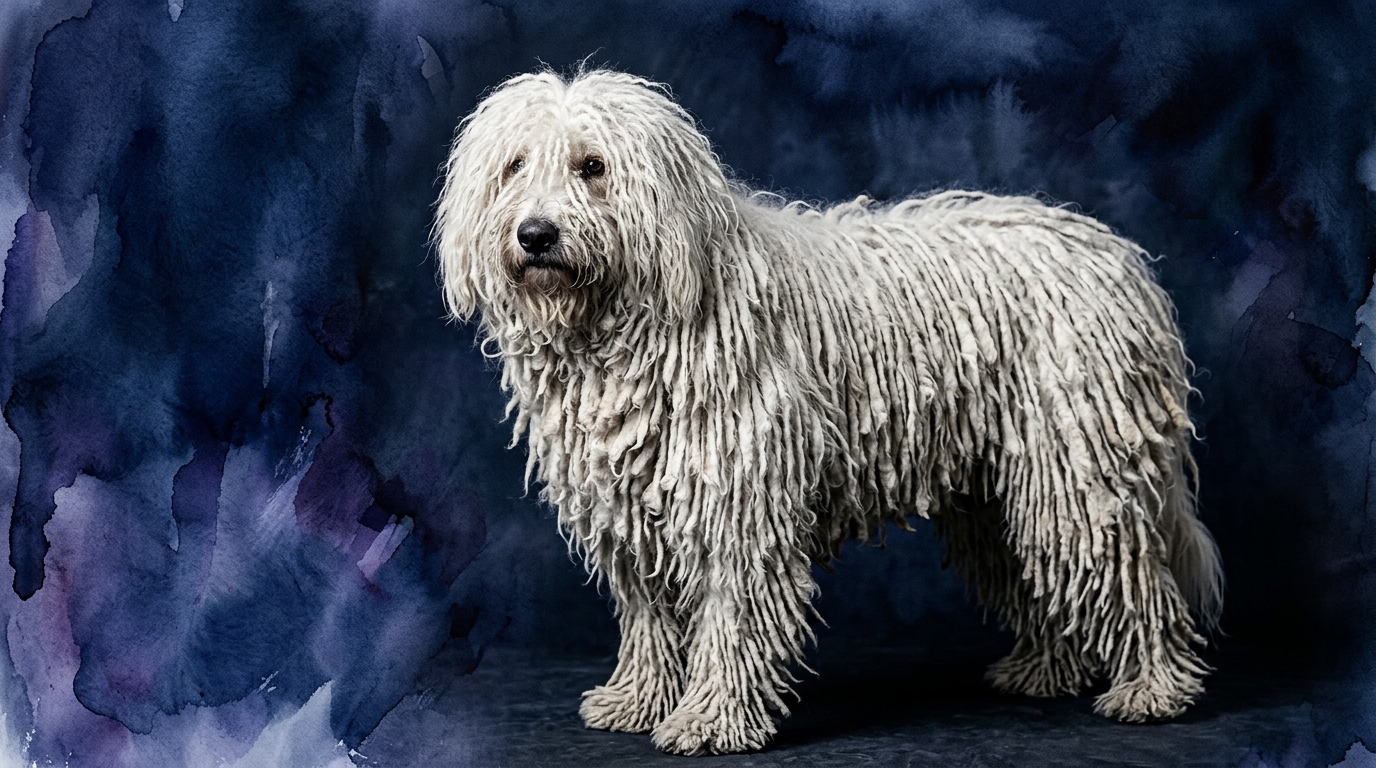

Side-by-Side IQ Profile: Komondor
The Komondor's problem-solving skills (3/5) are honed by centuries of independent livestock guarding. This breed excels at assessing environmental threats, deciding when to intervene, and strategizing defense against predators without human direction. Their decisions are often rooted in protective instincts, requiring them to evaluate situations autonomously.
Training a Komondor requires patience and understanding of its independent nature, contributing to its Training Speed (3/5). They are not inherently eager to please in the conventional sense and may question commands if they don't perceive a clear purpose. Consistency and positive reinforcement are key to leveraging their moderate learning speed.
A Komondor's social intelligence (3/5) is primarily directed towards its “flock”—be it sheep or family members—displaying profound loyalty and protectiveness. They are often reserved and wary of strangers, requiring careful, early socialization to ensure appropriate responses to new people and situations. Their social cues are about establishing boundaries and maintaining security.
The core of the Komondor's instinctive drive (3/5) is guarding. This manifests as a strong territorial imperative, constant vigilance, and a readiness to protect. This drive is deeply ingrained, shaping their daily behavior and requiring appropriate outlets for expression.
Komondors possess a solid memory (3/5) for their territory, routines, and identifying individuals who pose a threat versus those who belong. This memory supports their guarding duties, allowing them to recognize patterns and adapt their protective strategies based on past experiences.
Side-by-Side IQ Profile: Treeing Walker Coonhound
The Treeing Walker Coonhound's problem-solving (3/5) is intensely focused on its primary purpose: tracking and treeing prey. They navigate complex terrain, overcome obstacles, and decipher intricate scent trails, requiring significant cognitive effort to follow a specific target amidst other environmental smells.
While capable of learning, the Treeing Walker Coonhound's training speed (3/5) can be influenced by its powerful scent drive. They can be easily distracted when “on a scent,” making recall and focus challenging in certain environments. Engaging, reward-based methods are most effective to channel their moderate learning capacity.
Treeing Walker Coonhounds are typically amiable and enjoy companionship, often thriving in a social setting, whether with a human family or other dogs, reflecting their social intelligence (3/5). Their social intelligence is geared towards cooperative hunting in a pack and bonding with their handlers. They are generally outgoing but can be single-minded when their hunting instinct is activated.
The Treeing Walker Coonhound's instinctive drive (3/5) is overwhelmingly centered on hunting—specifically, trailing, baying, and treeing quarry. This drive is a powerful motivator, dictating much of their behavior and requiring outlets that satisfy this deep-seated urge.
This breed exhibits a robust memory (3/5), particularly for scent profiles and established hunting trails. Their ability to remember and differentiate between countless scents is crucial for their work, allowing them to pick up old trails and follow complex patterns over time and distance.
Where Komondor Wins Cognitively
The Komondor's cognitive superiority emerges in domains requiring independent judgment and self-directed protective strategy. Unlike many breeds that rely heavily on human commands, the Komondor was bred to make life-or-death decisions alone in the field. Its problem-solving capacity is keenly attuned to threat assessment and defense, evaluating potential dangers to its charges and responding autonomously. This manifests as a nuanced ability to discern between a harmless passerby and a genuine intruder, or to decide the optimal moment to intervene in a perceived threat.
Their social intelligence, while perhaps not broadly outgoing, is profoundly deep within their inner circle, exhibiting an unwavering loyalty and protective vigilance that requires constant, independent monitoring of their environment and the well-being of their family. This self-reliant cognitive processing for protection is a hallmark of the breed.
Where Treeing Walker Coonhound Wins Cognitively
Conversely, the Treeing Walker Coonhound demonstrates a distinct cognitive advantage in tasks demanding sustained, single-minded sensory focus and intricate environmental navigation. Its problem-solving prowess is unparalleled when it comes to deciphering a complex tapestry of scents, following a particular trail over varied terrain, and adapting its approach to obstacles or changing conditions. This requires a sophisticated form of abstract reasoning to interpret scent data and predict prey movement.
Their memory is particularly refined for olfactory information, allowing them to recall specific scent profiles and spatial maps of their hunting grounds with remarkable accuracy. This specialized intelligence enables them to perform their traditional role with an efficiency and dedication that few other breeds can match, showcasing a cognitive specialty driven by their powerful nose.
Which is Easier to Train and Why
Evaluating which breed is 'easier' to train, given their identical 3/5 Training Speed scores, hinges on understanding their fundamental behavioral drivers. The Komondor, with its profound independence, often requires a trainer to convince it of the value of a command. They are not inherently driven by a desire to 'please' in the typical sense; rather, they operate on their own assessment of a situation. This means repetitive drills without perceived purpose can be met with stubborn resistance. Training success with a Komondor often comes from establishing mutual respect, providing clear boundaries, and demonstrating the practical application of commands, especially in the context of their protective instincts. Early, consistent socialization is crucial to shape their social intelligence and prevent misdirected guarding behaviors.
The Treeing Walker Coonhound, while generally more amenable to human interaction, presents a different training challenge: its overwhelming instinctive drive for scent. Once 'on a scent,' the world shrinks to that single stimulus, making recall incredibly difficult. Training a Treeing Walker Coonhound demands competing with one of the strongest sensory drives in the canine world. This requires engaging, high-value rewards, consistent positive reinforcement, and often, specialized training in environments free from overwhelming scent distractions. While they can learn commands readily when focused, maintaining that focus against their innate drive is the primary hurdle. Therefore, neither is 'easy' in the conventional sense, but the Komondor's challenge lies in its independent will, while the Coonhound's challenge is its all-consuming focus on scent.
Which Suits Active Owners vs. Relaxed Owners
When considering lifestyle compatibility, the divergence between these two breeds becomes quite clear. The Komondor, despite its impressive stature, can be surprisingly calm indoors once its protective duties are understood and fulfilled. However, it is fundamentally a working dog that requires a 'job,' even if that job is guarding its family and property. Owners must provide ample secure outdoor space for patrolling and vigilance, and be prepared for the mental engagement that comes with managing a territorial guardian. They are not suited for apartment living or owners who cannot provide a clearly defined territory to oversee. A Komondor owner should be active in the sense of being present, consistent, and mentally engaged with their dog's needs, rather than necessarily needing intense physical exercise.
Conversely, the Treeing Walker Coonhound is unequivocally suited for active owners. This breed possesses boundless energy and an insatiable need to explore with its nose. They require significant daily exercise, ideally involving long walks, runs, or opportunities for scent work in safe, expansive environments. A relaxed owner who prefers minimal physical activity would quickly find themselves overwhelmed by a Coonhound's unmet energy demands, which can lead to destructive behaviors or incessant vocalizations. They are dogs that thrive on physical and mental stimulation directly related to their hunting heritage.
The Verdict
Choose a Komondor if you seek an independent, vigilant guardian for a spacious property and are prepared to manage a dog whose primary motivation is protection and autonomous decision-making. You value a reserved, loyal companion who excels at assessing threats and maintaining boundaries.
Opt for a Treeing Walker Coonhound if you are an exceptionally active individual or family eager to provide extensive daily exercise, mental stimulation through scent work, and can channel a powerful, single-minded hunting drive into productive activities.
🧠 Find Your Pet's IQ Score
Our Pet IQ Lab assessment covers 25+ tests across 5 cognitive dimensions — personalized to your breed.
Take the Full IQ Test →Frequently Asked Questions
Is a Komondor difficult to train due to its independence?
Training a Komondor requires patience and understanding of its independent nature. They often need to understand the purpose of a command and respond best to consistent, respectful training methods that leverage their protective instincts rather than trying to override them.
How much exercise does a Treeing Walker Coonhound need daily?
Treeing Walker Coonhounds are very active and require substantial daily exercise, typically an hour or more of vigorous activity. This should ideally include opportunities for off-leash running and engaging their powerful scenting abilities through walks or scent work.
Are Komondors good family dogs?
Komondors can be devoted family dogs, displaying profound loyalty and protectiveness towards their inner circle. However, their wary nature with strangers and strong guarding instincts necessitate early, extensive socialization to ensure they are well-adjusted and safe in various social situations.