
Side-by-Side Cognitive Profiles
The Cosmic Pet Pet IQ Lab provides a detailed framework for understanding canine intelligence across five key dimensions. Let's examine how the Maltese and the Nova Scotia Duck Tolling Retriever (Toller) compare.
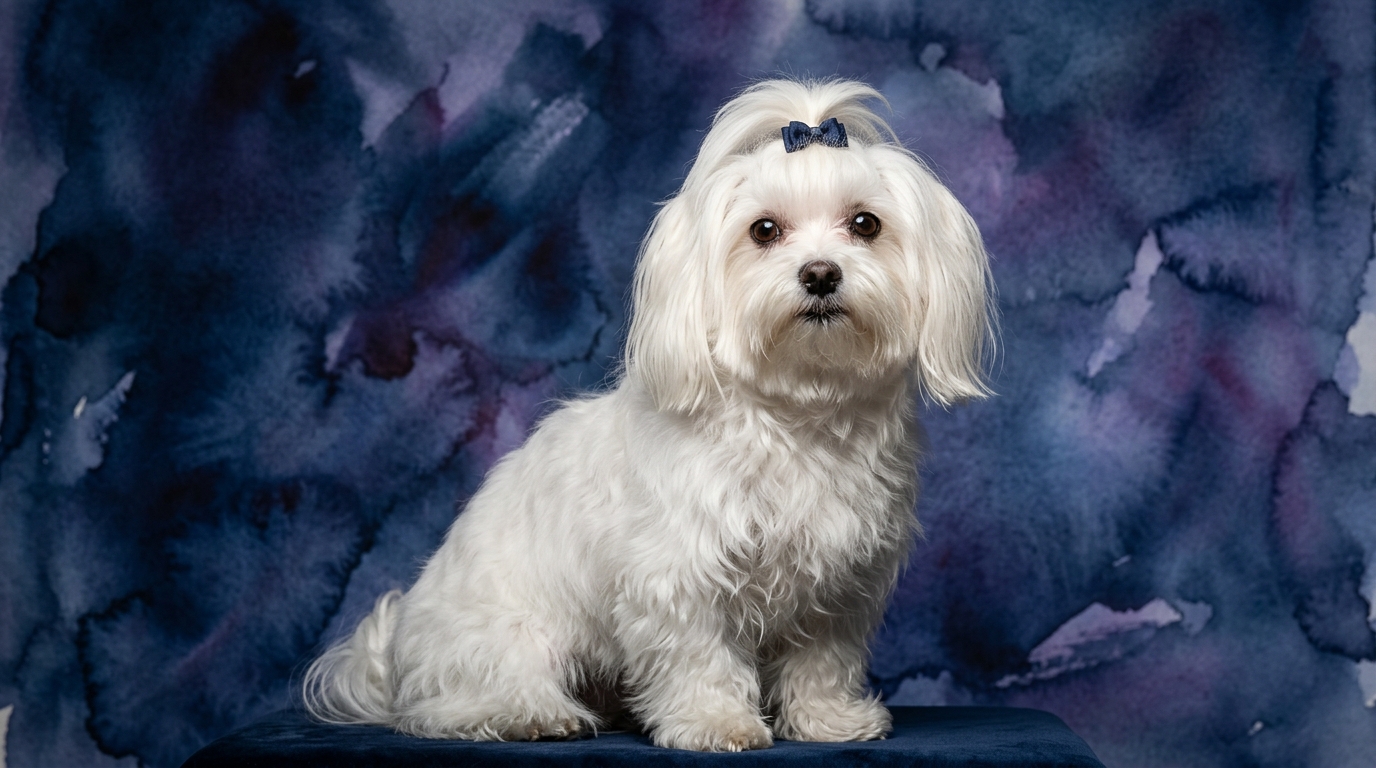
For the Maltese, a Toy breed, their cognitive profile is distinctively geared towards companionship. Their Problem Solving is rated at 3/5, indicating an ability to navigate household challenges like finding hidden treats or manipulating simple puzzle toys, often driven by a desire for comfort or social interaction. Training Speed is also 3/5; they absorb new commands at a moderate pace, benefiting greatly from positive reinforcement and consistent, gentle methods, with their eagerness to please often aiding retention. Social Intelligence is their exceptional strength, scoring 5/5; they are profoundly attuned to human emotions, subtle cues, and family dynamics, making them highly empathetic companions. Instictive Drive is low at 2/5, with minimal natural inclinations for hunting or guarding, their primary motivation being close human connection. Memory stands at 3/5, allowing them to reliably recall routines, learned commands, and familiar faces.
The Nova Scotia Duck Tolling Retriever, a Sporting breed not yet ranked by Coren, presents a cognitive profile shaped by its working heritage. Their Problem Solving is 3/5, showcasing practical skills, particularly in contexts related to retrieving, such as figuring out how to access an item from a tricky spot or navigating obstacles efficiently. Training Speed is 3/5, meaning they learn at a moderate pace, responding well to engaging activities and clear purpose, with consistency and positive reinforcement being key for their retention. Social Intelligence is 3/5; while capable of strong bonds and understanding human intentions, their social awareness is more focused on collaborative work than deep emotional attunement. Instictive Drive is a notable 3/5, centered around retrieving, scent work, and the unique 'tolling' behavior, which fuels persistence and focus on task-oriented activities. Memory is 3/5, providing a reliable recall for commands, action sequences, and locations, crucial for their retrieving duties.
Where the Maltese Wins Cognitively
The Maltese's undeniable cognitive triumph lies in their exceptional social intelligence, scoring a perfect 5/5. This isn't merely about recognizing their owner; it's a profound ability to read subtle human emotional states, body language, and vocal inflections with remarkable accuracy. A Maltese can often sense a shift in mood, offering comfort during distress or joining in celebratory moments without explicit prompting. They navigate complex family dynamics with grace, understanding individual relationships and boundaries, and often acting as emotional barometers within the home. This acute attunement allows them to form incredibly deep, empathic bonds, making them extraordinarily responsive and intuitive companions who seem to understand unspoken needs. Their cognitive processing is deeply intertwined with social context, enabling them to adapt their behavior to maintain harmony and connection, a skill that far exceeds the Toller's social understanding.
Where the Nova Scotia Duck Tolling Retriever Wins Cognitively
The Nova Scotia Duck Tolling Retriever shines brightest in its robust instinctive drive (3/5) and its application to practical, goal-oriented problem-solving. While their problem-solving score is numerically similar to the Maltese, the *nature* of their cognitive application differs significantly. Tollers excel at challenges requiring persistence, strategic thought related to physical tasks, and navigation within complex outdoor environments. Their instinctive drive to retrieve and engage with scents fuels a natural curiosity and an unwavering motivation to work through obstacles, whether it's figuring out how to extract a toy from behind a barrier or methodically searching for a hidden object. This drive makes them highly engaged in activities that tap into their ancestral purpose, allowing them to apply their cognitive skills to tangible, multi-step challenges with focused determination and impressive stamina. Their cognitive strengths are expressed through active engagement with the physical world, driven by an internal desire to achieve a task, a trait less pronounced in the comfort-seeking Maltese.
Which Is Easier to Train and Why
Both the Maltese and the Nova Scotia Duck Tolling Retriever share a moderate training speed (3/5), indicating neither breed is inherently faster at acquiring new commands. However, the *mechanisms* of motivation and the *types* of training that yield the best results diverge considerably due to their distinct cognitive profiles. The Maltese, with their superior social intelligence and lower instinctive drive, are primarily motivated by pleasing their human and receiving affection or praise. Their training thrives on gentle, consistent positive reinforcement, where the bond between dog and owner is a central pillar. They may become less engaged with repetitive drills lacking a social component but excel at learning behaviors that strengthen their connection to their family.
Conversely, the Toller's training, while also benefiting immensely from positive reinforcement, is significantly bolstered by their strong instinctive drive. They find intrinsic reward in completing tasks that engage their natural retrieving, scenting, or luring abilities. For a Toller, training is often most effective when framed as an engaging game or a purposeful job, incorporating elements of agility, scent work, or complex retrieving sequences. Their moderate social intelligence means they respond well to clear, consistent instructions and expectations, valuing the collaborative aspect of training. Therefore, 'easier' is subjective: the Maltese might be easier for an owner who prioritizes social compliance and emotional responsiveness, while the Toller might be easier for an owner who enjoys structured, task-oriented training that taps into a dog's working drive.
Which Suits Active Owners vs. Relaxed Owners
For the relaxed owner seeking a devoted, emotionally attuned companion whose primary joy comes from close interaction and comfort, the Maltese is often the more fitting choice. Their cognitive energies, driven by high social intelligence and a low instinctive drive, are primarily directed towards understanding and engaging within the home environment. They thrive on lap time, gentle indoor play, and being an integral, cherished part of daily family life, requiring moderate physical activity that can often be met with short walks or indoor games. Their 'work' is essentially being a loving and responsive family member, content with a less demanding schedule of physical exertion.
In contrast, the Nova Scotia Duck Tolling Retriever is an ideal match for active owners who genuinely enjoy engaging their dog in purposeful, mentally and physically stimulating activities. Their pronounced instinctive drive and practical problem-solving skills demand regular outlets such as retrieving games, scent work, agility training, long hikes, or even participation in dog sports. Tollers are at their happiest and most cognitively fulfilled when given a 'job' to do, channeling their natural aptitudes into challenging physical and mental exercises. An owner who understands and actively embraces this inherent need for engagement will forge a deeply rewarding partnership with a Toller, as their cognitive functions are best expressed through active, collaborative participation in a dynamic lifestyle.
The Verdict
Choose the Maltese if your priority is an emotionally responsive companion, deeply attuned to your social and emotional cues, thriving on close companionship and a gentler pace of life.
Opt for the Nova Scotia Duck Tolling Retriever if you're an active individual or family seeking a driven partner for outdoor adventures, who excels at task-oriented challenges and requires purposeful engagement.
🧠 Find Your Pet's IQ Score
Our Pet IQ Lab assessment covers 25+ tests across 5 cognitive dimensions — personalized to your breed.
Take the Full IQ Test →Frequently Asked Questions
Do Maltese dogs learn quickly?
Maltese dogs learn at a moderate pace (3/5 training speed). They respond best to consistent, positive reinforcement, especially when training incorporates their strong desire for social connection and affection from their owners.
Are Tollers good at problem-solving?
Nova Scotia Duck Tolling Retrievers demonstrate practical problem-solving skills (3/5), particularly when tasks relate to their retrieving instincts. They are adept at navigating physical obstacles to achieve a goal and are driven by purpose.
Which breed is more emotionally intelligent?
The Maltese exhibits significantly higher social intelligence (5/5) compared to the Toller (3/5). They are exceptionally skilled at reading human emotions and subtle social cues, fostering deep empathic bonds and intuitive understanding.