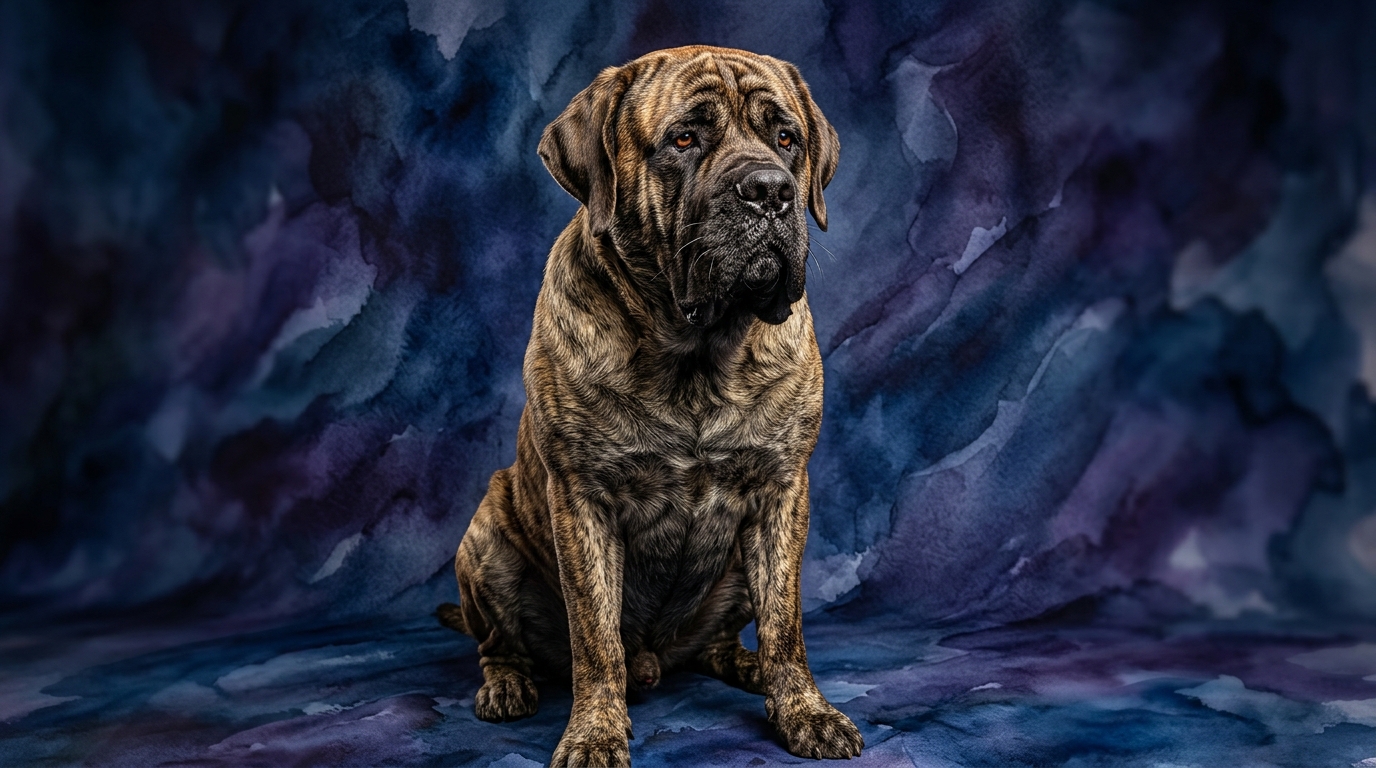
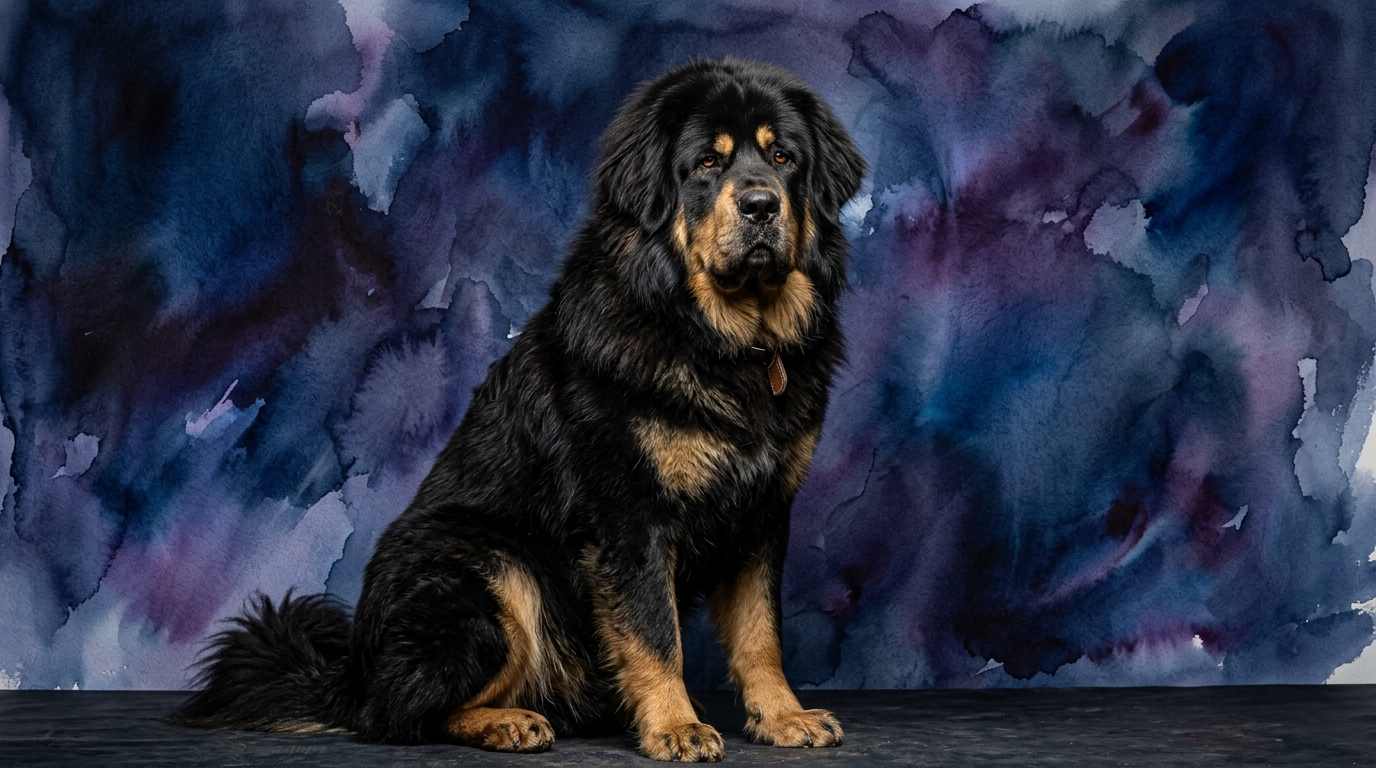
Side-by-Side IQ Profile: Unpacking Cognitive Dimensions
The Cosmic Pet Pet IQ Lab assesses canine intelligence across five key dimensions, and both the Mastiff and the Tibetan Mastiff register a consistent 3/5 across the board. However, this identical numerical score belies the unique ways each breed applies these cognitive abilities, reflecting their distinct historical roles and temperaments. Let's explore what a 3/5 truly means for each magnificent dog.
**Mastiff (Coren Rank #72):** This breed’s Coren ranking places them in the 'Fair Working Intelligence' category, indicating they generally grasp new commands in 40-80 repetitions and obey first commands 30% of the time or better. Their **Problem Solving (3/5)** manifests as a moderate ability to navigate novel situations, often relying on simple trial-and-error or seeking human guidance, rather than devising complex, independent strategies. **Training Speed (3/5)** is steady; they learn at an average pace, responding well to consistent, positive reinforcement, driven by a desire to please their human companions. Their **Social Intelligence (3/5)** is moderately attuned to human social cues and family dynamics, allowing them to form deep, empathetic bonds and respond to moods, though they can be reserved with strangers. The **Instinctive Drive (3/5)** is primarily expressed as a protective instinct towards their family and territory, typically responsive to human direction. Finally, their **Memory (3/5)** is solid and reliable for routines, learned commands, and familiar faces, retaining positive associations with consistency.
**Tibetan Mastiff (Not Coren-Ranked):** This lack of a Coren ranking hints at a more independent nature that doesn't conform to traditional obedience metrics. Their **Problem Solving (3/5)** is characterized by an independent, practical approach; faced with an obstacle, they are more likely to devise their own robust solution, such as finding a weakness in a fence, rather than seeking immediate human intervention. **Training Speed (3/5)** can feel slower to an inexperienced handler due to their inherent independence; they learn at an average pace but require motivation based on logic or perceived benefit, not just a desire to please. Their **Social Intelligence (3/5)** is discerning and highly attuned to their family and territory, quickly identifying friend from potential threat, often displaying aloofness or suspicion towards outsiders. The **Instinctive Drive (3/5)** is profoundly expressed as an inherent, self-directed sense of duty to protect their domain and family, operating with remarkable autonomy. Their **Memory (3/5)** is tenacious, particularly for territory boundaries, perceived threats, and established routines, contributing to consistent guarding behavior rather than rote obedience.
Where the Mastiff's Cognition Shines Brighter
Despite identical numerical scores, the Mastiff often demonstrates a nuanced cognitive advantage in environments where direct partnership and a more conventional 'dog-owner' dynamic are paramount. Their Coren rank of #72, while not indicating top-tier obedience, reflects a fundamental willingness to engage in structured learning that is more immediately apparent than their Tibetan counterpart's. This translates to Mastiffs excelling in scenarios demanding a high degree of responsiveness to human direction. For instance, a Mastiff's problem-solving (3/5) is often quicker to adapt to a handler's subtle body language cues in a complex obedience sequence, interpreting these as guides rather than commands to be independently evaluated. Their social intelligence (3/5) is particularly geared towards seamless integration into a human family's daily rhythm, making them more receptive to subtle emotional changes. They are often capable of offering comfort without explicit prompting, demonstrating a deeply integrated understanding of human distress. This cognitive alignment with human interaction makes their memory (3/5) exceptionally effective for retaining routines and commands directly associated with positive human feedback, fostering a predictable and highly responsive companion.
Where the Tibetan Mastiff's Cognition Takes the Lead
The Tibetan Mastiff, with its identical raw scores, possesses a distinct cognitive strength profoundly shaped by its ancient role as an autonomous, self-reliant guardian. Their problem-solving (3/5) truly shines when confronted with genuine security challenges, where their independence becomes an invaluable asset. Rather than passively waiting for human direction, a Tibetan Mastiff is prone to independently assessing an unfamiliar scent or an unusual sound on their property, then devising their own robust strategy for investigation or deterrence. This showcases a proactive, rather than reactive, intelligence. Their instinctive drive (3/5) is a powerful, self-activating system, making them unparalleled in their territorial awareness and vigilance, often requiring minimal human oversight once their role is understood. This deep-seated drive means their memory (3/5) is exceptionally robust for mapping their domain, recalling past encounters, and identifying subtle patterns that signify potential threats. Their social intelligence (3/5), while often perceived as aloof, is acutely discerning, enabling them to quickly categorize individuals as safe or suspicious. This critical cognitive skill was essential for a breed whose survival depended on independent judgment in isolated, high-stakes environments.
Trainability: Navigating Distinct Motivations
Assessing which breed is 'easier' to train necessitates a deeper understanding of their core motivations and learning styles. The Mastiff, characterized by an inherent desire to please its family and a general eagerness for companionship, typically offers a more straightforward training journey. Their training speed (3/5) benefits significantly from their responsiveness to positive reinforcement, such as praise and treats, and they often find genuine joy in the collaborative activity of learning. A Mastiff's social intelligence (3/5) enables them to readily understand and adapt to human expectations, making them more amenable to structured obedience classes and consistent commands. They are generally less inclined to question a command, focusing instead on executing it to earn approval and maintain harmony within their human 'pack.'
Conversely, the Tibetan Mastiff's profound independence, a defining characteristic forged by centuries of autonomous guarding, means their training speed (3/5) often feels slower and more challenging. They are not primarily driven by a desire to please but rather by what they perceive as logical or beneficial within their own framework of understanding. Training a Tibetan Mastiff demands extraordinary patience, crystal-clear communication, and the establishment of a relationship built on mutual respect and trust. They require a handler who can motivate them without coercion, appealing to their inherent logic and demonstrating the practical value of cooperation. Their strong instinctive drive (3/5) ensures that while they learn, they will always prioritize their perceived duty to guard, which can sometimes override obedience commands if they conflict with their deep-seated protective instincts, requiring experienced handling to navigate these complex scenarios.
Lifestyle Match: Active Engagement vs. Relaxed Companionship
The choice between a Mastiff and a Tibetan Mastiff also heavily depends on an owner's lifestyle, particularly their interpretation of 'active' and 'relaxed' engagement. For individuals seeking a companion that integrates seamlessly into a more relaxed, yet structured, home life, the Mastiff often proves to be an excellent fit. Despite their formidable size, they are generally content with moderate daily exercise—a good walk or supervised playtime in a secure yard—and are renowned for their ability to settle down indoors, often transforming into colossal, serene presences. Their cognitive profile, especially their social intelligence and desire for companionship, makes them highly adaptable to a family's established rhythm once foundational training is in place. They thrive on close human interaction and are happiest when fully integrated into daily activities, even if those activities are relatively sedate.
In contrast, the Tibetan Mastiff, despite an often calm indoor demeanor, typically requires a more 'active' owner in terms of mental engagement and the proactive management of their powerful instincts. Their strong instinctive drive (3/5) for guarding necessitates owners who are prepared to provide appropriate outlets for this behavior, such as a large, securely fenced property to patrol and monitor. These are not dogs that will be satisfied with just a casual stroll around the neighborhood; their minds are constantly assessing their environment. Owners must be 'active' in consistent, firm, and fair training, understanding that a Tibetan Mastiff's independence means they will regularly test boundaries. They are better suited to owners who genuinely appreciate and can effectively manage a dog with a profound sense of self and an enduring, ancient purpose, providing the necessary structure and expansive space for them to fulfill their deep-seated cognitive and instinctual needs.
The Verdict
If you seek a devoted, gentle giant who thrives on companionship and responds well to consistent, positive training methods, the Mastiff is likely your ideal companion.
For those prepared to understand and embrace an independent, ancient guardian with a profound sense of duty and a discerning mind, the Tibetan Mastiff offers a unique and deeply rewarding partnership.
🧠 Find Your Pet's IQ Score
Our Pet IQ Lab assessment covers 25+ tests across 5 cognitive dimensions — personalized to your breed.
Take the Full IQ Test →Frequently Asked Questions
Are Mastiffs good with children?
Mastiffs generally possess a gentle and patient temperament, often making them good with children in their own family. However, due to their immense size, supervision is always essential to prevent accidental bumps or knocks, and children should be taught how to interact respectfully with such a large dog.
Do Tibetan Mastiffs bark a lot?
Tibetan Mastiffs are known for their deep, resonant bark, which they use effectively to alert their owners to anything unusual, especially at night. While not incessantly vocal, their guarding instincts mean they will use their voice to mark their territory and warn off perceived threats, which can be frequent in busy environments.
What kind of owner is best for a Tibetan Mastiff?
The ideal owner for a Tibetan Mastiff is experienced with large, independent guardian breeds, possesses a secure, spacious property, and is committed to consistent, firm, and patient training. They thrive with owners who understand their need for autonomy and respect their discerning nature, providing leadership without coercion and appreciating their ancient role.