
Side-by-side IQ Profile
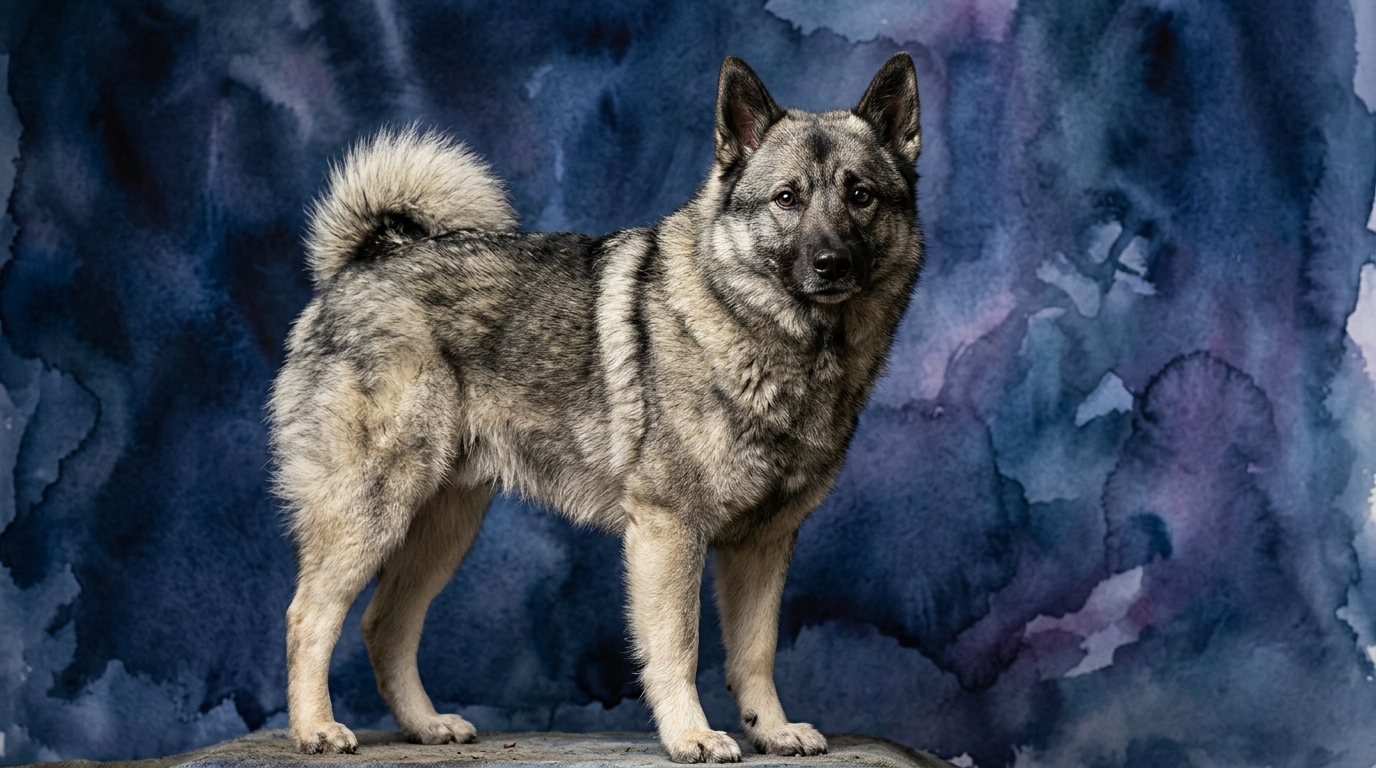
The Norwegian Elkhound, a robust spitz-type dog historically bred for hunting moose and other large game, registers impressively across several cognitive dimensions, reflected in its Coren rank of #36 among dog breeds. Its Problem Solving score of 4/5 indicates a significant capacity for independent thought and strategic action, essential for tracking and holding quarry. Training Speed also scores 4/5, suggesting a quick grasp of new commands and concepts, allowing for efficient instruction. Memory is strong at 4/5, enabling retention of complex sequences and spatial information over time. Social Intelligence is 3/5, implying a moderate understanding of human cues and social dynamics, while its Instinctive Drive, also 3/5, speaks to a balanced but present prey drive and intrinsic motivation for work.
The Russian Toy, a delicate, elegant breed originally developed as a companion for Russian aristocracy, is not included in Stanley Coren's ranking, yet possesses a distinct cognitive makeup optimized for its role. Across all five IQ dimensions – Problem Solving, Training Speed, Social Intelligence, Instinctive Drive, and Memory – the Russian Toy consistently scores 3/5. This suggests a capable, adaptable mind, albeit without the specialized cognitive peaks seen in the Elkhound. Its 3/5 in Problem Solving points to an ability to navigate its environment and figure out simpler challenges, while a 3/5 in Training Speed means it can learn, though perhaps requiring more repetition than some breeds. Social Intelligence at 3/5 indicates a reasonable connection with human emotions, and its 3/5 Instinctive Drive suggests a manageable level of intrinsic motivation and prey instinct, well-suited for indoor living. Memory at 3/5 implies a solid capacity for retaining learned behaviors and routines.
Where Norwegian Elkhound Wins Cognitively
The Norwegian Elkhound's cognitive profile demonstrates clear advantages rooted in its demanding historical role. Its superior Problem Solving score of 4/5 means this breed excels at independent thinking and navigating complex, dynamic situations. This isn't merely about solving puzzles, but about making autonomous decisions in the field, like figuring out how to circle back to a scent trail or outmaneuver a cautious animal. This cognitive strength translates into a dog that can often strategize its way through obstacles, whether it's opening a child-proof gate or devising a method to retrieve a dropped toy from an awkward spot. Furthermore, the Elkhound's 4/5 in Training Speed and Memory gives it a significant edge in acquiring and retaining intricate commands and routines. They can pick up new behaviors swiftly and reliably recall them, making them adept at advanced obedience, agility, or scent work. This capacity for rapid learning combined with robust memory allows them to build a large repertoire of understood cues and complex tasks, crucial for a dog expected to work cooperatively over long periods in challenging environments.
Where Russian Toy Wins Cognitively
While the Russian Toy's individual scores of 3/5 might not appear as numerically superior as the Elkhound's peaks, its balanced cognitive profile represents a distinct "win" within its intended domain: companionship. The Russian Toy's consistent 3/5 in Social Intelligence means it possesses a good, steady capacity for understanding and responding to human emotions and social cues. This isn't about complex, independent problem-solving in the wilderness, but rather a refined attunement to the nuances of its human family, making it an empathetic and responsive presence. Its 3/5 in Instinctive Drive, while lower than many working breeds, is a significant advantage for a domestic companion. This means a reduced propensity for intense prey drive, barking at every outdoor stimulus, or a constant need for strenuous physical output, making it easier to integrate into a relaxed household environment. Its balanced memory and problem-solving, both at 3/5, are perfectly adequate for learning household rules, enjoying interactive games, and navigating a domestic setting with grace and curiosity, rather than needing to constantly "work" its brain on complex, external tasks.
Which is Easier to Train and Why
Assessing trainability requires looking beyond just willingness and considering cognitive capacity for learning. The Norwegian Elkhound, with its 4/5 in Training Speed and Problem Solving, generally presents as easier to train for complex tasks and a wider range of behaviors. They possess a quicker uptake of new commands and a greater ability to generalize learned behaviors to new situations. This stems from their historical need to understand and execute intricate hunting strategies alongside humans, requiring both rapid learning and adaptive problem-solving on the fly. However, their 3/5 Instinctive Drive means they can be independently minded and may require consistent, engaging training methods to maintain focus, as their natural instincts might sometimes compete with human directives.
The Russian Toy, scoring 3/5 across Training Speed and Problem Solving, is certainly trainable but might require more patience and repetition. They learn effectively, but perhaps not with the same swiftness or intellectual leap as the Elkhound. Their smaller stature and companion role often mean their training focuses more on basic manners, house-training, and social etiquette rather than complex working tasks. Their 3/5 Instinctive Drive, being lower, can paradoxically make them easier to manage in a home setting, as they might be less prone to chasing small animals or exhibiting strong independent problem-solving that could lead to mischief. While the Elkhound learns faster and can master more intricate tasks, the Russian Toy's trainability is perfectly sufficient for a well-mannered companion, often benefiting from positive reinforcement and short, fun sessions that cater to its companionable nature.
Which Suits Active Owners vs Relaxed Owners
The cognitive profiles of these two breeds clearly delineate their suitability for different lifestyles. The Norwegian Elkhound, with its robust Problem Solving (4/5) and a moderate Instinctive Drive (3/5), thrives with active owners who can provide ample mental and physical stimulation. This is a breed that needs its brain challenged through training, puzzle toys, scent work, or regular engagement in activities that simulate its historical hunting role. Owners who enjoy hiking, running, or dog sports like agility will find the Elkhound a willing and capable partner. A relaxed owner might find an Elkhound's need for engagement manifests as boredom, leading to undesirable behaviors as it invents its own "problems" to solve.
Conversely, the Russian Toy, with its consistent 3/5 across all cognitive dimensions and a lower overall physical demand, is an ideal fit for more relaxed owners. Its balanced Instinctive Drive means it's less prone to high-energy outbursts or a constant need for outdoor adventure. While it still benefits from regular walks and interactive play, its cognitive needs are met more by consistent companionship, gentle games, and perhaps learning a few tricks, rather than complex working tasks. Owners who prefer a cozy companion for quiet evenings, short strolls, and intimate interaction will find the Russian Toy's cognitive makeup perfectly aligned with their lifestyle, providing affectionate presence without demanding intense mental or physical exertion.
The Verdict
Opt for the Norwegian Elkhound if you are an active individual or family prepared to engage a dog with significant problem-solving abilities and a strong drive for mental and physical work, appreciating a partner that thrives on purpose and challenge.
Select the Russian Toy if you seek a devoted, sensitive companion whose cognitive strengths lie in its balanced adaptability and emotional attunement, fitting seamlessly into a more relaxed household with consistent, gentle interaction.
🧠 Find Your Pet's IQ Score
Our Pet IQ Lab assessment covers 25+ tests across 5 cognitive dimensions — personalized to your breed.
Take the Full IQ Test →Frequently Asked Questions
Does the Norwegian Elkhound's higher problem-solving score make it more difficult to live with?
Not necessarily more difficult, but it means an Elkhound requires consistent mental stimulation to prevent boredom and potential destructive behaviors. Their capacity to figure things out means they can become quite adept at opening doors or finding ways to get into mischief if their minds aren't productively engaged.
Is the Russian Toy's lower training speed score a significant disadvantage for an owner?
Not for most companion owners. While they may take a bit longer to grasp new commands than an Elkhound, their 3/5 score indicates they are still perfectly capable of learning basic obedience and house rules with patient, positive reinforcement. Their focus on their owner can actually aid in consistent training.
How does the Instinctive Drive difference impact daily life with these breeds?
The Elkhound's 3/5 Instinctive Drive means it has a natural inclination for scenting, chasing, and independent action, requiring secure containment and outlets for these drives. The Russian Toy's 3/5 Instinctive Drive is typically less intense, making it generally more content with indoor life and less prone to bolting after perceived prey, though individual variation always exists.