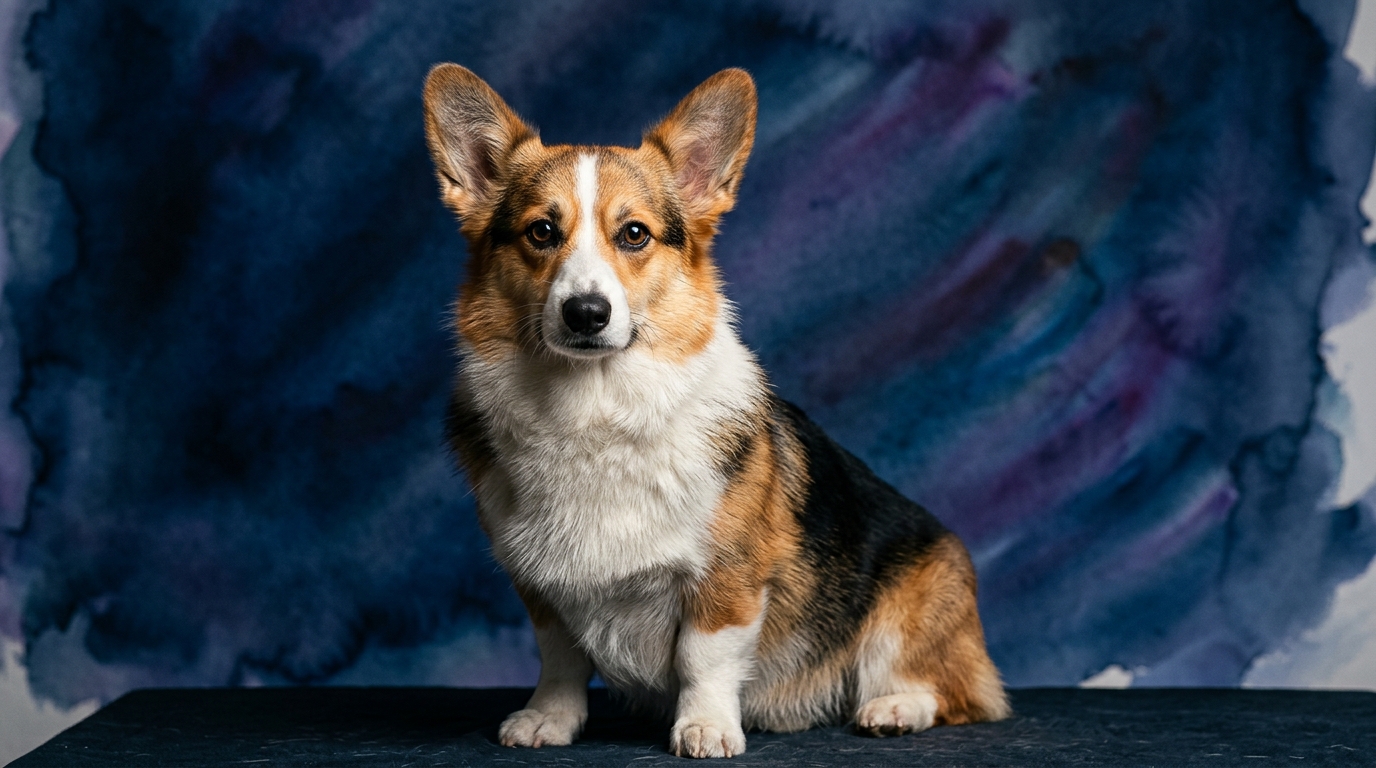

Side-by-Side Cognitive Profiles
The Pembroke Welsh Corgi, a member of the Herding group, holds a notable Coren rank of #11, indicating a strong capacity for working and obedience intelligence. Their Problem Solving is rated 4/5, reflecting an aptitude for navigating practical challenges, such as strategically moving livestock or deciphering complex environmental cues. Training Speed is exceptionally high at 5/5, meaning Corgis typically grasp new commands and behaviors with remarkable alacrity. Their Social Intelligence, at 4/5, highlights their ability to interpret human cues and integrate smoothly into family dynamics, fostering a cooperative partnership. An Instinctive Drive of 5/5 underscores their powerful herding impulse, a core motivator for their focus and task orientation. Lastly, their Memory, rated 4/5, ensures strong retention of learned behaviors, routines, and spatial information, contributing to consistent performance.
In contrast, the Black and Tan Coonhound, from the Hound group, does not feature on the Coren ranking, which speaks more to the specialized nature of their cognitive strengths rather than a lack of mental capacity. Their Problem Solving is rated 3/5, showcasing an ability to overcome obstacles primarily in the pursuit of a scent, such as navigating varied terrain or finding a path through dense cover. Training Speed stands at 3/5, indicating they learn at a moderate pace, often requiring more patience and repetition due to their deep-seated focus on scent. Social Intelligence is 3/5, meaning they form strong bonds but their communication style is less about intricate human-dog interaction and more about comfortable companionship. Their Instinctive Drive, also 3/5, is powerfully geared towards tracking, a relentless pursuit of scent that can sometimes override other directives. Their Memory, rated 3/5, is functional for routines and familiar people, but particularly strong for scent patterns and geographical layouts crucial to their tracking work.
Where the Pembroke Welsh Corgi Excels Cognitively
The Pembroke Welsh Corgi's cognitive strengths are particularly evident in their capacity for rapid learning and finely tuned social awareness. Their Training Speed rating of 5/5 signifies an exceptional ability to absorb new commands and behaviors with remarkable efficiency, often mastering complex sequences in fewer repetitions than many other breeds. This stems directly from their historical role, which demanded instant, precise responses to handler cues while managing livestock.
Furthermore, their Problem Solving score of 4/5, combined with their potent Instinctive Drive (5/5), allows them to excel at practical, dynamic challenges. Consider a Corgi strategically maneuvering a flock, anticipating movements and blocking escape routes – this demonstrates a sophisticated application of spatial reasoning and predictive behavior, rather than mere brute force. Their Social Intelligence (4/5) also provides a distinct advantage, allowing them to interpret human intentions and emotions with notable accuracy. This facilitates a deeper, more nuanced partnership, where the Corgi can adapt its behavior based on subtle shifts in its owner's mood or directives, making them highly responsive companions and working partners.
Where the Black and Tan Coonhound Shines Cognitively
While the Coonhound's cognitive strengths may not manifest in the same rapid-fire obedience as a Corgi, their unique aptitude for sustained focus and sensory processing is unparalleled in their specific domain. Their Instinctive Drive, rated 3/5, is a powerful, unwavering force when it comes to tracking. This is not a lower drive, but a specialized one; it means they can maintain intense concentration on a scent trail for hours, ignoring environmental distractions that would overwhelm many other breeds.
Their Problem Solving (3/5) is uniquely adapted to the complexities of the hunt. They aren't solving abstract puzzles but rather intricate environmental riddles, deciphering faint scent molecules, navigating dense undergrowth, and overcoming physical barriers to stay on a trail. This requires an incredible spatial awareness tied directly to olfactory information, a cognitive skill that far exceeds many breeds in its specific application. The Coonhound's Memory (3/5), while not top-tier for arbitrary commands, is exceptional for scent patterns and geographical layouts associated with tracking. They remember complex trails, the location of specific scents, and successful hunting grounds with remarkable fidelity, allowing them to learn and adapt their tracking strategies over time. This specialized memory is crucial for their primary function.
Training Dynamics: Corgi vs. Coonhound
The Pembroke Welsh Corgi generally presents as the easier breed to train, a direct reflection of their 5/5 Training Speed score. Their herding lineage instilled a deep-seated desire to work in tandem with humans, responding with precision to commands. Corgis typically exhibit a strong 'people-pleasing' temperament, eager for direction and quick to form associations between actions and rewards. When taught a new behavior, they often grasp the concept rapidly and require fewer repetitions to solidify the response. Their natural inclination to gather and direct translates into a receptive mind for structured learning, making them highly responsive to positive reinforcement and consistent cues.
In contrast, the Black and Tan Coonhound, with a Training Speed of 3/5, often requires a more patient and persistent approach to training. Their primary motivation is not to please a human handler in the same way a Corgi's is, but rather to follow their powerful nose. When a compelling scent is present, a Coonhound's instinctive drive to track can easily override any learned commands, making recall or focus challenging in stimulating environments. While they are capable learners, their independent nature and singular devotion to scent mean that training often involves competing with their innate drives. Establishing consistent responses requires a deep understanding of their motivations, often leveraging their love for food or specific toys, and a commitment to making training more rewarding than the allure of the trail. Behavioral differences like the Corgi's attentiveness to handler cues versus the Coonhound's environmental preoccupation are key here.
Lifestyle Suitability: Active vs. Relaxed Owners
For active owners seeking a highly engaged and mentally stimulated companion, the Pembroke Welsh Corgi is often a fitting match. Their Instinctive Drive (5/5) and Problem Solving (4/5) mean they thrive on structured activities that tap into their working heritage. Daily vigorous walks, engaging puzzle toys, and participation in dog sports like agility, obedience, or even herding trials are essential for their well-being. A Corgi that isn't sufficiently challenged mentally and physically can become bored, potentially leading to undesirable behaviors like nipping at heels (a residual herding tendency) or excessive barking. They are enthusiastic participants in adventures, eager to explore and learn alongside their human partners, making them ideal for owners who enjoy consistent interaction and dynamic activities.
Conversely, while the Black and Tan Coonhound also requires activity, their needs lean more towards owners who appreciate long, meandering explorations rather than high-intensity bursts. Their Instinctive Drive (3/5) manifests as a deep desire to follow scents, making them excellent companions for extensive hikes or 'sniffari' adventures where they can indulge their nose. However, their physical activity is often less about speed and more about endurance and persistent exploration. For more relaxed owners, a Coonhound can be a good fit if they are prepared for long, leashed walks or have secure, expansive areas where the dog can safely explore scent trails. Their lower social intelligence score compared to the Corgi suggests they might be content with less constant, direct interaction, preferring to quietly observe or follow a scent, yet they still appreciate companionship. They are generally less demanding of constant mental 'tasks' in the way a Corgi might be, but still need outlets for their inherent drive.
The Verdict
Choose the Pembroke Welsh Corgi if you desire a highly responsive, quick-learning companion eager for structured mental engagement and a strong partnership in diverse activities. Their precision and social aptitude make them ideal for owners seeking a dog to train in depth and involve in daily interactive routines.
Opt for the Black and Tan Coonhound if you appreciate a dog with an independent spirit, a deep passion for exploring the world through scent, and are prepared for patient, consistent training focused on their natural drives. They thrive with owners who enjoy long, investigative walks and can provide secure environments for scent work.
🧠 Find Your Pet's IQ Score
Our Pet IQ Lab assessment covers 25+ tests across 5 cognitive dimensions — personalized to your breed.
Take the Full IQ Test →Frequently Asked Questions
How does the Coren ranking apply to these breeds?
The Pembroke Welsh Corgi's Coren rank of #11 places it among breeds with excellent working intelligence, indicating high trainability and obedience. The Black and Tan Coonhound is not specifically ranked by Coren, which doesn't diminish its specialized cognitive abilities but suggests it may not fit the traditional obedience metrics as readily.
Do Black and Tan Coonhounds ever excel in obedience training?
While their Training Speed is rated 3/5, Black and Tan Coonhounds can certainly achieve high levels of obedience with patient, consistent, and motivation-driven training. Their independent nature means handlers must find ways to make compliance more rewarding than the allure of a captivating scent trail.
Can a Corgi adapt to a more relaxed lifestyle?
A Corgi can adapt to a more relaxed lifestyle, but it's crucial to provide consistent mental stimulation through puzzle toys, short training sessions, and interactive play to prevent boredom. Their inherent drive for activity means a completely sedentary existence is unlikely to satisfy their cognitive and physical needs, potentially leading to behavioral issues.