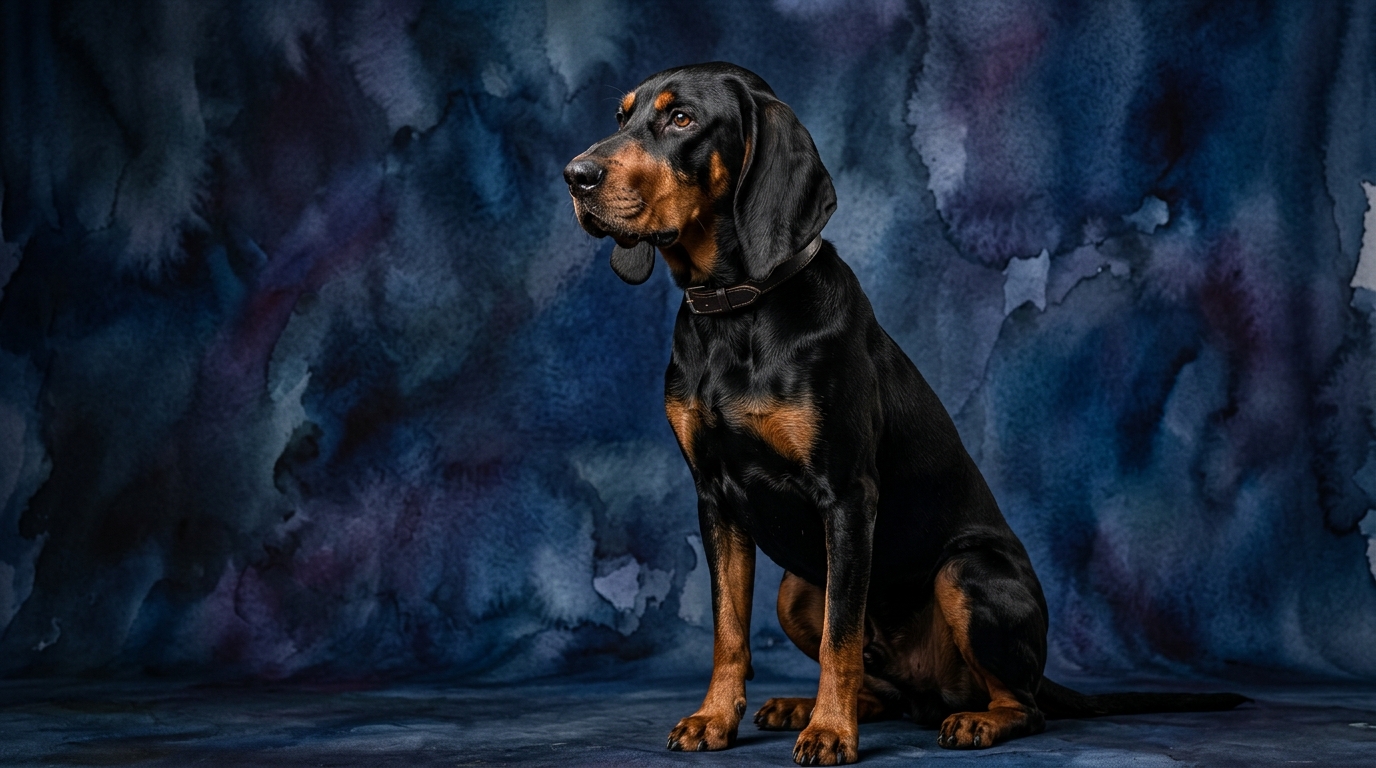
Black and Tan Coonhound at a glance
| IQ Rank / Score | 12/25 |
|---|---|
| Trainability | ★★☆☆☆ (2/5) |
| Social Intelligence | ★★★☆☆ (3/5) |
| Lifespan | 10-12 years |
| Shedding | Moderate to high |
| Exercise Needs | Moderate (30-45 min/day) |
| Origin | USA |
The Olfactory Tenacity: A Masterpiece of Scent Intelligence
The Black and Tan Coonhound's primary cognitive strength lies in their extraordinary olfactory tenacity, a specialized form of intelligence that drives every aspect of their being. This isn't merely a keen sense of smell; it's a sophisticated cognitive process involving complex scent discrimination, memory, and sustained focus. Bred specifically to follow cold trails – scents that are hours or even days old – these hounds possess a 'cold nose' that allows them to meticulously reconstruct an animal's path, sifting through an overwhelming tapestry of environmental odors. They don't just detect a scent; they interpret its age, direction, and intensity, building a mental map of their quarry's journey across challenging landscapes. This unwavering dedication to a scent, often ignoring all other stimuli, is a testament to their profound, instinct-driven intelligence.
Their cognitive world is predominantly scent-driven, impacting how they perceive and interact with their environment. While other breeds might focus on visual cues or human commands, the Black and Tan Coonhound is constantly processing a rich, invisible world of olfactory information. This requires immense mental stamina and an ability to maintain concentration over long periods, often through dense undergrowth, across water, and up trees. Their memory for specific scents and the terrain associated with them is exceptional, allowing them to learn and recall patterns in the environment that aid in their tracking. This highly specialized intelligence, honed over generations, makes them unparalleled in their chosen field, a true canine Sherlock Holmes of the wild.
Independent Trailing: Problem-Solving for the Hunt
Beyond their legendary nose, Black and Tan Coonhounds are exceptional independent problem-solvers, particularly when navigating the complexities of a scent trail. Unlike breeds that excel at taking human direction, these hounds were developed to work autonomously, often far from their handler, making critical decisions on their own. When a trail goes cold, or an obstacle arises, a Coonhound doesn't wait for instruction; they independently devise strategies to reacquire the scent, circle back, or find a way around barriers. This involves intricate spatial reasoning, environmental assessment, and a relentless trial-and-error approach to overcome challenges in pursuit of their goal. They are not merely following a line; they are actively interpreting, predicting, and adapting.
This independent problem-solving extends to their physical prowess as well. They must figure out how to climb over fallen logs, navigate steep inclines, or even cross small streams to stay on track. Their persistent 'bay' isn't just a vocalization; it's a communication tool, indicating their progress and the status of the hunt, demonstrating an innate understanding of their role within a cooperative hunting scenario, even when physically separated from their human partners. This blend of sensory acuity, physical endurance, and independent cognitive processing makes them uniquely suited for their historical role, showcasing an intelligence defined by practical application and self-reliance.
Training a Black and Tan Coonhound: Understanding the Drive
Training a Black and Tan Coonhound requires a deep understanding of their innate drives and cognitive priorities. While intelligent, their 'training speed' in traditional obedience often appears moderate (rating 2/5) due to their overwhelming instinctive drive (rating 5/5) to track. Their nose often takes precedence over human commands, leading to a perception of stubbornness. Effective training capitalizes on their love for scent work and their desire to please their 'pack leader' once a strong bond is established. Positive reinforcement, particularly using high-value, food-based rewards or opportunities for scent games, is crucial. Early and consistent recall training is paramount, as once a Coonhound locks onto a scent, their focus becomes almost singular.
Their intelligence shines when tasks are framed within their natural predilections. Incorporating scent-based games into training can transform a 'stubborn' hound into an eager participant. They excel at activities like K9 Nose Work or advanced tracking exercises where their natural talents are celebrated. Consistency, patience, and humor are vital; a Black and Tan Coonhound might take longer to master a 'stay' command than a Border Collie, but their dedication to a challenging scent puzzle will far outstrip many other breeds. Understanding that their 'distractibility' is often hyper-focus on their primary instinct helps owners reframe training challenges into opportunities.
Social Dynamics and Pack Intelligence
Black and Tan Coonhounds exhibit a moderate level of social intelligence (rating 3/5), deeply rooted in their history as pack animals. While they possess a strong affection for their human families and typically get along well with other dogs, their social interactions are often colored by their independent nature and hunting focus. They are loyal and form strong bonds, but unlike some companion breeds, they aren't necessarily 'people-pleasers' in the traditional sense; their drive is often internal or directed towards the hunt. They thrive in a family environment where they feel part of the 'pack' and appreciate consistent interaction, though they are perfectly content to entertain themselves with a good scent in the yard.
Within their pack, they communicate through a range of vocalizations, from their characteristic 'bawl' or 'chop' bay to more subtle whines and growls, demonstrating an innate understanding of pack communication. While not overtly demonstrative, their loyalty is profound. They can be good with children, viewing them as smaller pack members, but their size and boisterous nature require supervision. Their social intelligence is less about complex emotional manipulation or understanding subtle human cues and more about establishing clear pack hierarchies, cooperative living, and a deep, steadfast loyalty to their core family unit.
Historical Cognition: Bred for the Backwoods
The cognitive profile of the Black and Tan Coonhound is a direct reflection of their American origins, specifically developed for the challenging pursuit of raccoons and larger game like bear and mountain lion in the rugged Appalachian mountains. Their ancestors, likely English Foxhounds and Bloodhounds, were selectively bred for specific traits crucial to night hunting in dense, varied terrain. This historical context explains their extreme endurance, their ability to work independently for hours, their distinctive vocalizations to signal progress from afar, and their unparalleled 'cold-nose' ability. Unlike hounds bred for open-field hunting, the Coonhound needed to navigate complex forests, cross treacherous rivers, and 'tree' game, all while staying connected to their human companions through sound alone.
This selective breeding fostered a specialized intelligence that prioritizes self-reliance, physical and mental stamina, and an unwavering commitment to the scent. Their memory for terrain and the ability to extrapolate a trail's direction from faint scent particles are direct evolutionary adaptations to these demanding hunting conditions. The Black and Tan Coonhound represents a pinnacle of canine specialization, where their entire cognitive framework is a testament to generations of intelligent design for a very specific, challenging task.
Living with a Black and Tan Coonhound: Engaging Their Unique Intellect
For owners of a Black and Tan Coonhound, understanding and engaging their unique intellect is key to a happy and well-adjusted dog. Given their high instinctive drive and need for mental stimulation, simply providing physical exercise is often not enough. Scent work is their passion and their cognitive playground. Incorporate daily 'sniffaris' where they can follow interesting smells, hide-and-seek games with treats, or formal K9 Nose Work classes. Puzzle toys that dispense food can engage their problem-solving skills, especially those requiring them to manipulate objects with their paws or nose. Their powerful memory makes them excellent candidates for advanced tracking sports, which tap directly into their core strengths.
Neglecting their mental needs can lead to behavioral issues, as their intelligent minds will seek their own entertainment – often in ways humans find undesirable, such as destructive chewing or nuisance barking when they are bored. By channeling their incredible olfactory and problem-solving abilities into appropriate activities, owners can foster a deep bond and witness the remarkable intelligence that lies at the heart of this dedicated and fascinating breed. Embracing their unique cognitive landscape is the most rewarding way to live with a Black and Tan Coonhound.
3 At-Home Tests to Measure Your Black and Tan Coonhound's IQ
These tests are adapted from peer-reviewed ethology research. No equipment is needed beyond items you have at home. Run each test 5–10 times for reliable results.
The Myth: "Black and Tan Coonhounds are stubborn and unintelligent because they 'don't listen' during obedience training."
✅ This breed possesses a highly specialized form of intelligence, excelling in tasks requiring complex scent discrimination, endurance, and independent decision-making. Their 'stubbornness' is often a manifestation of their powerful instinctual drive and unwavering focus on their primary function – tracking – rather than a lack of cognitive ability.
Black and Tan Coonhound vs. Similar Breeds
🧠 What's Your Dog's IQ Score?
Our full Pet IQ Lab assessment includes 12+ tests across 5 cognitive dimensions, calibrated for Black and Tan Coonhounds specifically.
Take the Full IQ Test →Frequently Asked Questions
How smart is a Black and Tan Coonhound?
Our Pet IQ Lab framework scores cognition across five dimensions (max 25). The Black and Tan Coonhound totals 12/25 — average for a domestic dog. The full article breaks down each dimension with at-home tests.
Are Black and Tan Coonhounds easy to train?
Black and Tan Coonhounds are independent learners; short, highly-motivating sessions work best. They score 2/5 on Training Speed in our breed profile.
Are Black and Tan Coonhounds good with children and other pets?
Black and Tan Coonhounds can live well with families when socialized early. Their Social Intelligence scores 3/5, so supervise interactions with small children and introduce new pets gradually.
Do Black and Tan Coonhounds need a lot of mental stimulation?
Black and Tan Coonhounds benefit from 10-15 minutes of focused enrichment a day: food puzzles, short training drills, or novel toys rotated weekly.
How much exercise does a Black and Tan Coonhound need?
Black and Tan Coonhounds do well with 20-40 minutes of daily walks and play plus a few short training moments.
How good is a Black and Tan Coonhound's memory?
Black and Tan Coonhounds score 2/5 on memory. They remember high-value associations well; less-used cues fade without refresher sessions.
What is the typical lifespan of a Black and Tan Coonhound?
Typical lifespan is 10-12 years for a large dog like the Black and Tan Coonhound.
The Black and Tan Coonhound stands as a testament to specialized canine intelligence, a breed whose cognitive strengths are as profound as their bay. By appreciating their unique mental landscape, owners can unlock the full potential of this dedicated and intelligent companion.