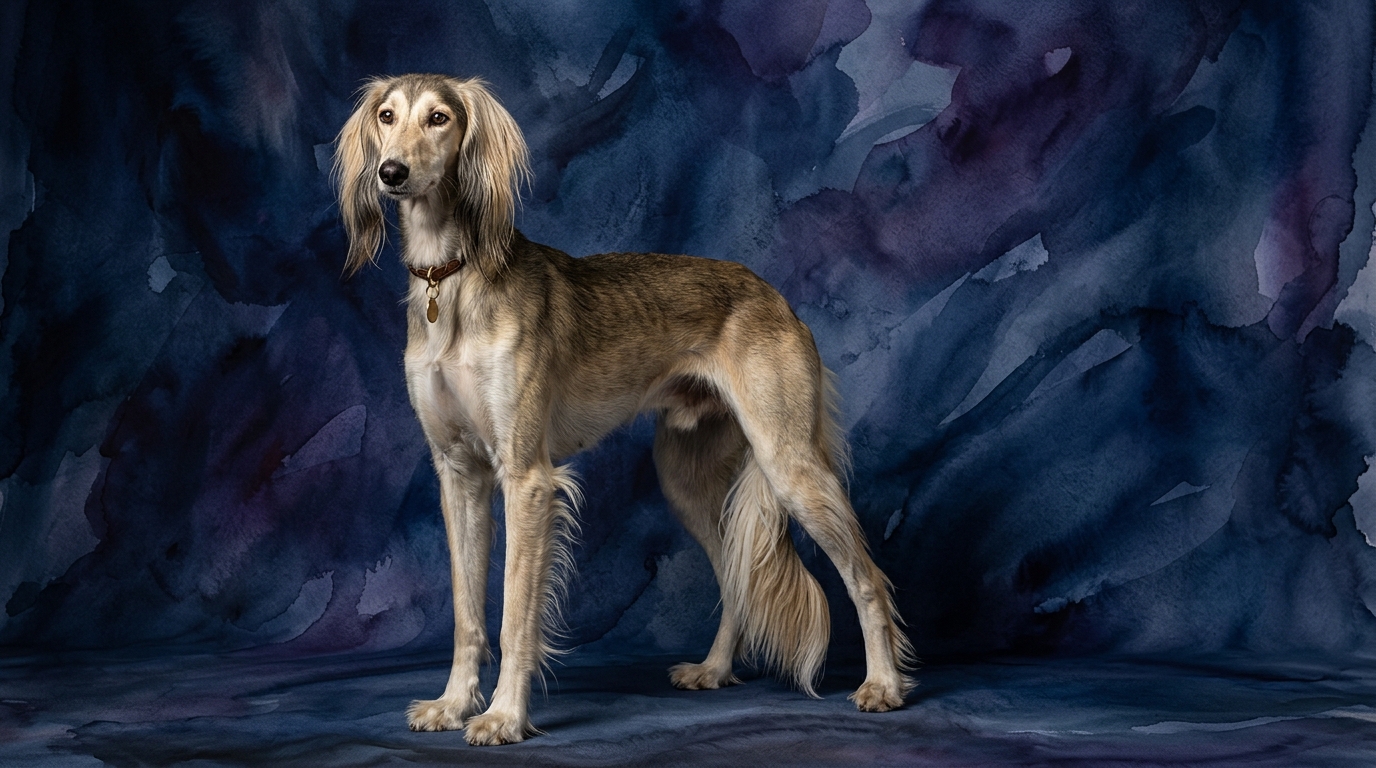
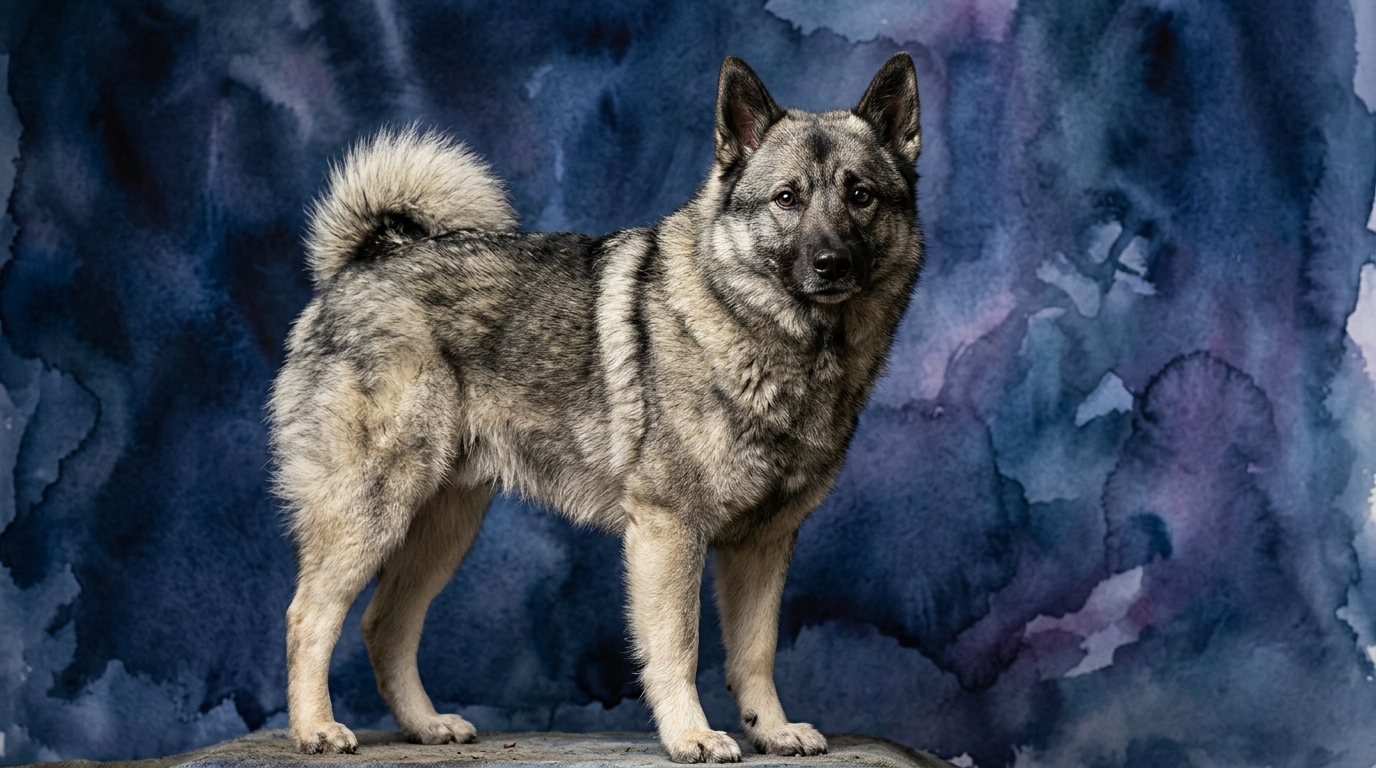
Side-by-Side Cognitive Profiles
At The Cosmic Pet Pet IQ Lab, we evaluate canine intelligence across five key dimensions, providing a granular view of each breed's cognitive strengths. For the Saluki, a breed not ranked on the Coren scale, we observe a profile reflecting its ancient lineage as a sighthound, emphasizing autonomy and swift, independent action. The Norwegian Elkhound, holding a respectable Coren rank of #36, presents a cognitive makeup that speaks to its history as a tenacious hunting partner, valuing collaboration and persistent problem-solving.
The Saluki's Problem Solving score of 3/5 indicates an aptitude for making quick, self-directed decisions, particularly in visually stimulating, open environments. These dogs are not inherently inclined to seek human assistance for every challenge; rather, their cognitive architecture supports independent judgment during the chase. Their Training Speed, also at 3/5, reflects their ability to learn but often on their own terms, requiring trainers to be engaging and persuasive rather than purely directive. Social Intelligence scores 3/5, suggesting they are reserved with strangers but form deep, nuanced bonds with their inner circle, understanding familiar human cues with quiet observation. Their Instinctive Drive, at 3/5, is powerfully geared towards visual pursuit, driven by an ancient impulse to chase what they see. Finally, Saluki Memory, at 3/5, is reliable for routines and learned behaviors, though their independent streak can sometimes make their recall appear selective.
In contrast, the Norwegian Elkhound exhibits a Problem Solving score of 4/5, showcasing a resourceful and clever mind capable of tackling complex environmental puzzles with tenacity. Their historical role demanded independent decision-making in the field, often involving sustained effort to locate and hold game. A Training Speed of 4/5 means Elkhounds are generally eager learners, picking up new commands and routines with efficiency and a desire to engage with their handler. Their Social Intelligence, at 3/5, reveals an affectionate and watchful nature within their family unit, often more outwardly expressive than the Saluki and attuned to human intentions. The Elkhound's Instinctive Drive, also 3/5, is characterized by a strong hunting impulse focused on tracking, baying, and holding prey, requiring both stamina and strategic thinking. Their Memory, scoring 4/5, is robust, allowing them to retain a wide array of commands, learned behaviors, and spatial knowledge over time, facilitating consistent performance.
Where the Saluki Excels Cognitively
The Saluki's cognitive strengths truly shine in scenarios demanding swift, autonomous decision-making without constant human input. Their 3/5 Problem Solving score, while not indicating a proclivity for complex puzzles, speaks to an exceptional capacity for instantaneous threat assessment and tactical maneuvering during a high-speed chase. This isn't about figuring out how to open a treat puzzle; it's about evaluating terrain, predicting prey movement, and adjusting their own trajectory in milliseconds. Their reserved Social Intelligence allows them to remain focused on a task, minimizing distractions from external stimuli, and their independent nature means they are less prone to 'checking in' with a handler when their instincts take over. This self-reliance, honed over centuries, is a distinct cognitive advantage in specific, visually-driven contexts.
Where the Norwegian Elkhound Leads Cognitively
The Norwegian Elkhound's cognitive profile reveals a dog built for persistent, collaborative, and adaptable work. Their 4/5 Problem Solving and 4/5 Memory scores are particularly compelling. Elkhounds excel at tasks requiring sustained mental effort and the application of learned strategies to achieve a goal, such as navigating complex scent trails or figuring out how to access a desired object. This is complemented by their superior Training Speed, which allows them to absorb and implement new instructions efficiently. Their cognitive architecture supports a more structured learning process and a willingness to engage in partnership, making them adept at mastering intricate sequences of commands or solving multi-step challenges. They demonstrate a capacity for focused attention on a task, demonstrating a persistent drive to complete objectives once engaged.
Trainability: A Tale of Two Hounds
When it comes to trainability, the differences between these two breeds become quite pronounced, largely due to their distinct cognitive wiring and historical roles. The Norwegian Elkhound, with its 4/5 Training Speed and 4/5 Memory, generally presents as the more amenable student. Their history as a hunting partner required a dog that could understand and execute commands, often at a distance, and work in concert with a human. This translates to a natural eagerness to learn and a responsiveness to cues, making them generally easier to teach complex behaviors and achieve a high level of obedience. They typically enjoy the process of training and thrive on mental engagement with their handler.
The Saluki, with its 3/5 Training Speed and 3/5 Memory, requires a more nuanced approach. Their independent nature, cultivated through centuries of solitary hunting, means they are not inherently driven to 'please' in the traditional sense. While they are certainly capable of learning, their compliance often hinges on understanding the benefit to themselves, or the enjoyment of the activity itself. Training a Saluki demands patience, creativity, and a reliance on positive reinforcement techniques that make learning a rewarding game. They may learn quickly but choose when to apply that knowledge. Understanding their sighthound instincts and providing appropriate outlets for them, rather than trying to suppress them, is key to successful training.
Matching Canine Cognition to Lifestyle
The cognitive profiles of the Saluki and Norwegian Elkhound also offer insights into which breed might better suit different owner lifestyles. For owners who are relaxed in their approach to dog ownership and seek a low-maintenance companion, neither breed is an ideal fit. Both require significant mental and physical engagement, albeit in different forms. However, the *type* of active owner they suit varies considerably.
The Saluki is a superb companion for active owners who appreciate an independent spirit and can provide ample, safe opportunities for running and expressing their sighthound instincts. These owners understand that a Saluki's cognitive needs are met through bursts of high-speed activity and mental freedom, rather than constant structured tasks. They thrive with owners who respect their reserved nature and find satisfaction in a deeply loyal, yet often self-sufficient, companion. Owners looking for a dog to participate in competitive obedience or highly structured activities might find the Saluki's independent streak challenging.
The Norwegian Elkhound, with its higher scores in Problem Solving, Training Speed, and Memory, is an excellent match for active owners who enjoy structured outdoor activities and mental challenges. These dogs thrive on being given a 'job' and excel in activities like hiking, dog sports, scent work, or even search and rescue. Their cognitive makeup makes them eager partners in adventure, capable of learning complex routes and commands. Owners who are prepared to channel the Elkhound's stamina and intelligence into consistent, engaging activities will find a resilient and rewarding companion. They are less suited for owners who cannot commit to regular mental stimulation and physical exercise.
The Verdict
Choose the Saluki if you admire an independent, graceful companion whose cognitive strengths lie in autonomous, swift decision-making, and you are prepared for a nuanced, patient approach to training.
Opt for the Norwegian Elkhound if you seek a resilient, intelligent partner for active pursuits and enjoy a dog that thrives on collaborative problem-solving and consistent, structured training.
🧠 Find Your Pet's IQ Score
Our Pet IQ Lab assessment covers 25+ tests across 5 cognitive dimensions — personalized to your breed.
Take the Full IQ Test →Frequently Asked Questions
Are Salukis truly untrainable due to their independence?
No, Salukis are not untrainable, but their independent nature requires consistent, positive reinforcement training methods and patience. They respond best when they understand the benefit to themselves, rather than merely seeking to please, making engagement and motivation key.
How does the Elkhound's Coren ranking relate to its daily behavior?
The Elkhound's #36 Coren rank suggests a strong capacity for understanding new commands quickly and obeying known commands reliably. In daily life, this translates to a dog that's generally receptive to learning, responsive to its handler's cues, and capable of performing tasks consistently once trained.
Do either of these breeds make good family pets?
Both breeds can be wonderful family pets, though with different considerations. Salukis are often gentle and quiet indoors, forming strong bonds with their immediate family and being reserved with strangers, while Elkhounds are typically robust, playful, and watchful, thriving on being an integrated and active part of family activities.