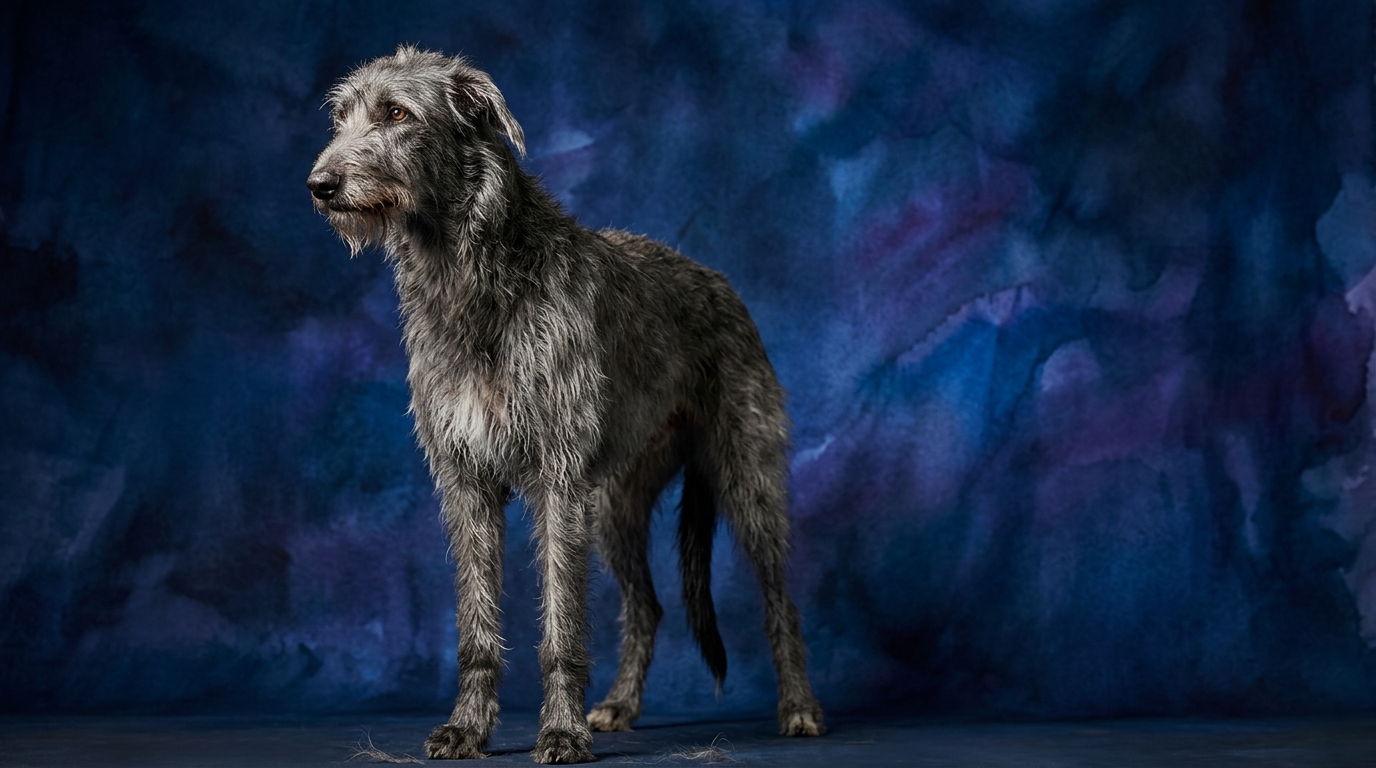
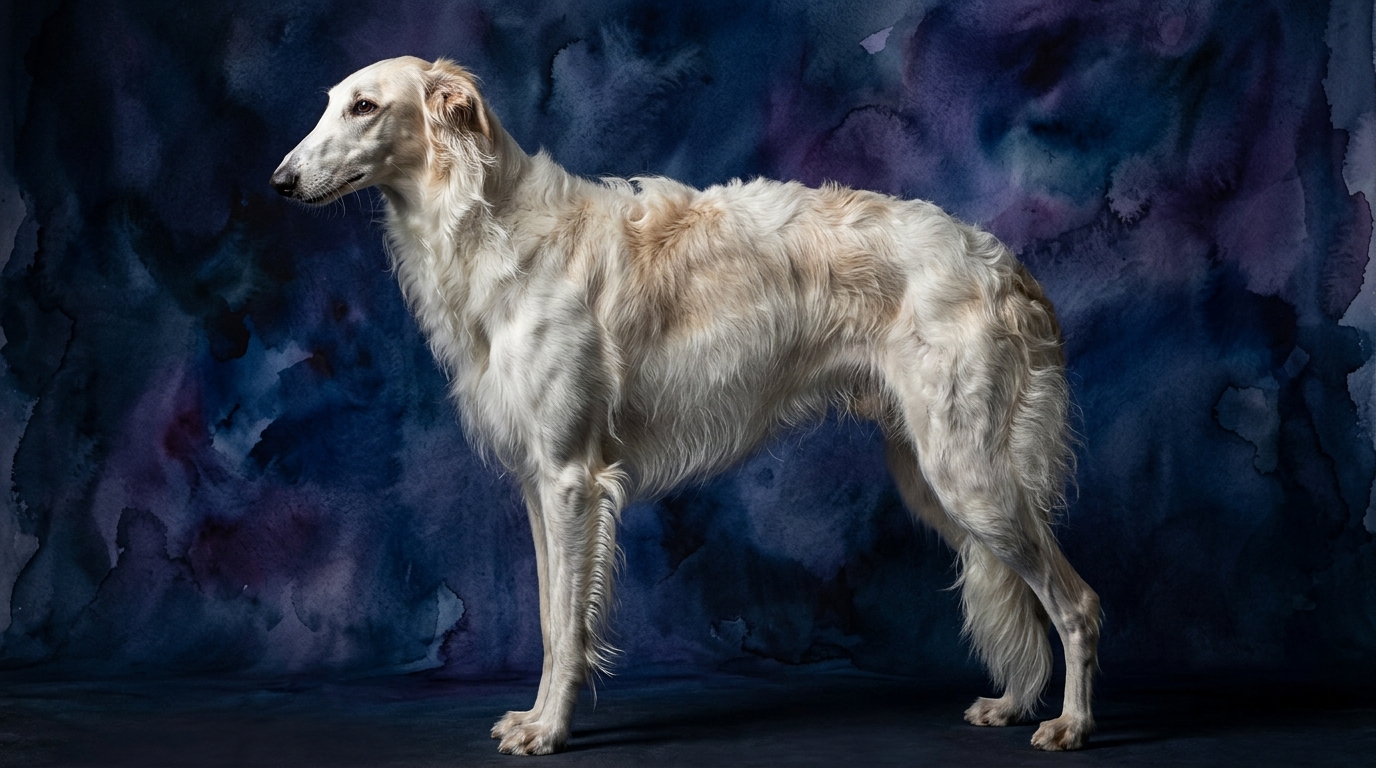
Side-by-Side IQ Profile
The Scottish Deerhound, an ancient Scottish breed historically a courser of red deer, exhibits a 3/5 in Problem Solving, suggesting an average capacity for independent navigation and decision-making over challenging terrain. Its Training Speed, also 3/5, indicates a moderate learning pace requiring patience and consistent, positive reinforcement. Social Intelligence at 3/5 points to an average capacity for understanding social cues, often reserved with strangers but deeply bonded with family. An Instinctive Drive of 3/5 highlights its inherent sighthound prey drive for large game, demanding outlets for coursing impulses. Memory, rated 3/5, suggests average recall of experiences. This breed is not included in the Coren ranking system for working intelligence.
The Borzoi, originating from Russia as a wolf courser, also scores 3/5 in Problem Solving, reflecting its capacity for strategic pursuit, often in pairs, anticipating prey movements across vast open spaces. Its Training Speed, 3/5, means it learns at an average rate, though its independent nature often requires creative, engaging methods. With 3/5 Social Intelligence, the Borzoi typically displays an aristocratic aloofness, forming deep, quiet bonds with its chosen people. Its Instinctive Drive, 3/5, is a powerful, focused burst for chasing dangerous prey like wolves. Memory at 3/5 signifies average retention. Notably, the Borzoi holds a Coren rank of #75, placing it in "Fair Working/Obedience Intelligence," indicating it understands new commands after 40-80 repetitions and obeys the first command approximately 30% of the time.
Where Scottish Deerhound Wins Cognitively
Given identical 3/5 ratings, the Scottish Deerhound’s history as a solo or small-group deer courser in varied, rugged landscapes suggests a subtle advantage in environmental problem-solving and independent navigation. Its 3/5 Problem Solving likely manifests as adaptability in complex, changing terrains, requiring quick, self-reliant decisions during a chase. This isn't about formal obedience, but practical intelligence for its demanding task. Additionally, its "gentle giant" reputation within its family, despite a 3/5 Social Intelligence, could imply a nuanced understanding of household dynamics and quiet empathy, expressing deep affection and awareness of family emotions without overt demonstration. This represents a specific facet of its social cognition.
Where Borzoi Wins Cognitively
The Borzoi, despite sharing identical 3/5 scores, presents a distinct cognitive edge from its role as a wolf courser. Its 3/5 Problem Solving, in this context, implies strategic intelligence focused on anticipating and outmaneuvering dangerous prey in open fields, often coordinating with other Borzoi. This suggests a specific situational awareness and predictive ability. Crucially, the Borzoi's Coren rank of #75 provides a quantifiable baseline for formal obedience, which the unranked Deerhound lacks in this specific metric. This indicates a measurable, albeit slow, capacity to comprehend and respond to human directives, suggesting a slightly more direct path to structured command understanding. Its 3/5 Instinctive Drive might also manifest as a more explosive, focused burst of determination when triggered, honed by confronting formidable prey.
Which Is Easier to Train and Why
Both Scottish Deerhound and Borzoi, with identical 3/5 Training Speed scores, are independent sighthounds, bred for autonomous decision-making rather than strict obedience. Their average learning pace means patience, consistency, and positive reinforcement are paramount. The Borzoi's Coren rank of #75 provides a tangible, though modest, expectation: they will learn commands, but require many repetitions and exhibit low first-command reliability. This highlights that their primary motivation isn't handler appeasement. Training a Borzoi benefits from short, engaging sessions and a strong appreciation for their independent spirit. The unranked Scottish Deerhound shares this sighthound independence. Its training approach is similarly focused on positive reinforcement and making learning feel like a game. Neither breed is 'easy' in the traditional sense; both demand trainers who value their intelligence in observation and independent action, understanding that their 3/5 Instinctive Drive needs constructive outlets like lure coursing. Both require a nuanced, patient approach due to their shared temperament and average training speed.
Which Suits Active Owners vs Relaxed Owners
For both Scottish Deerhound and Borzoi, 'active' ownership means providing appropriate outlets for their unique physical and cognitive needs, rather than constant high-impact exercise. These '45 mph couch potatoes' are calm indoors but require significant daily exercise. A Scottish Deerhound, with its 3/5 Instinctive Drive for stamina, needs regular, long runs in securely fenced areas. Its 3/5 Problem Solving benefits from exploring new routes or scent games. They suit owners who appreciate a calm indoor companion but commit to daily, vigorous outdoor activity. The Borzoi, with its 3/5 Instinctive Drive for explosive speed, also requires daily opportunities to run and chase in large, secure spaces. Their 3/5 Social Intelligence can make them more aloof, appreciating owners who respect their personal space while ensuring consistent interaction. For both, 'relaxed owners' doesn't mean sedentary; it means understanding their need for focused exercise sessions followed by ample downtime. Owners who prioritize safe, expansive running and appreciate an intelligent, comfort-loving companion once exercised are ideal.
The Verdict
Choose a Scottish Deerhound if you appreciate a gentle, deeply bonded companion who thrives on independent outdoor exploration and quiet companionship indoors.
Opt for a Borzoi if you are drawn to an aristocratic, somewhat aloof sighthound that offers measured affection and requires specific outlets for its explosive coursing drive.
🧠 Find Your Pet's IQ Score
Our Pet IQ Lab assessment covers 25+ tests across 5 cognitive dimensions — personalized to your breed.
Take the Full IQ Test →Frequently Asked Questions
Do Scottish Deerhounds and Borzoi get along with other pets?
Both breeds possess a 3/5 Instinctive Drive, meaning a strong prey drive. While they can coexist with other household pets, especially if raised together, careful supervision and management are essential, particularly with smaller animals.
Are these sighthounds good with children?
With a 3/5 Social Intelligence, both breeds can be gentle and tolerant with respectful children, especially those they are raised with. However, due to their large size and independent nature, supervision is always recommended, and they may prefer quieter interactions.
How much exercise do a Scottish Deerhound and a Borzoi need daily?
Both breeds, despite their calm indoor demeanor, require significant daily exercise, primarily opportunities for powerful, off-leash running in a securely fenced area to satisfy their 3/5 Instinctive Drive. This is typically followed by long periods of rest.