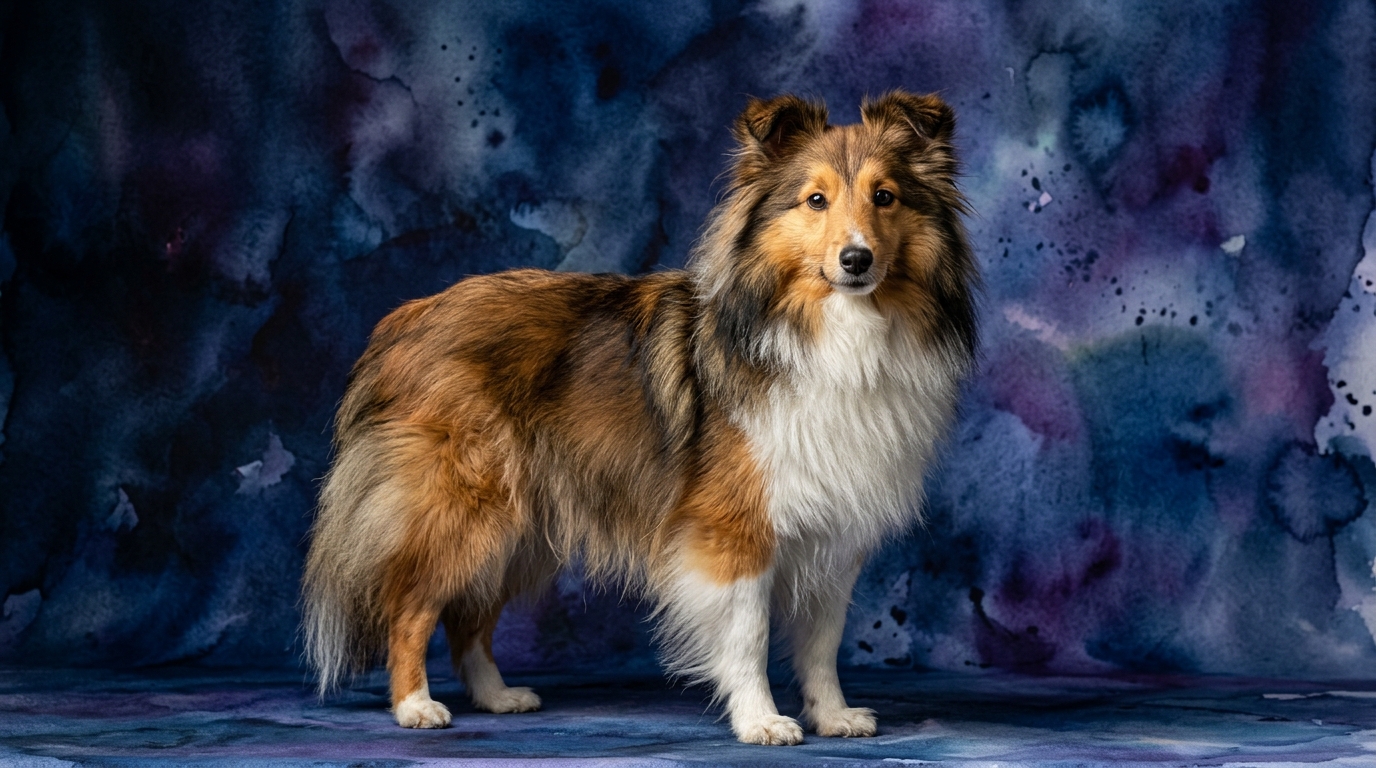

Side-by-Side IQ Profile: Sheltie vs. Russian Toy
The Cosmic Pet Pet IQ Lab employs a five-dimensional framework to assess canine cognitive abilities, offering a nuanced view beyond simplistic labels. Let's delve into how the Shetland Sheepdog and the Russian Toy measure up across these specific dimensions.
The Shetland Sheepdog, a breed originally developed for herding, demonstrates a robust cognitive profile, reflecting its working heritage. Its Problem Solving is rated at 4/5, indicating a strong capacity to analyze situations, adapt strategies, and independently figure out solutions, whether it's navigating a complex agility course or understanding how to manipulate objects to achieve a goal. Training Speed for the Sheltie is an exceptional 5/5; these dogs grasp new commands and routines with remarkable rapidity, often requiring only a few repetitions to solidify a behavior. Their Social Intelligence scores 4/5, reflecting an acute awareness of human emotions and social dynamics within their family unit, though they can be reserved with strangers. Instinctive Drive is a powerful 5/5, manifesting as an intense desire to herd, chase, and work alongside their human partners. Finally, their Memory is rated 5/5, allowing them to retain vast amounts of information, from complex command sequences to the location of specific items, over extended periods.
In contrast, the Russian Toy, primarily bred for companionship, presents a different set of cognitive strengths. Its Problem Solving is rated 3/5, meaning it can learn to navigate familiar environments and solve basic challenges, but may not excel at abstract puzzles or require extensive independent problem-solving in daily life. Training Speed for the Russian Toy is 3/5; they are certainly trainable and capable of mastering a wide range of commands, but they typically require more consistent repetition and patience than a Sheltie to achieve fluency. Their Social Intelligence is also 3/5; they form deep, attentive bonds with their primary caregivers and are sensitive to their moods, though they can be quite selective and sometimes wary of unfamiliar people or animals. Instinctive Drive is rated 3/5, indicating a moderate prey drive for small toys and an alert nature, but without the intense, focused working impulse seen in herding breeds. Their Memory scores 3/5, sufficient for retaining routines and basic commands, yet perhaps less expansive than a Sheltie's for complex, multi-layered information or long-term recall of intricate sequences.
Where the Shetland Sheepdog Excels Cognitively
The Shetland Sheepdog's cognitive strengths are profoundly rooted in its herding background, making it particularly adept at tasks requiring independent thought and rapid execution. With a Coren rank of #6, they possess an exceptional ability to generalize learning, meaning a concept learned in one context can be applied to a new, similar situation without extensive re-training. This manifests as a dog that can quickly understand new rules or adapt to changes in a routine. Their superior problem-solving (4/5) combined with a powerful instinctive drive (5/5) means they don't just follow instructions; they proactively engage with their environment, making decisions on the fly to achieve goals, like strategically blocking an escape route for imaginary sheep or figuring out how to open a stubborn cabinet. Their memory (5/5) further enhances this, allowing them to build a complex mental map of their world and recall intricate sequences of actions or commands with precision, making them formidable competitors in dog sports like agility or obedience.
Cognitive Strengths of the Russian Toy
While the Russian Toy's cognitive profile differs from the Sheltie's, it shines in areas tailored to its role as a dedicated companion. Their strengths lie in their focused social intelligence (3/5) geared towards intimate human connection. They excel at reading the subtle cues of their primary caregivers, anticipating needs for cuddles or play, and thriving on direct, affectionate interaction. This intense focus on their human's well-being is a form of cognitive specialization, making them incredibly attuned to their family's emotional landscape. Their moderate instinctive drive (3/5) means they are less compelled to engage in complex, independent tasks, which can be a significant benefit for owners not seeking a working partner. Instead, their cognitive resources are largely directed towards forming strong, reciprocal bonds, making them masters of companionship and providing consistent emotional support within a home environment. They are content with simpler mental engagement, finding satisfaction in shared activities rather than constantly seeking challenging puzzles.
Training Ease: A Tale of Two Temperaments
When it comes to ease of training, the Shetland Sheepdog generally presents a smoother path for owners. Their exceptional training speed (5/5) means they absorb new commands and behaviors with remarkable efficiency, often understanding the expectation after just a few repetitions. This is bolstered by their high memory (5/5) and strong instinctive drive (5/5), which often includes a keen desire to please and engage in structured activities with their handler. Shelties frequently enjoy the process of learning and actively seek out opportunities for mental engagement, making them highly responsive to positive reinforcement and eager to participate in advanced obedience or trick training. Owners will find that a Sheltie often requires less effort to maintain learned behaviors and can quickly progress through various levels of training.
The Russian Toy, with a training speed of 3/5, requires a different approach. They are certainly capable of learning and becoming well-mannered companions, but they typically demand more patience, consistency, and creative motivation from their trainers. Their focus on human companionship means that training is most effective when it strengthens the bond and is perceived as an enjoyable shared activity, rather than a demanding task. Owners might find that Russian Toys respond best to short, frequent training sessions infused with ample praise and high-value rewards. While they may not pick up complex sequences as rapidly as a Sheltie, their devotion to their family ensures that with consistent effort, they can master essential commands and integrate seamlessly into a household. The key is understanding their desire for connection and leveraging that to build a positive learning experience.
Matching Breeds to Lifestyles: Active vs. Relaxed Owners
The cognitive profiles of these two breeds offer clear guidance for matching them with suitable owner lifestyles. The Shetland Sheepdog is an ideal companion for active owners who thrive on engagement and mental stimulation. Their high problem-solving, instinctive drive, and memory mean they require consistent mental challenges to prevent boredom and potential frustration. Owners who enjoy dog sports like agility, obedience, rally, or even herding trials will find a Sheltie to be an enthusiastic and capable partner. They flourish with regular training sessions, puzzle toys, and opportunities to use their natural herding instincts, even if it's just 'herding' family members or toys. A Sheltie needs an owner who is prepared to invest time in their cognitive well-being, providing structure and a variety of enriching activities.
Conversely, the Russian Toy is a superb fit for more relaxed owners who prioritize intimate companionship and a less demanding daily routine. While they still benefit from basic training and playtime, their lower scores in instinctive drive and problem-solving suggest they are not inherently driven to seek out complex mental tasks. They are content with consistent affection, moderate daily walks, and interactive play sessions that strengthen their bond with their human. Owners who appreciate a devoted lap dog, a constant shadow, and a companion whose greatest joy is simply being with them will find the Russian Toy incredibly fulfilling. They adapt well to apartment living and do not require extensive outdoor adventures, making them suitable for individuals or families with a quieter pace of life, provided they still receive ample social interaction and mental stimulation through play and gentle training.
The Verdict
Choose the Shetland Sheepdog if you seek a highly trainable, cognitively driven partner for advanced training, dog sports, and a life filled with mental challenges and activity.
Opt for the Russian Toy if you desire a devoted, affectionate companion who thrives on close human interaction and a more relaxed lifestyle, appreciating simpler forms of mental engagement.
🧠 Find Your Pet's IQ Score
Our Pet IQ Lab assessment covers 25+ tests across 5 cognitive dimensions — personalized to your breed.
Take the Full IQ Test →Frequently Asked Questions
Are Russian Toys difficult to train due to their lower IQ scores?
No, Russian Toys are not difficult to train; they are simply trained differently than a Sheltie. Their training speed is moderate, meaning they require more patience and consistency, but they are eager to please their loved ones and respond well to positive reinforcement and bond-building training methods.
Do Shetland Sheepdogs make good family pets, given their strong instinctive drive?
Shetland Sheepdogs can make wonderful family pets, especially for active families willing to engage their minds and bodies. Their herding drive needs appropriate outlets, and early socialization is key, but their social intelligence and memory help them integrate well into a structured family environment.
Which breed is better for apartment living?
The Russian Toy is generally better suited for apartment living due to its small size and lower overall demand for extensive outdoor activity and complex mental tasks. A Shetland Sheepdog can adapt to an apartment, but only if its owners are committed to providing significant daily mental stimulation and physical exercise outside the home.