
Side-by-Side IQ Profile: Staffordshire Bull Terrier vs. Norwegian Elkhound
The Cosmic Pet Pet IQ Lab provides a detailed framework for understanding the cognitive architecture of our canine companions. For the Staffordshire Bull Terrier, we observe a balanced, robust profile reflecting its terrier lineage. Its Problem Solving is rated 3/5, indicating a moderate capacity for navigating novel challenges, often relying on physical prowess and determination rather than complex strategizing, adopting a direct and persistent approach. Training Speed is also 3/5; while eager to please, their independent streak means consistent positive reinforcement is crucial for solidifying learned behaviors. Social Intelligence stands at 3/5, meaning they possess a moderate understanding of social cues, with interactions often driven by their affectionate yet boisterous personality, necessitating careful socialization for nuanced responses. Their Instinctive Drive is 3/5, reflecting a moderate prey drive and inclination towards vigorous physical activity like chasing and digging. Finally, Memory is 3/5, showing moderate retention of experiences and commands, though less frequently practiced skills might require occasional refreshers.
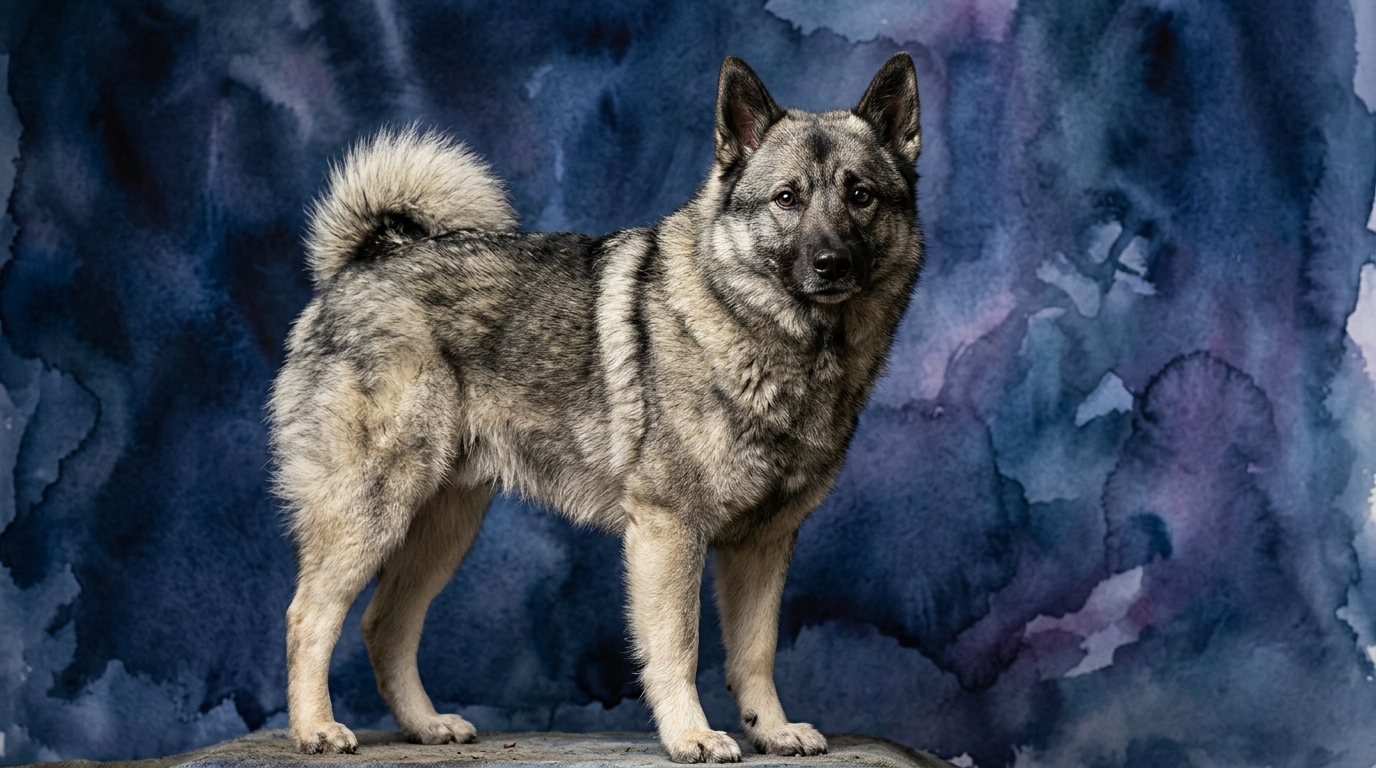
In contrast, the Norwegian Elkhound, with its Coren rank of #36, presents a cognitive profile geared towards independent work and sustained focus. Its Problem Solving is rated 4/5, indicating a strong aptitude for figuring out complex situations and adapting strategies, a trait honed by its historical role in tracking large game. Training Speed is 4/5; these dogs absorb new commands and routines quickly, demonstrating a ready willingness to learn, though their independent hound nature can sometimes present a unique challenge to engagement. Social Intelligence is 3/5, similar to the Staffy, meaning they show a moderate level of social understanding, often reserved with strangers but possessing a distinct sense of their place within a social structure, frequently communicating vocally. Instinctive Drive is 3/5, a moderate drive influenced by their hunting heritage, manifesting as a keen sense of smell and robust endurance, yet generally manageable prey drive. Significantly, Memory is 4/5, allowing them to retain learned behaviors, commands, and complex routes over long periods, greatly aiding in training and daily life.
Where the Staffordshire Bull Terrier Wins Cognitively
While the Elkhound might show higher raw cognitive scores in certain dimensions, the Staffordshire Bull Terrier often demonstrates a unique cognitive strength rooted in its unwavering determination and physical resilience, which can sometimes provide a practical advantage. Their 'never give up' attitude means they will relentlessly pursue a goal, even if it requires brute force or repeated attempts rather than elegant strategizing. This tenacity, a cognitive trait in itself, allows them to overcome physical obstacles or persist through challenging training exercises where a dog with a higher problem-solving score but less grit might disengage. For instance, in a task requiring sustained effort to manipulate a stubborn toy or navigate a physically demanding agility course, the Staffy's sheer will to succeed can outshine a dog that might analyze the situation more but give up quicker due to frustration or lack of physical drive. Furthermore, their robust social engagement, while rated 3/5, is often characterized by an intense focus on their immediate human family, which, in a specific social context, can translate to a highly tuned responsiveness to their beloved owner’s emotional state. This deep connection fosters a profound, albeit specific, bond and responsiveness within their chosen pack, a unique form of social cognition focused on their primary human companions.
Where the Norwegian Elkhound Wins Cognitively
The Norwegian Elkhound distinctly excels in areas requiring independent thought and sustained recall, reflecting its heritage as a big-game hunter. Their superior problem-solving (4/5) means they are adept at navigating complex environments and figuring out solutions without constant human intervention. For example, an Elkhound might more readily devise a method to open a tricky gate or find its way back home through an unfamiliar path by analyzing its surroundings and remembering past experiences, whereas a Staffy might rely more on direct trial-and-error. Their strong memory (4/5) is a significant cognitive advantage, allowing them to retain intricate scent trails, complex command sequences, and the layout of vast territories over extended periods. This makes them exceptional at tasks requiring long-term retention, such as advanced obedience routines, tracking sports, or remembering specific hiding spots for toys. Furthermore, their quicker training speed (4/5) isn't just about absorbing commands; it's linked to their observational learning and their capacity to generalize concepts across different situations, indicating a more flexible and adaptive cognitive framework than the Staffy's more direct approach. This allows them to quickly grasp the underlying principles of a task, making subsequent learning faster and more efficient across various contexts.
Which is Easier to Train and Why
Based on The Cosmic Pet Pet IQ Lab scores, the Norwegian Elkhound generally presents as the easier dog to train, primarily due to its higher scores in both Training Speed (4/5) and Memory (4/5), coupled with superior Problem Solving (4/5). Elkhounds tend to absorb new commands and routines more rapidly and retain them for longer, meaning fewer repetitions are needed and learned behaviors are more durable. Their innate capacity for independent decision-making, honed by centuries of hunting, translates into a dog that can process information efficiently and apply learned rules to new contexts. For instance, an Elkhound taught to 'stay' will likely generalize this command to various situations more quickly and reliably than a Staffy, demonstrating a more fluid understanding of the command's application. Their keen observational skills also contribute to faster learning, as they can often pick up cues from their environment and handler with minimal direct instruction, making the overall training process more streamlined and less labor-intensive.
The Staffordshire Bull Terrier, with scores of 3/5 across the board, requires a more patient and consistent approach. While eager to please, their moderate training speed and memory mean that new skills take longer to ingrain and may need more frequent reinforcement to prevent them from fading. Their strong, often physical, drive and occasional stubbornness can make initial training phases more challenging, as they might prioritize their immediate impulses over a learned command. For example, getting a Staffy to reliably recall when engrossed in a scent or play can be a more significant undertaking than with an Elkhound, which might be more attuned to its handler's directives and less prone to distraction by environmental stimuli. While Staffies are certainly trainable, their learning curve demands a dedicated owner who understands the value of repetition and positive reinforcement to consistently reinforce desired behaviors, making the Elkhound generally more amenable to diverse training regimens and faster skill acquisition.
Which Suits Active Owners vs. Relaxed Owners
Both breeds possess a robust physical nature, but their cognitive profiles and historical roles suggest different types of 'activity' and owner engagement. The Norwegian Elkhound, with its strong problem-solving, training speed, and memory, thrives with active owners who can provide mentally stimulating activities alongside physical exercise. These dogs benefit immensely from activities like scent work, advanced obedience, agility, or hiking where they can utilize their keen intellect and endurance. A relaxed owner who can't provide this mental engagement might find an Elkhound becoming bored and potentially developing undesirable behaviors, as their higher cognitive capacity needs an outlet. They are not content with just a walk around the block; they need to be challenged to think and work, making them ideal for owners who enjoy an intellectually engaging partnership.
The Staffordshire Bull Terrier, while also requiring regular exercise to manage its physical drive, might be a slightly better fit for active owners who prioritize companionship and physical play over highly complex mental tasks. Their moderate problem-solving and training speed mean they enjoy games of fetch, vigorous tug-of-war, or long walks, but might not demand the same level of intricate mental challenges as an Elkhound. For an active owner who loves engaging in physical activities and wants a devoted, tenacious companion to share those experiences, the Staffy excels, forming a deep emotional bond that drives much of their responsiveness. While both breeds require consistent activity, the Elkhound demands significant intellectual engagement, whereas the Staffy thrives on consistent physical interaction and profound emotional connection with its primary human. A truly relaxed owner, however, might struggle with either breed's exercise needs, but the Elkhound's pronounced need for mental stimulation makes it less suited for a purely sedentary lifestyle.
The Verdict
If you seek a devoted, physically robust companion for active play and deep emotional connection, and you are prepared for consistent, patient training to navigate their moderate learning curve and independent spirit, the Staffy could be your ideal match.
If you desire a cognitively agile, independent thinker for activities like tracking, advanced obedience, or hiking, and you are ready to provide ample mental stimulation alongside physical exercise, the Elkhound will thrive in your home.
🧠 Find Your Pet's IQ Score
Our Pet IQ Lab assessment covers 25+ tests across 5 cognitive dimensions — personalized to your breed.
Take the Full IQ Test →Frequently Asked Questions
Do Staffordshire Bull Terriers have a strong prey drive?
Yes, Staffies have a moderate instinctive drive, which includes a prey drive stemming from their terrier heritage. This means they might be inclined to chase small animals, so secure leashing and recall training are essential, especially in unfenced areas.
Are Norwegian Elkhounds good with children?
Norwegian Elkhounds are generally good with children, displaying a patient and tolerant nature, especially if raised with them. However, their moderate social intelligence means early socialization and supervision are always recommended, as with any breed interacting with young children.
What kind of mental stimulation do Elkhounds need?
Elkhounds thrive on mental challenges that engage their problem-solving and memory skills. Activities like puzzle toys, scent work, advanced obedience training, agility, or even learning complex tricks are excellent ways to satisfy their need for cognitive engagement.
Is a Staffy a good first dog for someone new to dog ownership?
A Staffordshire Bull Terrier can be a good first dog for an owner committed to consistent training, early socialization, and providing ample physical activity. Their devotion and moderate cognitive scores mean they are trainable, but their independent streak requires dedication from a new owner.
How do Elkhounds communicate their needs?
Norwegian Elkhounds are known for being quite vocal, often using a distinct 'bay' or 'yodel' to express themselves. They also communicate through body language and can be quite expressive with their eyes and tail, indicating their moods and desires to attentive owners.