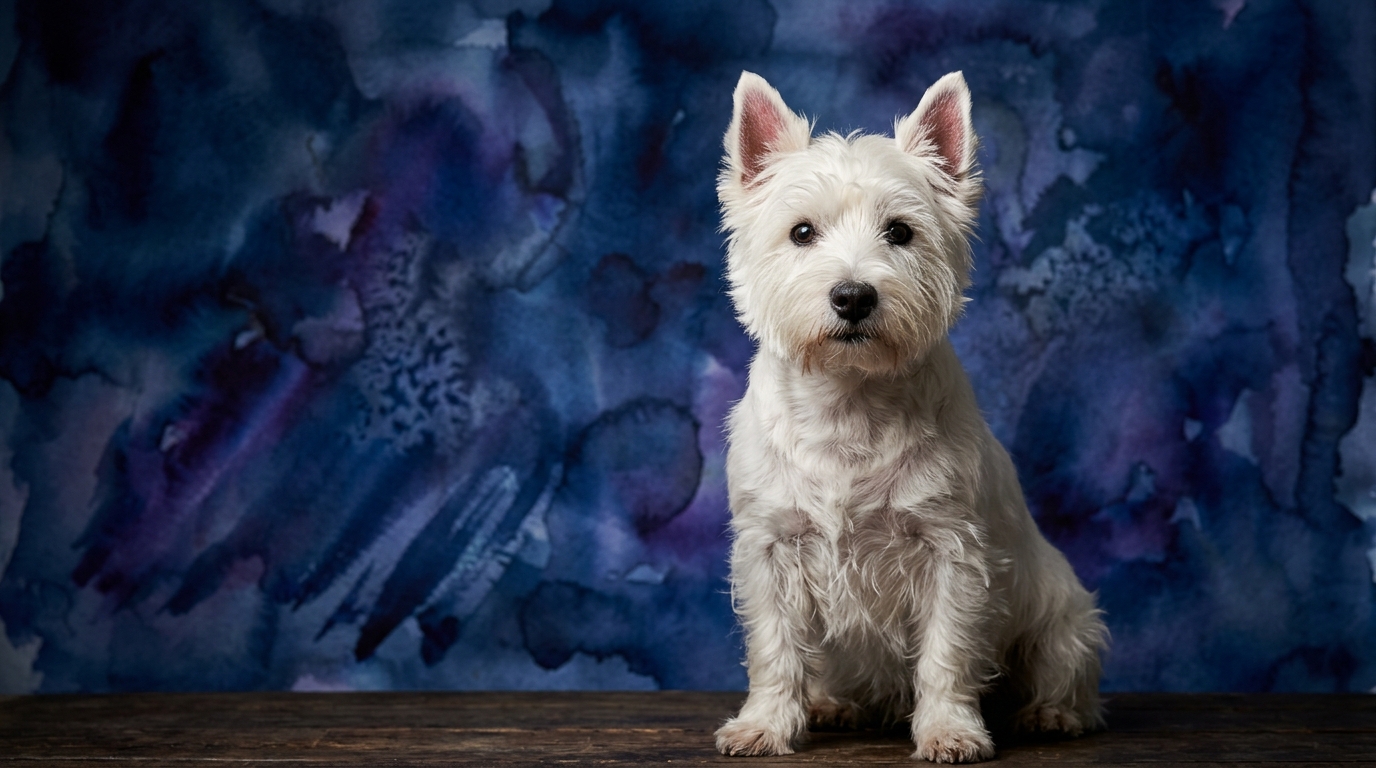
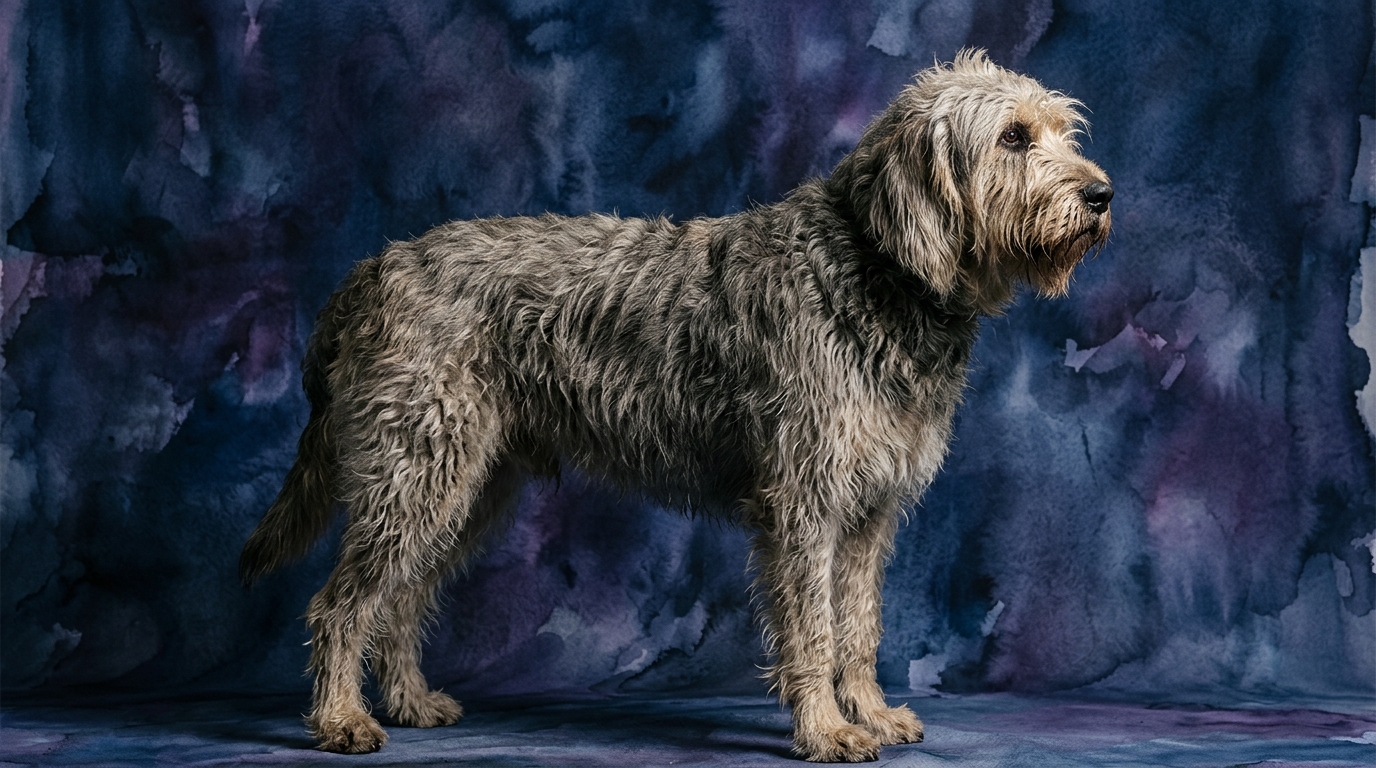
Side-by-Side IQ Profile: Westie vs. Otterhound
The Cosmic Pet Pet IQ Lab employs a five-dimensional approach to assess canine cognition, offering a nuanced view beyond simple obedience. For the West Highland White Terrier, we observe a Coren rank of #47, placing it within the average working/obedience intelligence group, suggesting a respectable capacity for understanding and executing commands. The Otterhound, while not Coren-ranked, presents a distinct profile shaped by its ancient purpose.
Both breeds register a 'Problem Solving' score of 3/5. For the Westie, this often manifests as clever resourcefulness in navigating its immediate environment, whether figuring out how to get a dropped toy from under furniture or devising ways to gain attention. Its terrier heritage predisposes it to independent thought in pursuit of its goals. The Otterhound's 3/5 in this dimension typically reflects its methodical, persistent approach to tracking, systematically working through scent puzzles rather than impulsive diversions.
In 'Training Speed,' both breeds receive a 3/5. The Westie's moderate score here indicates it can learn new commands at a steady pace, provided the trainer understands its independent nature and employs engaging, positive reinforcement methods; rote repetition might bore it. The Otterhound's 3/5 suggests it also learns steadily, but its strong primary drive for scent work often means that other tasks might take a back seat in its motivation, requiring patient, consistent training that respects its inherent focus.
Regarding 'Social Intelligence,' both breeds are rated 3/5. The Westie often exhibits a confident, sometimes assertive, social demeanor, capable of forming strong bonds with its human family and interacting with others, though it may have a discerning nature with strangers or other dogs. The Otterhound, a breed historically accustomed to working in packs, tends to be genial and tolerant, displaying a cooperative intelligence when interacting with its human companions and often showing a friendly disposition towards other canines and people.
Their 'Instinctive Drive' also stands at 3/5 for both. For the Westie, this score reflects its strong prey drive, propensity for digging, and vocal nature, all deeply ingrained behaviors from its vermin-hunting past. These drives are powerful motivators and require appropriate outlets. The Otterhound's 3/5 is overwhelmingly dominated by its profound olfactory instincts; its drive to follow a scent trail is almost unparalleled, guiding much of its behavior and interaction with the world.
Finally, 'Memory' presents the most significant difference. The West Highland White Terrier scores 4/5, indicating a good capacity for retaining learned behaviors, commands, and routines over time. This contributes to its ability to be a well-mannered companion with consistent reinforcement. The Otterhound, with a 3/5 for 'Memory,' retains information adequately, but its recall of specific commands might be more susceptible to distraction by an enticing scent, suggesting a memory that is highly functional within its primary hunting context but less generalizable for diverse obedience tasks.
Where the West Highland White Terrier Wins Cognitively
The West Highland White Terrier's cognitive advantage primarily lies in its superior 'Memory' score of 4/5, which directly translates to more reliable retention of commands and routines compared to the Otterhound's 3/5. This enhanced memory contributes to its Coren rank of #47, signifying a breed that generally grasps and remembers new instructions more readily within a domestic setting.
A Westie's sharper recall means it can often achieve a higher level of precision in obedience tasks and maintain consistent behavior over time with less refresher training. For an owner, this translates to a companion who is generally quicker to solidify good habits and remember boundaries, making day-to-day interactions more predictable and manageable. While both breeds show similar problem-solving abilities, the Westie's better memory often allows it to apply past solutions more consistently to new, similar challenges.
Furthermore, the Westie's independent problem-solving, though rated equally at 3/5, often manifests in a more adaptable way for varied domestic scenarios. Its terrier ingenuity, combined with its memory, allows it to learn and remember complex sequences or rules within a household, such as navigating puzzle toys or understanding nuanced household routines, with a slightly more robust retention than its Otterhound counterpart.
Where the Otterhound Wins Cognitively
While the Otterhound's raw scores might not show a numerical advantage in most categories, its cognitive strengths are deeply specialized and highly effective within its intended purpose. Its 'Instinctive Drive' of 3/5, though numerically equal, is singularly focused on scent work, representing an unparalleled olfactory processing ability that arguably surpasses the Westie's more generalized drives.
The Otterhound's methodical 'Problem Solving' (3/5) shines brightest when confronted with complex scent trails. This isn't about quick, agile solutions like a terrier might employ, but rather a persistent, systematic unraveling of a scent puzzle over long distances and varied terrains. Its cognitive process here involves deep focus, endurance, and a sophisticated interpretation of olfactory data that is a hallmark of true scent hounds.
Moreover, the Otterhound's 'Social Intelligence' (3/5), while matching the Westie's score, is often geared towards cooperative pack dynamics. This translates to a dog that can be remarkably tolerant and amiable, capable of working in harmony with others (both canine and human) on a shared task, a trait less pronounced in the typically more individualistic terrier. Its genial nature and desire for companionship, while not a numerical win in a single category, represents a distinct cognitive and temperamental advantage for certain social environments.
Which is Easier to Train and Why
When considering overall ease of training, the West Highland White Terrier generally holds a slight edge, primarily due to its superior 'Memory' score of 4/5 compared to the Otterhound's 3/5. This enhanced memory means a Westie is more likely to retain commands and learned behaviors consistently over time, making the reinforcement process more efficient. While its 'Training Speed' is 3/5, its ability to recall past lessons helps solidify training faster, provided the trainer can engage its independent terrier spirit.
However, the Westie's 'Instinctive Drive' (3/5) includes a strong independent streak and a propensity for digging and barking, which can present training challenges if not properly channeled. These behaviors require consistent, firm, but positive guidance to redirect their natural inclinations towards acceptable outlets. A Westie will test boundaries and requires a trainer who appreciates its cleverness and can make learning a rewarding game.
The Otterhound, with its 3/5 in both 'Training Speed' and 'Memory,' coupled with a powerful, all-consuming 'Instinctive Drive' for scent, can be more challenging for general obedience training. Its nose often dictates its attention, making it easily distracted from commands if an interesting scent is present. Training an Otterhound requires immense patience, creativity, and a willingness to incorporate scent work into its learning to keep it engaged. While amiable, its focus can be singularly directed, making 'come' commands difficult if it's on a trail.
Which Suits Active Owners vs. Relaxed Owners
The West Highland White Terrier, while small, is far from a sedentary companion and generally suits moderately active owners. Its 'Instinctive Drive' (3/5) demands regular mental and physical engagement; these aren't lap dogs content with minimal activity. Owners who enjoy daily walks, interactive play sessions, and perhaps some agility or earthdog trials will find a Westie a delightful, spirited partner. Their problem-solving minds (3/5) thrive on novelty and challenge, making them unsuitable for entirely relaxed lifestyles where mental stimulation is scarce.
Conversely, the Otterhound, despite its large size, can surprisingly suit owners with a more relaxed daily routine, provided their definition of 'relaxed' includes ample opportunity for scent-driven exploration. Its 'Instinctive Drive' (3/5) demands long, meandering walks where it can follow its nose, but it's not typically a high-energy, constantly-on-the-go breed in the same way a Border Collie might be. After a good sniff-ari, an Otterhound is often quite content to lounge, making it suitable for owners who appreciate a laid-back home life but are dedicated to providing specific, quality outdoor time for scenting.
For truly relaxed owners seeking a low-maintenance exercise routine, neither breed is ideal. The Westie needs consistent engagement to prevent boredom and destructive behaviors, while the Otterhound, though calm indoors, requires significant outdoor time to satisfy its profound olfactory needs. An active owner who enjoys varied activities might lean towards the Westie's versatility, whereas an owner who appreciates long, exploratory walks and a calm home presence might find the Otterhound a better fit.
The Verdict: When to Choose Each Breed
The Verdict
Choose the West Highland White Terrier if you desire a clever, independent companion with a reliable memory for training, who thrives on consistent engagement, varied activities, and can adapt well to different domestic routines.
Opt for the Otterhound if you value a genial, cooperative companion with an unparalleled scenting ability, and you are prepared for long, exploratory walks and a patient, consistent approach to training that respects its deep instinctive drives.
🧠 Find Your Pet's IQ Score
Our Pet IQ Lab assessment covers 25+ tests across 5 cognitive dimensions — personalized to your breed.
Take the Full IQ Test →Frequently Asked Questions
Are West Highland White Terriers easy to house train?
With their 4/5 memory and moderate training speed, Westies are generally receptive to house training. Consistency, positive reinforcement, and a regular schedule are key to establishing good habits and leveraging their ability to remember routines effectively.
How much exercise does an Otterhound need daily?
Otterhounds require significant daily exercise, not necessarily high-intensity, but certainly ample time for exploratory walks. Their powerful instinctive drive means they need opportunities to follow scent trails, which can translate to one to two hours of dedicated outdoor time, allowing them to engage their nose and body at a moderate pace.
Can Westies and Otterhounds live together in harmony?
Yes, with proper introductions and socialization, a Westie and an Otterhound can coexist. The Westie's confident nature and the Otterhound's generally amiable disposition can complement each other, though supervision during initial interactions is always recommended to ensure a smooth integration.