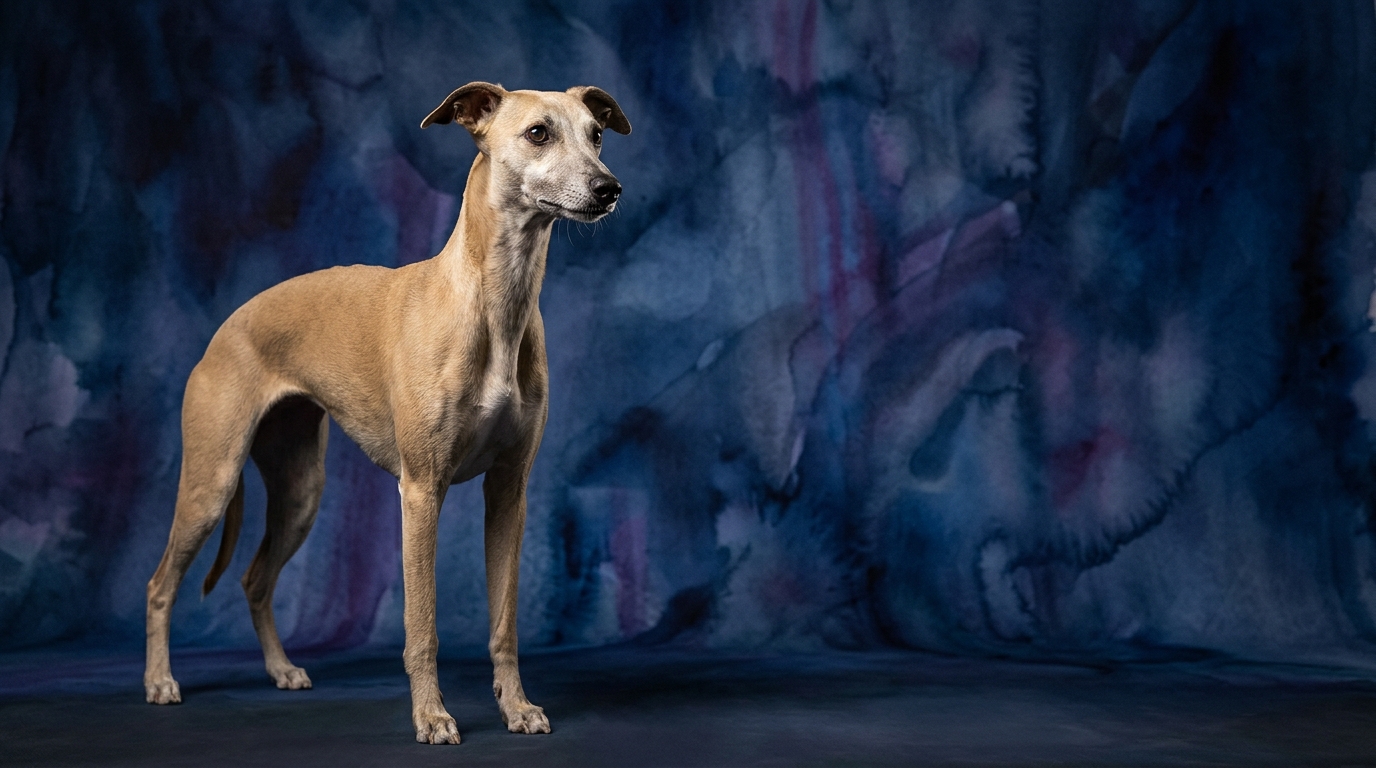

Side-by-Side IQ Profile: Whippet vs. Briard
The Whippet, ranking #51 on the Coren scale, suggests a moderate capacity for understanding new commands, often requiring a patient and consistent approach. Their problem-solving ability, rated at 3/5, indicates a practical intelligence focused on immediate environmental factors, particularly those related to movement and prey. They are adept at navigating familiar spaces and reacting swiftly to visual cues but may not independently devise intricate solutions to novel abstract challenges. Training speed, at 2/5, reflects their independent sighthound nature; while capable of learning, they are not inherently driven by a desire to please through obedience in the same way some other breeds are, often requiring high motivation. However, their social intelligence, a strong 4/5, highlights their exceptional ability to read and respond to human emotions, forming deep, empathetic bonds. The Whippet's most defining cognitive trait is its 5/5 instinctive drive, an intense and highly specialized focus on pursuit, which is a powerful, intrinsic motivator. Memory, at 3/5, is adequate for retaining routines and familiar associations, though complex command sequences might require regular refreshers.
The Briard, with a respectable Coren rank of #30, demonstrates a good capacity for understanding and executing new commands efficiently. Their problem-solving score of 4/5 indicates a resourceful mind, capable of analyzing and overcoming environmental obstacles, especially when it involves their protective or managerial instincts. This often translates into figuring out how to achieve a goal, such as strategically herding family members or outsmarting a perceived threat. Their training speed, also 4/5, reflects their working heritage; they are typically eager students who grasp new concepts quickly and enjoy engaging in structured learning. Unlike the Whippet, the Briard’s social intelligence is rated at 3/5, signifying a loyal and protective nature primarily directed towards their inner circle, often with a reserved demeanor towards strangers. Their instinctive drive, 3/5, is centered on herding and guarding, manifesting as a desire to oversee and protect their 'flock,' a drive that is present but generally more controllable than a sighthound's. A strong 4/5 memory ensures they retain complex training and environmental knowledge over long periods, contributing to their reliability and vigilance.
Where the Whippet Wins Cognitively
Whippets' primary cognitive advantage lies in their superior social intelligence and unparalleled instinctive drive. Their 4/5 social intelligence rating indicates a profound capacity for emotional attunement; they are exceptionally adept at reading the nuances of human mood and body language. This allows them to forge remarkably deep, empathetic connections with their immediate family, often anticipating comfort or attention needs without explicit cues. They thrive on this intimate social bond, making them sensitive and responsive companions in a domestic setting, understanding the subtle dynamics of their human 'pack.' This makes them particularly intuitive partners for individuals seeking a deeply connected canine friend.
Furthermore, the Whippet's 5/5 instinctive drive, rooted in their sighthound heritage, represents a highly specialized form of intelligence. While often interpreted as a challenge for owners, this drive signifies an acute ability to perceive, process, and react to visual stimuli with incredible speed and precision. Their entire cognitive system is optimized for the chase, demonstrating an almost instinctive understanding of pursuit dynamics, spatial awareness at high speeds, and target acquisition. This specialized cognitive focus, though narrow, is exceptionally refined and powerful within its domain, making them masters of rapid, instinct-driven action during appropriate outlets like lure coursing.
Where the Briard Wins Cognitively
The Briard's cognitive strengths shine particularly in problem-solving, training speed, and memory, reflecting their history as diligent herding and guarding dogs. With a 4/5 problem-solving score, Briards demonstrate a robust capacity to analyze and navigate complex situations, often devising their own solutions to perceived challenges or obstacles. This might manifest as figuring out how to open a gate to gather a stray 'flock member' or strategically positioning themselves to oversee their family in a busy park. Their intelligence here is active and analytical, focused on practical application within their environment, making them resourceful and often independent thinkers.
Their 4/5 training speed is another significant advantage. Briards possess a keen desire to understand and comply with commands, often grasping new concepts and behaviors with fewer repetitions than many breeds. This responsiveness stems from their working heritage, where quick learning and reliable execution were crucial for effective herding and protection. Paired with a 4/5 memory, Briards not only learn quickly but also retain that knowledge over extended periods, making their training durable and reliable. This strong memory also contributes to their protective instincts, allowing them to recall past interactions or potential threats, informing their cautious approach to strangers.
Which is Easier to Train and Why
Based on our Pet IQ Lab data, the Briard is generally easier to train for obedience and complex tasks than the Whippet. The Briard's 4/5 training speed indicates a natural aptitude for learning new commands quickly, coupled with a 4/5 problem-solving ability that allows them to grasp the 'why' behind actions. Their historical role demanded a dog capable of understanding and executing instructions reliably, often in dynamic situations, fostering a disposition that seeks to engage with and respond to human direction. They tend to be more focused on their handler during training sessions, eager to please and to understand what is being asked of them, facilitating a smoother training process.
In contrast, the Whippet's 2/5 training speed and 3/5 problem-solving suggest a more independent approach to learning. Whippets, as sighthounds, are wired for independent action, pursuing visual stimuli without constant human directives. While they can certainly be trained, it often requires more patience, consistency, and a highly positive, reward-based approach to overcome their innate desire to follow their nose or eyes. Their strong instinctive drive (5/5) means they can be easily distracted by movement, making focused training sessions more challenging without careful environmental management. Whippets respond best to training that makes sense to them and often prefer to cooperate rather than strictly obey, demanding a different style of handler engagement.
Which Suits Active Owners vs. Relaxed Owners
The Whippet, despite its reputation as a '45 mph couch potato,' often suits owners who appreciate a balance of intense activity and profound relaxation. While they possess an explosive 5/5 instinctive drive for short, high-speed bursts, they are not dogs that require hours of sustained, high-impact exercise daily. Their need for activity is satisfied by opportunities to run freely in a secure area, engaging their prey drive, followed by long periods of rest. Therefore, they could suit a relaxed owner who enjoys quiet evenings, provided that owner is committed to regular, albeit brief, intense exercise sessions where the Whippet can truly express its sighthound nature. Their high social intelligence (4/5) means they thrive on close companionship during downtime and are content to snooze by their human.
The Briard, with its robust build and herding heritage, generally suits more active owners who can provide consistent physical and mental engagement. While their instinctive drive (3/5) is not as singularly focused as the Whippet's, it translates into a need for purpose and regular activity. Briards benefit from activities that engage their problem-solving (4/5) and memory (4/5) skills, such as advanced obedience, agility, or even herding trials. They require daily walks, playtime, and structured training to prevent boredom and channel their protective energies positively. Owners who enjoy hiking, long walks, or dog sports would find the Briard a fulfilling and capable companion, thriving on shared activities that challenge their intellect and physique, reinforcing their role as a working partner.
The Verdict
Choose a Whippet if you desire a sensitive, empathetic companion who enjoys intense but brief bursts of activity, followed by quiet, affectionate lounging, and you appreciate an independent spirit.
Opt for a Briard if you seek a loyal, protective working dog that thrives on consistent mental and physical challenges, enjoys structured training, and can be a vigilant guardian.
🧠 Find Your Pet's IQ Score
Our Pet IQ Lab assessment covers 25+ tests across 5 cognitive dimensions — personalized to your breed.
Take the Full IQ Test →Frequently Asked Questions
Are Whippets difficult to train due to their independence?
Whippets' independent nature and strong prey drive (5/5 instinctive drive) mean training requires patience, consistency, and high-value rewards. While not as quick to learn complex obedience as some breeds (2/5 training speed), they respond well to positive reinforcement and bond-based methods, making them trainable for dedicated owners who understand their sighthound instincts.
How does a Briard's protective instinct relate to its social intelligence?
A Briard's 3/5 social intelligence is geared towards discernment; they are highly attuned to their family but reserved with strangers, interpreting new social interactions with caution. This protective instinct stems from their herding and guarding roles, where vigilance and careful assessment of outsiders were crucial for their charges' safety, leading to a more selective social engagement.
Can a Whippet participate in dog sports despite its lower training speed?
Absolutely! While their 2/5 training speed might mean a slower learning curve for complex routines, Whippets excel in sports that leverage their natural abilities, like lure coursing or fast CAT, where their 5/5 instinctive drive and speed are paramount. They can also enjoy agility and flyball with dedicated, positive training, focusing on fun and engagement rather than strict precision.