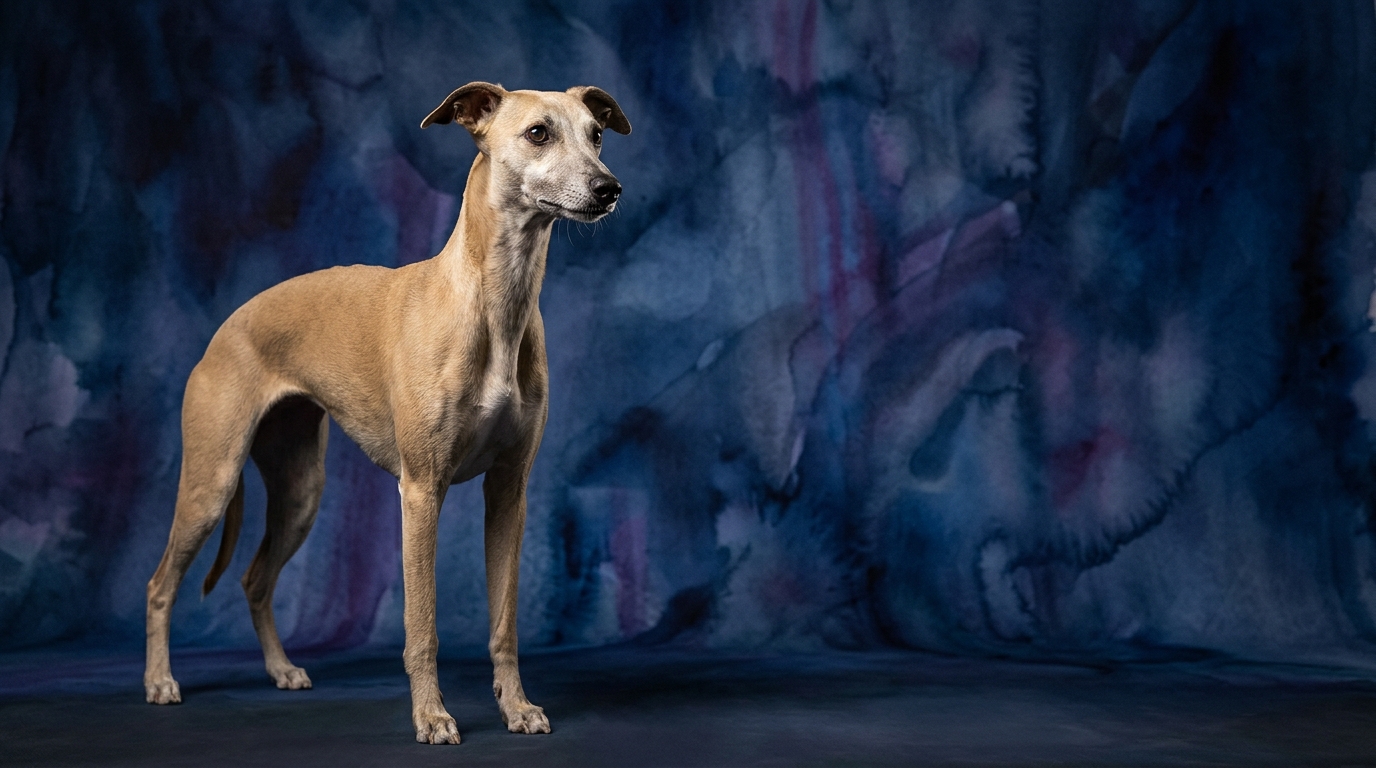
Whippet at a glance
| IQ Rank / Score | #51 |
|---|---|
| Trainability | ★★☆☆☆ (2/5) |
| Social Intelligence | ★★★★☆ (4/5) |
| Lifespan | 11-14 years |
| Shedding | Low to moderate |
| Exercise Needs | High (60+ min/day + training) |
| Origin | England |
The Whippet's Mind: A Symphony of Sight and Speed
The elegant Whippet, often admired for its sleek lines and graceful athleticism, possesses a cognitive profile far more intricate than its quiet demeanor suggests. Their defining cognitive trait is a remarkable visual-kinetic intelligence, allowing them to process moving targets with exceptional speed and calculate precise interception angles even while sprinting at 55 km/h. This isn't merely physical speed; it's a testament to rapid visual processing, immediate threat assessment, and sophisticated motor planning, all working in seamless concert.
This incredible ability isn't a modern development; it's a legacy forged in necessity and purpose. Whippets were meticulously bred by working-class miners in 19th century northern England for high-stakes racing and efficient rabbit hunting, earning them the affectionate moniker "the poor man's racehorse" because they were the fastest breed affordable to working people. Their history underscores a breed designed for precision, quick decision-making under pressure, and an unparalleled chase instinct, qualities that are deeply embedded in their current cognitive makeup.
Unpacking the Whippet's Cognitive Blueprint
When we delve into the Whippet's intelligence profile, as observed in their everyday behaviors, we uncover a compelling mix of cognitive strengths and unique approaches. Their Problem Solving ability rates a respectable 3/5, indicating they can navigate moderate cognitive puzzles, especially those related to their immediate environment or achieving a desired outcome like retrieving a favorite toy from a tricky spot. Owners might observe them strategizing to reach a sunbeam or figuring out how to nudge a door open.
Training Speed, at 2/5, suggests Whippets learn new commands and complex routines at a moderate pace, often requiring patient, consistent positive reinforcement rather than rote repetition. This isn't a reflection of a lack of understanding, but rather a characteristic sighthound independence and a preference for choosing their actions, meaning motivators must be tailored specifically to their strong drives and desires. They excel when training feels like a game or leads to a chase.
Where Whippets truly shine is in Social Intelligence, scoring a remarkable 4/5. They exhibit a keen awareness of human emotions, subtle body language, and social cues, forming deep, empathic bonds with their families and often integrating seamlessly into household dynamics. This makes them highly attuned companions, often anticipating needs or offering comfort without direct prompting, showcasing a profound connection to their human counterparts.
Their Instinctive Drive is a powerful 5/5, a direct echo of their heritage as hunters and racers. This manifests as an intense prey drive and an inherent joy in running and chasing anything that moves, which absolutely needs appropriate, safe outlets such as a securely fenced yard or supervised lure coursing to be fulfilled constructively. Understanding and respecting this core drive is paramount to their overall well-being and engagement. Memory, at 3/5, indicates they retain learned behaviors and associate experiences effectively over time, contributing to their adaptability and consistent habits, remembering routes and routines with precision.
Stanley Coren's obedience ranking places the Whippet at #51 out of 138 breeds. This ranking primarily assesses a dog's capacity for formal obedience training and working commands, placing Whippets in the "Average Working/Obedience Intelligence" category. It highlights their moderate eagerness to please in a structured training context, rather than defining their overall mental capabilities, which extend far beyond mere compliance into areas like independent problem-solving and nuanced social understanding. This suggests training success hinges on understanding their intrinsic motivations rather than expecting immediate, robotic adherence.
Testing Your Whippet's Wits at Home
Want to get a glimpse into your Whippet's unique thought processes? These simple, at-home experiments are designed to reveal different facets of their intelligence, from spatial reasoning to social understanding.
3 At-Home Tests to Measure Your Whippet's IQ
These tests are adapted from peer-reviewed ethology research. No equipment is needed beyond items you have at home. Run each test 5–10 times for reliable results.
The Myth: "Whippets are fragile, nervous dogs unsuited to anything beyond gentle companionship."
✅ While graceful, Whippets are surprisingly robust and athletic, bred for speed and endurance in challenging conditions, making them far from fragile. Their gentle nature indoors is a testament to their adaptability and comfort, not a sign of physical frailty; they thrive with active engagement and are perfectly capable of enjoying adventurous outings beyond the couch.
Whippet vs. Similar Breeds
🧠 What's Your Dog's IQ Score?
Our full Pet IQ Lab assessment includes 12+ tests across 5 cognitive dimensions, calibrated for Whippets specifically.
Take the Full IQ Test →Frequently Asked Questions
How smart is a Whippet?
Our Pet IQ Lab framework scores cognition across five dimensions (max 25). The Whippet totals 17/25 — high for a domestic dog. The full article breaks down each dimension with at-home tests.
Are Whippets easy to train?
Whippets are independent learners; short, highly-motivating sessions work best. They score 2/5 on Training Speed in our breed profile.
Are Whippets good with children and other pets?
Yes — their Social Intelligence rates 4/5 in our Pet IQ Lab framework. With early socialization and supervised play, most Whippets integrate well into families with respectful children and other pets.
Do Whippets need a lot of mental stimulation?
Absolutely. With Problem Solving 3/5 and Instinctive Drive 5/5, Whippets need daily mental work — puzzle feeders, scent games, training sessions, or nose-work — to avoid boredom.
How much exercise does a Whippet need?
Whippets need active engagement. Plan for 45-60 minutes of exercise and training per day, plus mental stimulation.
How good is a Whippet's memory?
Whippets score 3/5 on memory. They remember high-value associations well; less-used cues fade without refresher sessions.
What is the typical lifespan of a Whippet?
Expect a lifespan of 11-14 years for a healthy Whippet.
The Whippet is a master of visual-kinetic intelligence, a loyal and empathic companion whose elegant form belies a surprisingly robust and clever mind. By understanding their unique cognitive profile, owners can unlock the full potential of this exceptional breed, revealing a dog far deeper than their reputation for speed alone.