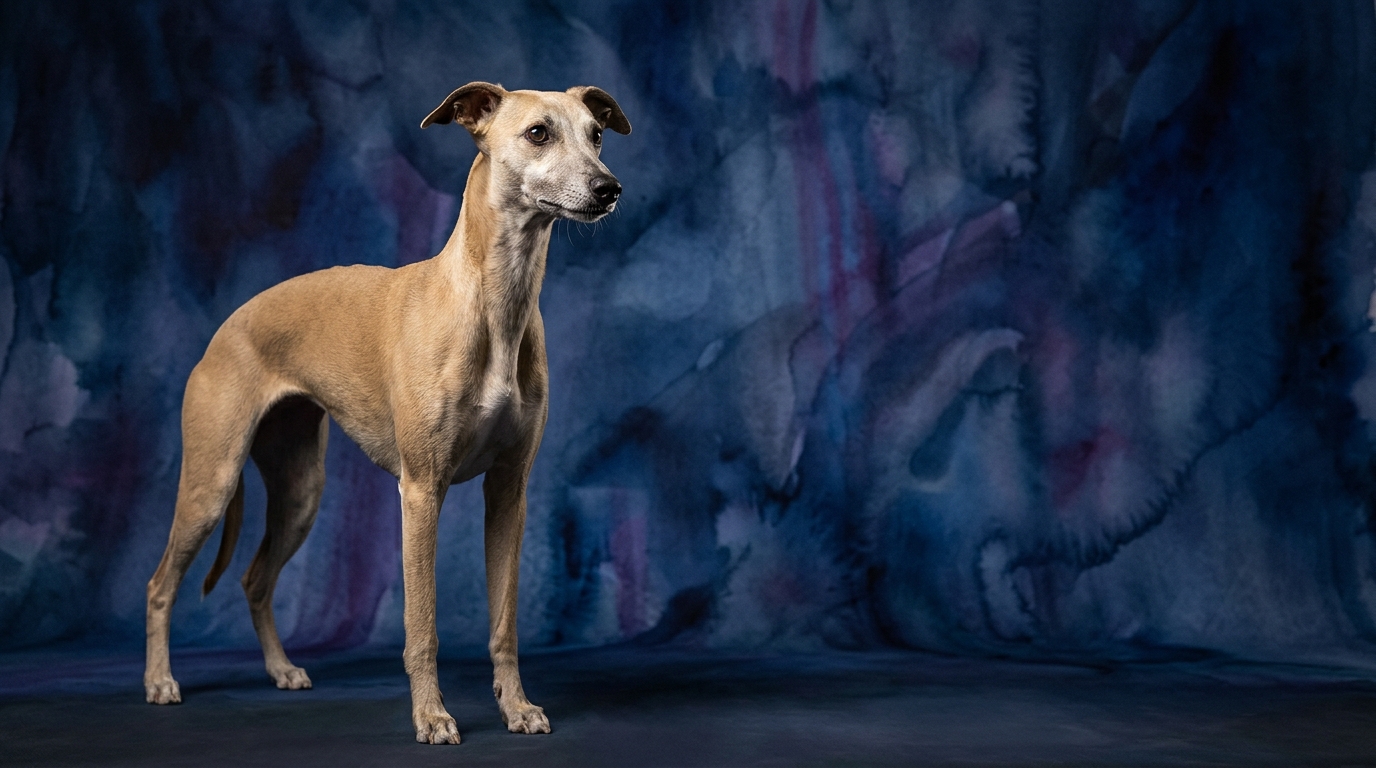

Side-by-Side Cognitive Profiles: Whippet vs. Norfolk Terrier
The Cosmic Pet Pet IQ Lab employs a five-dimensional framework to assess canine cognition, providing a granular view of each breed’s mental architecture. For the Whippet, a sighthound known for its graceful speed, we observe a Coren rank of #51, indicating a solid foundation in working and obedience intelligence. Their Problem Solving score of 3/5 suggests a capacity for navigating moderately complex situations, capable of learning routines and solving familiar puzzles, though they may not consistently devise novel solutions without guidance. Training Speed for the Whippet stands at 2/5, implying they might require more patience and consistent repetition to master new commands, often prioritizing their own interests over immediate compliance. However, their Social Intelligence shines at 4/5, indicating a keen awareness of human emotional states and social cues, making them highly attuned companions. The Whippet’s Instinctive Drive is a notable 5/5, reflecting their powerful prey drive and inherent focus on pursuit, a core aspect of their sighthound heritage. Finally, their Memory is rated 3/5, meaning they retain learned information and experiences adequately over time, remembering routines and familiar faces.
In contrast, the Norfolk Terrier, a robust and plucky terrier breed, does not hold a specific Coren rank, yet exhibits a distinct cognitive profile. Their Problem Solving ability is rated 3/5, mirroring the Whippet’s capacity for moderate complexity, capable of figuring out how to get to a desired treat or navigate familiar obstacles. The Norfolk Terrier shows a slight edge in Training Speed at 3/5, suggesting they can pick up new commands with reasonable consistency, though their independent terrier spirit can sometimes make them selective learners. Their Social Intelligence is 3/5, indicating a fair understanding of human interactions and social dynamics, forming strong bonds with their families but perhaps not possessing the same nuanced sensitivity as the Whippet. The Instinctive Drive for the Norfolk Terrier is 3/5, reflecting their historical role as vermin hunters, a drive that manifests as curiosity and persistence rather than the Whippet’s focused pursuit. Their Memory also stands at 3/5, allowing them to recall training, places, and people effectively.
Where the Whippet’s Cognition Excels
The Whippet’s cognitive strengths are particularly evident in two key areas: social intelligence and instinctive drive. With a Social Intelligence score of 4/5, Whippets demonstrate a superior ability to read and respond to human emotions and body language. This translates into a highly empathetic companion, often anticipating their owner's moods and offering comfort or quiet companionship without explicit cues. Their high social intelligence makes them exceptionally sensitive to their environment and the people within it, fostering deep, intuitive bonds. Furthermore, their Instinctive Drive of 5/5, while sometimes posing training challenges, is a remarkable cognitive strength in its own right. This intense drive speaks to a highly focused attention system dedicated to movement and pursuit, requiring rapid processing of visual stimuli and instantaneous decision-making during a chase. This isn't just raw instinct; it's a sophisticated, specialized form of predatory problem-solving, demanding acute observation and lightning-fast execution.
Where the Norfolk Terrier’s Cognition Shines
The Norfolk Terrier’s cognitive profile, while different from the Whippet's, presents its own distinct advantages. Their primary cognitive edge lies in Training Speed, rated at 3/5, which is a point higher than the Whippet. This indicates that Norfolk Terriers generally grasp new commands and routines with greater readiness and fewer repetitions. Their inherent drive, while not as singularly focused as a sighthound's, contributes to a persistent and often curious approach to learning. This moderate training speed, combined with their 3/5 problem-solving ability, suggests a dog that is keen to engage in interactive learning and can often figure out how to achieve desired outcomes through trial and error, making them responsive to consistent, engaging training methods. Their cognitive makeup leans towards an alert, attentive learner who enjoys mental stimulation through directed tasks.
Trainability: A Tale of Two Temperaments
When it comes to ease of training, the Norfolk Terrier generally holds an advantage over the Whippet. The Norfolk Terrier's Training Speed of 3/5 suggests they are more consistently receptive to learning new commands and routines. Their instinctive drive, while present, is more diffuse than the Whippet's, manifesting as curiosity and determination rather than an overwhelming urge to chase. This means they are often less distracted by distant movement and more inclined to focus on their handler during training sessions. Conversely, the Whippet’s Training Speed of 2/5, coupled with their powerful 5/5 Instinctive Drive, means training can be a more deliberate process. Their sighthound nature dictates that a moving squirrel or distant plastic bag can instantly override any command, making off-leash reliability a significant challenge without extensive, specialized training. Whippets require patient, positive reinforcement, and a deep understanding of their prey drive to make training effective, often needing more repetition before a behavior becomes ingrained. While both breeds are capable of learning, the Norfolk Terrier typically offers a more straightforward and less distraction-prone training experience, whereas the Whippet demands a more nuanced, understanding approach to work with, rather than against, their innate predispositions.
Matching Canine Cognition to Owner Lifestyles
The cognitive profiles of the Whippet and Norfolk Terrier lend themselves to different owner lifestyles. For active owners who appreciate bursts of intense activity followed by calm companionship, the Whippet can be an ideal match. Their 5/5 instinctive drive means they thrive on opportunities for safe, vigorous sprints, but their 4/5 social intelligence also means they deeply value relaxed, cuddly interactions on the couch. Owners who enjoy a quiet home but are prepared for daily sprints in a secure area, and who appreciate a deeply empathetic canine presence, will find the Whippet highly rewarding. Their lower training speed might challenge those seeking quick obedience titles, but their social acumen provides a rich emotional connection. They suit individuals or families who value a sensitive, graceful companion capable of intense, short-duration exercise.
The Norfolk Terrier, with its balanced cognitive scores, is well-suited for owners who seek a spirited, engaging companion that enjoys consistent activity and mental challenges. Their 3/5 problem-solving and training speed, combined with a 3/5 instinctive drive, means they thrive on interactive play, puzzle toys, and regular training sessions that keep their minds stimulated. They are robust and persistent, making them excellent companions for owners who enjoy hiking, agility, or earthdog trials, where their terrier instincts can be channeled productively. While they are certainly active, their energy is often more sustained and inquisitive rather than purely speed-driven. They are a good fit for owners who desire a confident, curious dog that is generally biddable but retains an independent streak, and who can provide consistent mental and physical engagement.
The Verdict
Choose a Whippet if you seek an empathetic, graceful companion who enjoys intense bursts of speed followed by quiet companionship and can appreciate their profound social intelligence.
Opt for a Norfolk Terrier if you desire a spirited, trainable, and mentally engaged dog that thrives on consistent interaction, varied activities, and retains a charming terrier tenacity.
🧠 Find Your Pet's IQ Score
Our Pet IQ Lab assessment covers 25+ tests across 5 cognitive dimensions — personalized to your breed.
Take the Full IQ Test →Frequently Asked Questions
Which breed is better for first-time dog owners?
The Norfolk Terrier's slightly higher training speed and more manageable instinctive drive generally make them a more straightforward choice for first-time owners. Their robust nature and eagerness to engage in training can be less challenging than navigating a Whippet's intense prey drive and specific exercise needs.
Do Whippets or Norfolk Terriers need more exercise?
Whippets require intense bursts of exercise, such as sprinting in a secure area, to satisfy their high instinctive drive, but are otherwise quite calm indoors. Norfolk Terriers need consistent, moderate daily activity and mental stimulation, like walks, playtime, and puzzle toys, to keep their terrier minds and bodies content.
Are these breeds good with children?
Both breeds can be good with respectful children, but their approaches differ. Whippets, with their high social intelligence, are often gentle and tolerant, though they appreciate calm interactions. Norfolk Terriers are sturdy and playful, often enjoying interactive games, but their terrier tenacity means they may need supervision to ensure proper boundaries are respected by both dog and child.