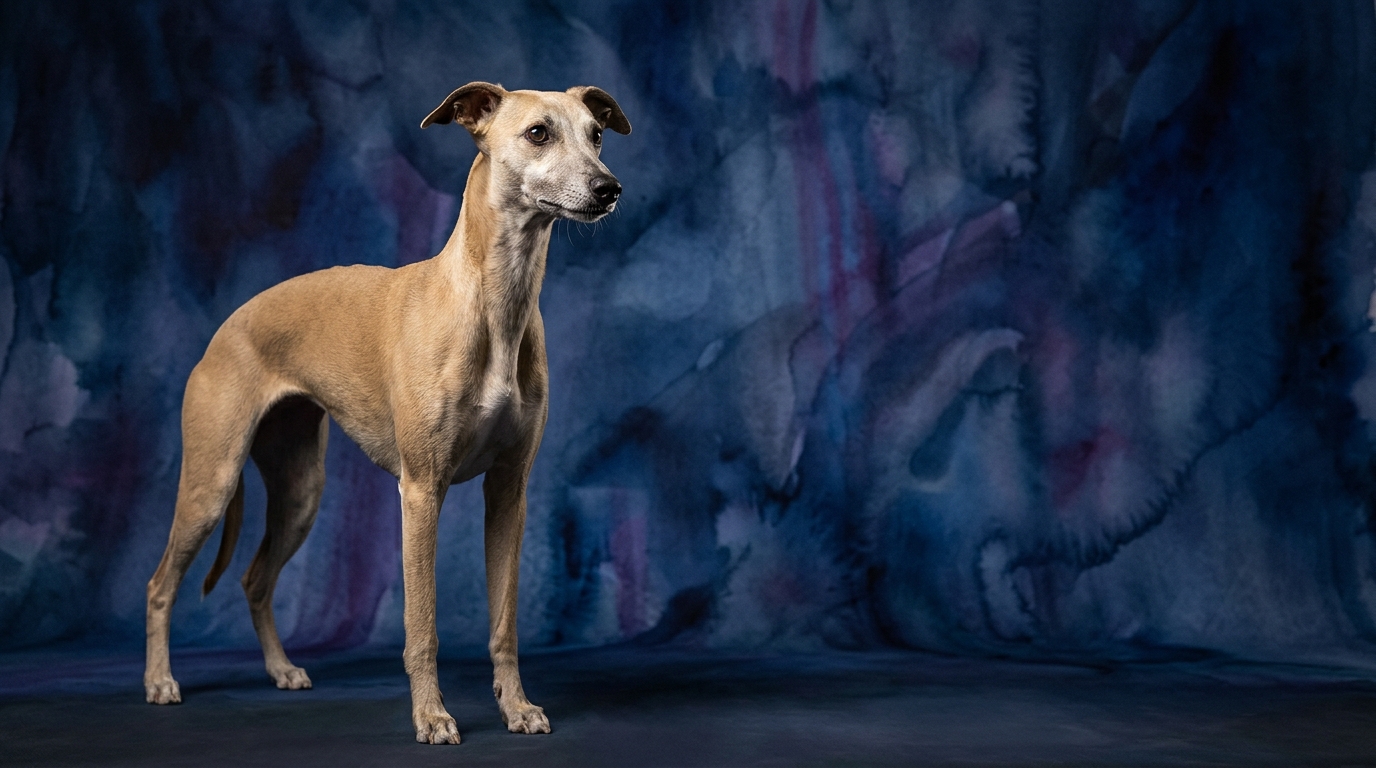

Side-by-Side IQ Profile: Whippet vs. Smooth Fox Terrier
**Whippet (Hound, Coren rank #51)**
**Problem Solving (3/5):** Whippets demonstrate a moderate capacity for navigating challenges, particularly when directly motivated by food, comfort, or the pursuit of a moving object. They can learn to open simple latches or find hidden toys, but typically rely on learned patterns rather than innovative, abstract problem-solving. Their intelligence in this area is often practical and focused on achieving immediate, tangible goals.
**Training Speed (2/5):** This breed requires patient and consistent training, as they pick up new commands at a deliberate pace. While capable of learning a wide repertoire, their independent sighthound nature means they often need repetition and positive reinforcement to solidify behaviors, and can be sensitive to harsh methods, which may cause them to disengage.
**Social Intelligence (4/5):** Whippets possess an exceptional ability to read human emotions and social cues, forming deep, often intuitive bonds with their families. They are highly attuned to their owners' moods and can offer comforting presence, making them remarkably empathetic companions who thrive on close interaction.
**Instinctive Drive (5/5):** With an exceptionally strong prey drive, Whippets are masters of sight-hunting. They are acutely aware of movement, capable of lightning-fast pursuit, and instinctively compelled to chase. This drive is a fundamental aspect of their cognitive makeup, shaping their focus and reactions in various environments.
**Memory (3/5):** Whippets retain learned behaviors and significant experiences reasonably well. They remember routines, familiar faces, and past training, though their recall of commands might sometimes be overshadowed by a sudden, compelling instinct, requiring consistent reinforcement to maintain reliability.
**Smooth Fox Terrier (Terrier, Not Coren-ranked)**
**Problem Solving (3/5):** Smooth Fox Terriers are adept at navigating their environment and overcoming obstacles, often employing clever strategies to achieve their aims, such as figuring out how to access forbidden areas or retrieve a favorite toy. Their terrier tenacity fuels a resourceful approach to challenges, making them quite inventive in their pursuits.
**Training Speed (3/5):** This breed generally learns new commands at a good pace, often eager to engage in training sessions when provided with positive reinforcement and mental stimulation. While intelligent, their independent and sometimes stubborn terrier spirit means consistency and engaging methods are crucial to maintain their focus and cooperation.
**Social Intelligence (3/5):** Smooth Fox Terriers understand human interactions well enough to integrate effectively into a family, though their social responses are often more direct and less nuanced than a Whippet's. They enjoy companionship but might be more driven by their own curiosity and agenda rather than a deep emotional attunement to human feelings.
**Instinctive Drive (3/5):** Exhibiting a moderate but persistent prey drive, typical of a terrier bred for hunting vermin, Smooth Fox Terriers show keen interest in digging, chasing small animals, and exploring. This drive is manageable but requires appropriate outlets to prevent it from becoming destructive or overwhelming in a domestic setting.
**Memory (3/5):** Smooth Fox Terriers hold onto training and past experiences effectively, remembering commands, routines, and significant events. They can also vividly recall negative experiences, which may influence their future behavior or interactions, making early positive socialization important.
Where the Whippet Wins Cognitively
The Whippet demonstrates a clear cognitive edge in social intelligence, scoring 4/5 compared to the Smooth Fox Terrier's 3/5. This means Whippets are generally more perceptive of human emotions and subtle social cues, often forming profoundly empathetic and comforting connections with their families. They possess an innate ability to understand and respond to the emotional landscape of their household, making them exceptional emotional support animals in a quiet capacity. Furthermore, their instinctive drive is more pronounced at 5/5, reflecting their powerful sighthound heritage and an unparalleled ability to spot, track, and pursue moving targets with incredible focus and speed. This specialized cognitive strength, honed over centuries for hunting by sight, is a distinct evolutionary advantage for the Whippet in its specific domain.
Where the Smooth Fox Terrier Wins Cognitively
The Smooth Fox Terrier exhibits a slight advantage in training speed, scoring 3/5 compared to the Whippet's 2/5, suggesting they may grasp new commands and routines with a little more alacrity and less repetition. This often stems from their terrier eagerness to engage in interactive tasks and a desire for mental stimulation. While both breeds score 3/5 in problem-solving, the Smooth Fox Terrier's approach to challenges is often characterized by a tenacious resourcefulness. They are more likely to persistently experiment with different methods to achieve a goal, like figuring out how to open a cupboard or retrieve a hidden toy, driven by an unwavering curiosity and a "can-do" attitude that is a hallmark of their breed.
Which is Easier to Train and Why
The Smooth Fox Terrier generally presents as the more straightforward breed to train, primarily due to its 3/5 training speed, a point higher than the Whippet's 2/5. Terriers, by nature, often possess a keen desire to engage with their human counterparts in activities, including learning new tasks, provided the methods are stimulating and positive. Their problem-solving tenacity often translates into a willingness to work through challenges during training. Whippets, while certainly capable of learning, can be more sensitive and may become disengaged or "shut down" with even slightly harsh or inconsistent training methods. Their independent sighthound nature means they often need more patience and very gentle, positive reinforcement to solidify behaviors. Moreover, the Whippet's intense 5/5 instinctive drive makes them highly susceptible to distractions, especially movement, demanding significantly more consistent focus-building and environmental management during training sessions compared to the Smooth Fox Terrier's more moderate 3/5 instinctive drive.
Which Suits Active Owners vs. Relaxed Owners
For **active owners**, both breeds offer rewarding companionship, though their activity needs differ in style. The Whippet, despite its reputation for being a couch potato indoors, requires significant bursts of vigorous exercise to satisfy its 5/5 instinctive drive and sighthound heritage. Owners who enjoy regular, fast-paced off-leash runs in very secure areas, or participate in dog sports like lure coursing, will find an exceptional companion in a Whippet. The Smooth Fox Terrier also thrives with active owners who can provide ample opportunities for exploration, digging, and engaging, interactive play. Its moderate instinctive drive and energetic nature make it a good fit for hiking, agility, or earthdog trials, where its problem-solving and tenacity can be channeled constructively.
For **relaxed owners**, the Whippet can be a surprisingly suitable choice, provided their intense, short bursts of exercise are reliably met. Once their physical needs are satisfied, they are incredibly content to lounge and cuddle, displaying their high 4/5 social intelligence by simply enjoying quiet companionship and being close to their people. Their calm indoor demeanor is a significant draw. The Smooth Fox Terrier, while trainable and affectionate, may be less suited for truly relaxed owners. Their persistent curiosity, problem-solving abilities, and need for mental engagement mean that without sufficient outlets for their energy and intellect, they are more prone to boredom-driven behaviors like digging, barking, or inventive mischief, demanding a bit more proactive management and engagement from their owners.
The Verdict
Choose a Whippet if you appreciate a deeply empathetic, socially intelligent companion who forms strong emotional bonds, and you can provide regular, intense bursts of exercise in secure locations balanced with a calm, affectionate indoor presence.
Choose a Smooth Fox Terrier if you seek an engaging, resourceful, and tenacious partner who learns readily with positive methods and thrives on interactive play and exploration, and you enjoy a bit of spirited terrier wit and independence.
🧠 Find Your Pet's IQ Score
Our Pet IQ Lab assessment covers 25+ tests across 5 cognitive dimensions — personalized to your breed.
Take the Full IQ Test →Frequently Asked Questions
Do Whippets learn tricks easily?
Whippets can learn tricks, but their 2/5 training speed means it requires patience and consistent, positive reinforcement. They respond best when motivated by high-value treats or toys, and when training sessions are kept short, fun, and free from distractions.
Are Smooth Fox Terriers good at problem-solving?
Yes, Smooth Fox Terriers are quite adept at problem-solving (3/5), often using their wit and tenacity to navigate challenges or achieve goals like finding hidden toys or escaping enclosures. This resourcefulness can also manifest as clever ways to get into mischief if not properly channeled.
Which breed is more overtly affectionate?
Whippets generally exhibit higher social intelligence (4/5) and are often described as more overtly affectionate, sensitive to their owners' moods, and prone to forming deep emotional bonds. Smooth Fox Terriers are affectionate in their own right but tend to be more independent and less overtly demonstrative, often showing affection through play and companionship.