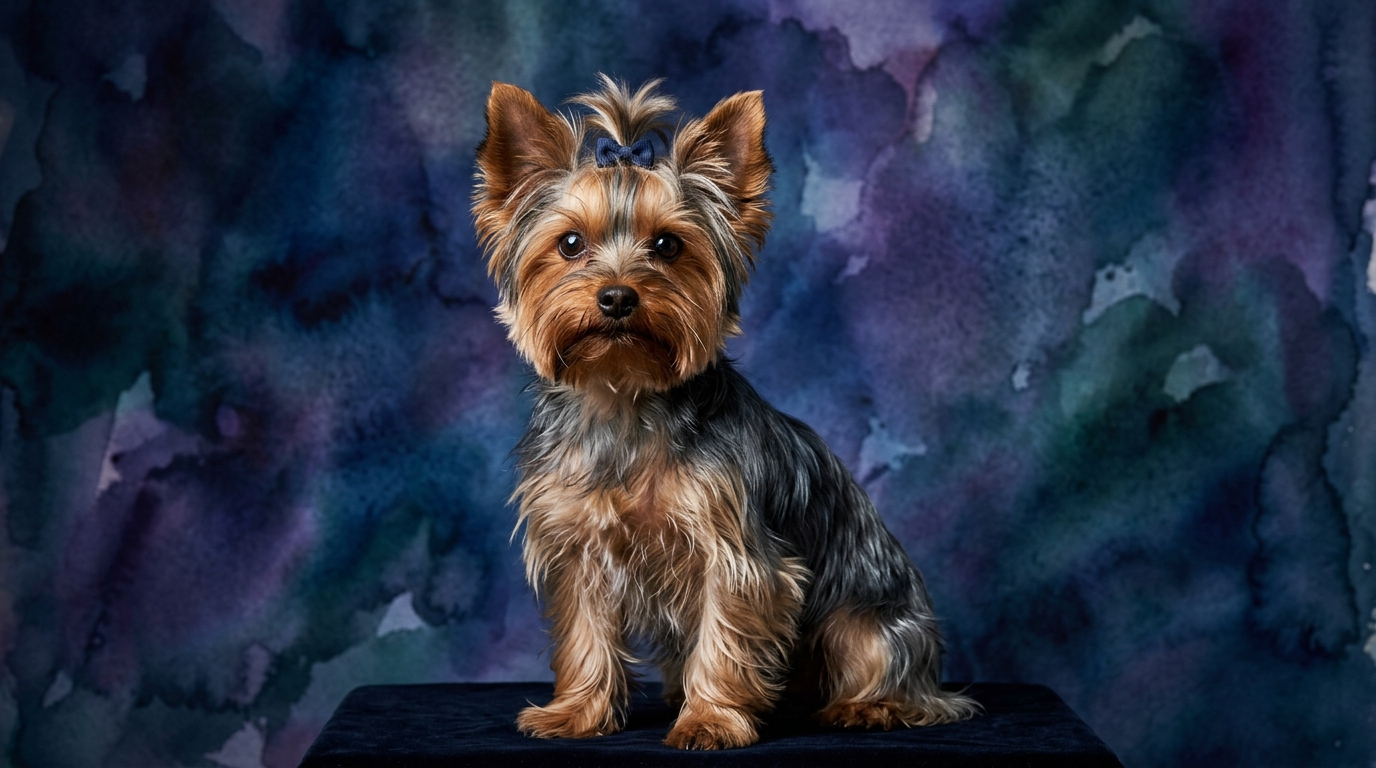
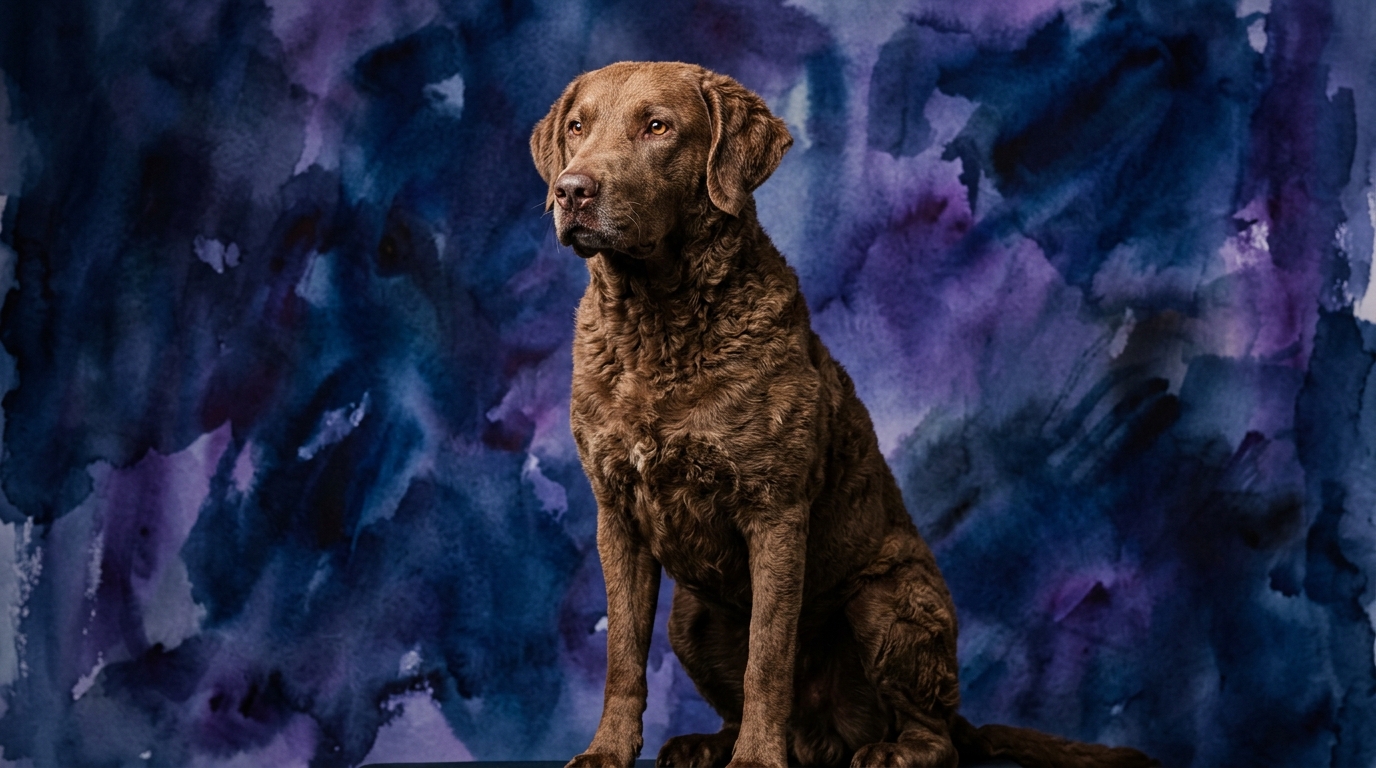
Side-by-Side Cognitive Profiles: Yorkie vs. Chessie
The Cosmic Pet Pet IQ Lab offers a nuanced framework for understanding canine cognition, breaking down intelligence into five distinct dimensions. When we apply this framework to the Yorkshire Terrier and the Chesapeake Bay Retriever, their shared Coren rank belies significant differences in their mental strengths and operational styles.
For the **Yorkshire Terrier**, we observe a fascinating blend of companion-oriented and terrier-specific cognitive traits. Their **Problem Solving** scores 3/5, indicating a moderate capacity for independent thought in novel situations; they often prefer to follow established routines or seek human direction rather than devise complex, spontaneous solutions. **Training Speed** registers at 4/5, suggesting they grasp new commands and behaviors quite readily, especially when motivated by positive reinforcement and consistent methods. Their **Social Intelligence** is a strong 4/5, highlighting an excellent ability to interpret human cues, adapt to social dynamics, and form deep bonds, making them highly attuned companions. The **Instinctive Drive** for a Yorkie is notably high at 4/5; this score reflects their strong terrier heritage for hunting vermin, manifesting as keen senses, tenacity, and sometimes vocal alerts. Finally, their **Memory** is also a robust 4/5, enabling them to retain commands, routines, and social interactions over extended periods.
Turning to the **Chesapeake Bay Retriever**, we see a cognitive blueprint engineered for demanding outdoor work and partnership. Their **Problem Solving** capability is stronger at 4/5, indicating a greater aptitude for independent thinking and strategic navigation of challenging environments, a trait crucial for their retrieving duties. **Training Speed** matches the Yorkie at 4/5, demonstrating their quick uptake of new tasks and instructions, particularly those related to their working purpose. However, their **Social Intelligence** scores 3/5, suggesting they are capable of forming strong bonds and understanding human direction, but may exhibit a more independent or reserved social demeanor compared to the highly effusive Yorkie. The Chessie's **Instinctive Drive** stands at 3/5; while lower than the Yorkie's, this drive is intensely focused on retrieving, swimming, and working in partnership, rather than independent hunting. Their **Memory** is excellent, mirroring the Yorkie at 4/5, essential for remembering complex retrieves, field patterns, and learned commands.
Where the Yorkshire Terrier Shines Cognitively
The Yorkshire Terrier's cognitive strengths distinctly align with its role as a beloved companion and alert household member. Their most pronounced advantage lies in **Social Intelligence**, scoring 4/5 compared to the Chessie's 3/5. This higher social acumen means Yorkies are exceptionally skilled at reading human emotions, understanding subtle body language, and adapting their behavior to the mood and needs of their family. They often initiate comforting cuddles or offer playful distractions with an uncanny sense of timing, demonstrating a profound emotional attunement that enriches the human-animal bond.
While both breeds share a 4/5 in **Training Speed**, the Yorkie's smaller stature and high social intelligence often translate into a perceived ease of training for basic obedience and house manners within a domestic setting. Their desire to please and their sensitivity to human feedback can make them very responsive to positive reinforcement, quickly learning household rules and tricks. Furthermore, their 4/5 **Instinctive Drive**, while needing careful management, gives them a spark of terrier tenacity and alertness that makes them excellent, albeit sometimes vocal, watchdogs for their size, keenly aware of their surroundings and quick to alert their owners to anything unusual.
Where the Chesapeake Bay Retriever Excels Cognitively
The Chesapeake Bay Retriever's cognitive profile is optimized for robust, independent, and persistent work, especially in challenging outdoor conditions. Their superior **Problem Solving** ability, rated 4/5 against the Yorkie's 3/5, is a significant advantage. This means a Chessie is more likely to assess a complex situation, such as navigating dense cover or breaking ice to retrieve a bird, and devise an effective solution independently. They exhibit a thoughtful, strategic approach to obstacles, a trait invaluable for their original purpose as dedicated waterfowl retrievers.
The Chessie's 4/5 **Memory** is also a cornerstone of their working success, enabling them to recall precise locations of fallen game, remember intricate field patterns, and execute multi-part commands with accuracy over long distances and extended periods. This enduring memory, combined with their strong physical capabilities, allows them to perform tasks that require both mental mapping and physical endurance. While their **Instinctive Drive** (3/5) is numerically lower than the Yorkie's, it is intensely focused on cooperative retrieving tasks rather than independent hunting, which makes it a powerful asset for directed work. This drive manifests as an unwavering desire to work alongside their handler, retrieving tirelessly and with great determination, making them highly purpose-driven partners.
Training Dynamics: Which Breed is More Amenable?
When considering trainability, both the Yorkshire Terrier and the Chesapeake Bay Retriever share an impressive 4/5 score for **Training Speed**, suggesting both breeds can learn new commands quickly. However, the *nature* of their training and the *ease* of achieving desired behaviors differ significantly due to their other cognitive dimensions.
The Yorkshire Terrier's high **Social Intelligence** (4/5) and strong desire for human interaction often make them appear easier to train for companion tasks. They are typically eager to please their owners and respond well to positive reinforcement, thriving on praise and affection. Their learning curve for basic obedience, house-training, and even complex tricks can be quite rapid, provided training is consistent and engaging. However, their 4/5 **Instinctive Drive**, rooted in their terrier heritage, can present challenges. This drive often translates into a tenacious prey drive, a tendency to dig, and vocalization, which requires diligent and patient redirection to channel into appropriate outlets rather than suppression. Impulse control training is paramount for a Yorkie.
The Chesapeake Bay Retriever also learns quickly (4/5 Training Speed), but their training is often more focused on developing their working aptitudes. Their 4/5 **Problem Solving** ability means they can quickly understand the 'why' behind a command and apply it in varied scenarios, making them excellent candidates for advanced obedience, agility, and field trials. Their 3/5 **Instinctive Drive**, though lower than the Yorkie's, is strongly geared towards retrieving and working, providing a powerful intrinsic motivation for training in these areas. However, their 3/5 **Social Intelligence** means they can sometimes be more independent or reserved, requiring a handler who understands how to motivate a working dog and builds respect through fair, consistent leadership rather than relying solely on eager-to-please antics. They may also be less forgiving of inconsistent training, as their problem-solving nature means they can quickly identify and exploit loopholes.
Lifestyle Match: Active vs. Relaxed Owners
The cognitive profiles of these two breeds offer clear guidance for matching them with appropriate owner lifestyles, whether active or relaxed. The **Chesapeake Bay Retriever**, with its 4/5 **Problem Solving** and 3/5 **Instinctive Drive** geared towards strenuous work, is unequivocally suited for highly active owners. These dogs require substantial daily physical exercise, such as long runs, swimming, or retrieving sessions, to satisfy their physical needs. Beyond physical exertion, their strong problem-solving skills mean they also demand significant mental stimulation through training, puzzle toys, and engaging activities to prevent boredom and destructive behaviors. Owners who enjoy outdoor sports, hunting, or competitive dog sports will find an ideal partner in a Chessie.
Conversely, the **Yorkshire Terrier**, while possessing a robust 4/5 **Instinctive Drive**, manages to satisfy many of its needs within a more contained environment due to its size. This makes them a better fit for owners who might describe themselves as relaxed, though this doesn't imply a lack of engagement. While they enjoy walks and playtime, their exercise needs can often be met with indoor games, short walks, and focused interactive play. Their high 4/5 **Social Intelligence** means they thrive on human companionship and mental stimulation through interaction, trick training, and puzzle toys, rather than endless physical exertion. Relaxed owners who are home frequently and enjoy a close, interactive bond with their pet will find the Yorkie's cognitive makeup to be a perfect match, offering lively companionship without the intense physical demands of a working retriever.
The Verdict
Choose the Yorkshire Terrier if you seek a highly socially intelligent, adaptable companion who thrives on close interaction and can find mental fulfillment in a less physically demanding home environment.
Opt for the Chesapeake Bay Retriever if you are an active, outdoors-oriented individual or family seeking a robust, problem-solving partner for strenuous outdoor activities and dedicated working tasks.
🧠 Find Your Pet's IQ Score
Our Pet IQ Lab assessment covers 25+ tests across 5 cognitive dimensions — personalized to your breed.
Take the Full IQ Test →Frequently Asked Questions
Do Yorkshire Terriers require a lot of mental stimulation despite their size?
Yes, despite their small stature, Yorkshire Terriers have a strong 4/5 Memory and 4/5 Social Intelligence. They thrive on mental engagement through trick training, puzzle toys, and consistent interaction with their owners to prevent boredom and channel their instinctive drive appropriately.
Is a Chesapeake Bay Retriever a good choice for a first-time dog owner?
A Chesapeake Bay Retriever's strong problem-solving skills (4/5) and focused instinctive drive (3/5) mean they excel with consistent, experienced training. While trainable, their independent nature and high demands for physical and mental engagement can be challenging for inexperienced owners who may not be prepared for their specific needs.
How does 'Instinctive Drive' differ between these two breeds?
The Yorkie's 4/5 Instinctive Drive manifests as a classic terrier prey drive, vocal alerts, and digging, requiring redirection. The Chessie's 3/5 drive, while numerically lower, is intensely focused on cooperative retrieving from water and land, making it a powerful asset for specific working tasks with a handler.