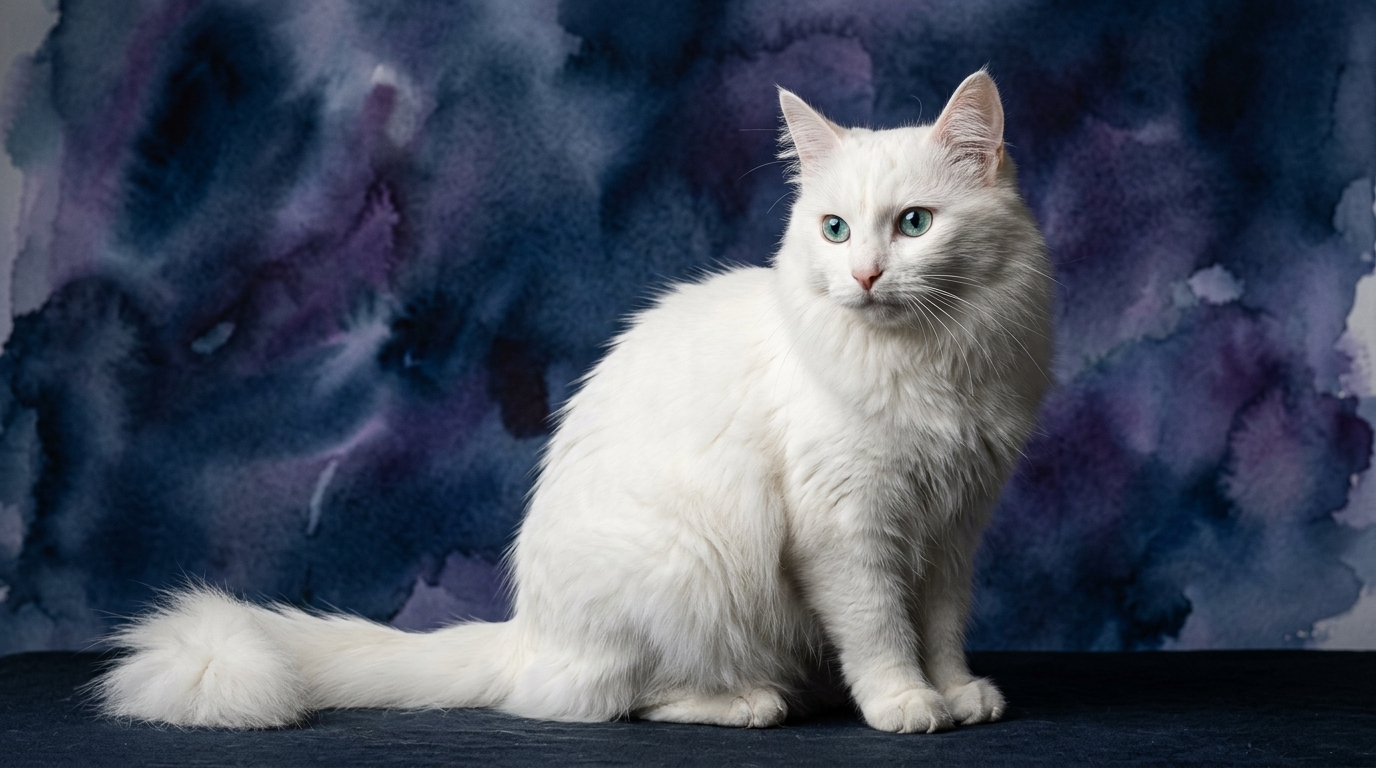
Turkish Angora at a glance
| IQ Rank / Score | 22/25 |
|---|---|
| Trainability | ★★★★☆ (4/5) |
| Social Intelligence | ★★★★☆ (4/5) |
| Lifespan | 12-16 years |
| Shedding | Low to moderate |
| Exercise Needs | Needs active play (45-60 min/day) |
| Origin | Turkey (Ankara) |
The Turkish Angora: An Elegant Mind in a Graceful Form
Originating from the ancient lands of Turkey, specifically the Ankara region, the Turkish Angora isn't just a vision of feline grace; they possess a distinct and compelling intelligence profile. These medium-sized cats are renowned for their agility and playful nature, but their cognitive abilities are where they truly shine, presenting a blend of curiosity, persistence, and surprisingly deep social understanding.
Unlike many breeds developed through selective human intervention, the Turkish Angora stands as one of the few natural cat breeds, evolving in Central Anatolia over thousands of years. This crucial historical detail means their intelligence was shaped by genuine survival pressures, not breeding programs focused on specific traits. This natural selection gifted them with a robust intellectual toolkit, essential for navigating ancient landscapes and securing resources.
Our Pet IQ Lab's assessment paints a vivid picture of the Turkish Angora's brainpower: they score an exceptional 5/5 in Problem Solving, a commendable 4/5 in Training Speed, a sensitive 4/5 in Social Intelligence, a robust 4/5 in Instinctive Drive, and an impressive 5/5 in Memory. This combination makes them particularly adept at navigating complex environments and forming strong, lasting bonds with their human companions.
At the core of the Turkish Angora's intelligence is their role as an 'elegant problem-solver.' They don't just tackle puzzles; they approach them with a thoughtful persistence that is both fascinating and effective. These cats rarely give up on a challenge, whether it's reaching a coveted toy or figuring out a new game, often developing their own unique, creative methods to achieve their goals. This innate drive to master their environment sets them apart.
A Legacy of Survival: Where Angora Wit Was Forged
The Angora’s history as a naturally developed breed profoundly impacts their cognitive capabilities. Imagine thousands of years where only the most resourceful, adaptable, and clever cats thrived. This isn't a story of pampered pets but of resilient survivors. Their ancestors faced real-world challenges – finding food, avoiding predators, and adapting to varied climates – all without human architects guiding their genetic evolution. This is why the Turkish Angora is one of the few natural cat breeds — they developed without human selection in Central Anatolia over thousands of years. Their intelligence was shaped by genuine survival pressures, not breeding programs.
This natural selection process honed specific cognitive functions. A cat that could remember where the best hunting grounds were, or how to outsmart a tricky situation, was a cat that passed on its genes. This translates directly to their 5/5 Memory score today, allowing them to recall complex patterns and learned behaviors with remarkable accuracy. They don't just learn; they retain that knowledge, making them formidable learners for tricks and routines.
Their 5/5 Problem Solving isn't merely about pushing a button; it's about persistent, creative strategizing. If a direct approach doesn't work, a Turkish Angora is likely to try several alternatives, observing consequences and adapting their technique. This ingenuity, born from necessity, makes them particularly adept at manipulating objects, opening cabinets, or even figuring out how to get attention when conventional methods fail.
Furthermore, their 4/5 Instinctive Drive showcases a strong connection to their predatory heritage. This isn't just about hunting mice; it's about a deep engagement with play, tracking, and exploration. This drive, combined with their problem-solving prowess, means they actively seek out mental and physical challenges, preferring interactive play over passive entertainment. Owners often find their Angoras initiating games or 'hunting' household items with focused intensity.
Decoding the Angora's Cognitive Blueprint: What Their Scores Mean
Let's delve deeper into what those intelligence scores mean for you and your Turkish Angora. A 5/5 in Problem Solving is truly exceptional. It signifies a cat that approaches challenges not with frustration, but with persistent curiosity. If a door is slightly ajar, they won't just bat at it; they'll try pushing, pulling, or even strategically jumping on the handle. This means they excel at puzzle toys and can often figure out how to access 'off-limits' areas.
Their 4/5 Training Speed indicates a remarkable aptitude for learning. While not as universally driven by food as some breeds, Angoras respond incredibly well to positive reinforcement, especially when treats or beloved toys are involved. They grasp new commands and tricks quickly, provided the training is engaging and consistent. Owners often report success with clicker training for complex behaviors.
A Social Intelligence score of 4/5 highlights their capacity for meaningful interaction. Turkish Angoras are typically very responsive to human emotions and cues. They often initiate interaction, 'talk' with expressive meows and body language, and form deep bonds with their chosen humans. They understand routines and can anticipate events, sometimes even signaling their desires or needs with specific behaviors.
The 4/5 Instinctive Drive speaks to their strong natural cat behaviors. This manifests as a love for chasing, pouncing, and exploring. They are highly attuned to their environment, noticing small movements and sounds. Providing ample opportunities for predatory play, like wand toys or hide-and-seek, is crucial for their mental stimulation and overall well-being. This drive fuels their curiosity and pushes them to investigate new things.
Finally, their 5/5 Memory means they are excellent at learning and recalling sequences, locations, and even specific training cues over long periods. If you teach your Angora a trick, they’re likely to remember it months later. They also remember routines, so don't be surprised if they remind you when it's dinner time or playtime, often with a subtle nudge or a pointed gaze.
3 At-Home Tests to Measure Your Turkish Angora's IQ
These tests are adapted from peer-reviewed ethology research. No equipment is needed beyond items you have at home. Run each test 5–10 times for reliable results.
The Myth: "Long-haired pure white cats are bred for looks alone and lack functional intelligence."
✅ The truth is beautifully different for the Turkish Angora. As a natural breed, their pure white coats, often accompanied by striking blue or odd-colored eyes, developed organically over millennia, not through human-driven selection for aesthetic extremes. Their intelligence was a direct product of survival, making them resilient, clever, and highly adaptable cats, regardless of their pristine appearance. The Turkish Angora’s elegant problem-solving capabilities stand as a testament against this superficial judgment, proving that beauty and brains can indeed coexist and thrive naturally.
Turkish Angora vs. Similar Breeds
🧠 What's Your Cat's IQ Score?
Our full Pet IQ Lab assessment includes 12+ tests across 5 cognitive dimensions, calibrated for Turkish Angoras specifically.
Take the Full IQ Test →Frequently Asked Questions
How smart is a Turkish Angora?
Our Pet IQ Lab framework scores cognition across five dimensions (max 25). The Turkish Angora totals 22/25 — exceptionally high for a domestic cat. The full article breaks down each dimension with at-home tests.
Are Turkish Angoras easy to train?
Turkish Angoras are generally easy to train when you use consistent, reward-based sessions. They score 4/5 on Training Speed in our breed profile.
Are Turkish Angoras good with children and other pets?
Yes — their Social Intelligence rates 4/5 in our Pet IQ Lab framework. With early socialization and supervised play, most Turkish Angoras integrate well into families with respectful children and other pets.
Do Turkish Angoras need a lot of mental stimulation?
Absolutely. With Problem Solving 5/5 and Instinctive Drive 4/5, Turkish Angoras need daily mental work — puzzle feeders, scent games, training sessions, or interactive wand toys — to avoid boredom.
How much exercise does a Turkish Angora need?
Turkish Angoras need active engagement. Plan for 45-60 minutes of play and climbing per day, plus mental stimulation.
How good is a Turkish Angora's memory?
Turkish Angoras score 5/5 on memory. They remember routines, hiding spots, and learned cues for months, sometimes years.
What is the typical lifespan of a Turkish Angora?
Most Turkish Angoras live 12-16 years with good veterinary care, quality diet, and indoor living.
The Turkish Angora truly represents a blend of elegant beauty and robust, naturally-honed intelligence. Understanding their unique cognitive profile allows us to appreciate them not just for their stunning appearance, but for the profound and captivating minds that dwell beneath that luxurious fur.