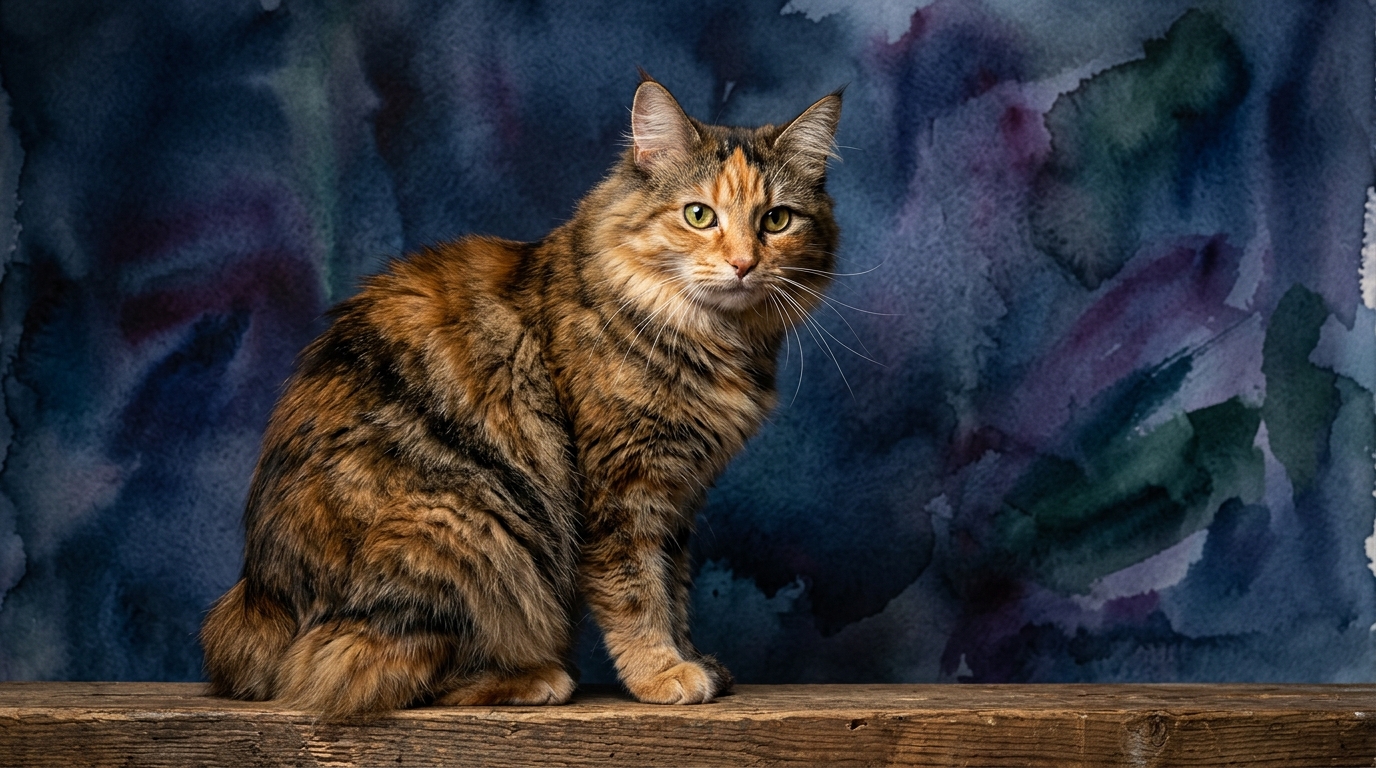
Cymric at a glance
| IQ Rank / Score | 19/25 |
|---|---|
| Trainability | ★★★★☆ (4/5) |
| Social Intelligence | ★★★☆☆ (3/5) |
| Lifespan | 12-16 years |
| Shedding | Low to moderate |
| Exercise Needs | Needs active play (45-60 min/day) |
| Origin | Canada (Manx variant) |
Introduction to Cymric Intelligence
Known for their distinctive lack of a tail and a playful, often 'dog-like' demeanor, the Cymric cat is far more than just a pretty face; they possess a fascinating and dynamic intelligence that captivates their human companions. At The Cosmic Pet's Pet IQ Lab, we delve deep into the cognitive landscape of these unique felines, exploring what makes the long-haired Manx variant a truly exceptional intellectual force in the feline world. Hailing from Canadian origins as a variant of the famed Manx, the Cymric showcases a blend of sharp wits, profound curiosity, and a remarkable capacity for learning, distinguishing them as one of the most cognitively engaging cat breeds. Their medium build belies an agile mind, constantly observing, assessing, and interacting with their environment in ways that often surprise and delight their human families. This comprehensive profile unpacks the core facets of Cymric intelligence, from their unique problem-solving approaches to their surprising historical adaptations, offering insights into how to best nurture and understand their extraordinary minds.
The Primary Angle: Adaptive Problem-Solving and Strategic Agility
The defining cognitive characteristic of the Cymric cat lies in their *adaptive problem-solving and strategic agility*, a trait deeply intertwined with their intense curiosity and energetic disposition. Unlike some feline counterparts whose intelligence might lean towards subtle observation or quiet contemplation, Cymrics are active participants in their cognitive development, constantly seeking to understand and manipulate their surroundings. This manifests as a proactive engagement with challenges, whether it's figuring out how to open a cupboard, retrieve a hidden toy, or navigate complex physical spaces. Their intelligence isn't just about speed; it's about a persistent, methodical approach to obstacles, often employing trial-and-error coupled with remarkable memory for successful strategies. They demonstrate an almost 'engineered' approach to their environment, consistently learning from interactions and refining their methods for future success. This innate drive to explore and master their domain ensures they are perpetually learning, turning every interaction into a cognitive exercise. Their agility, both physical and mental, allows them to experiment with different solutions, making them exceptionally skilled at overcoming barriers and achieving their desired outcomes. This dynamic interplay between their physical prowess and sharp intellect truly sets the Cymric apart, fostering an intelligent companion who is both engaging and remarkably resourceful.
A Surprising Twist: The Genetic Blueprint of Balance and Spatial Cognition
While the Cymric's most iconic feature is their lack of a tail, a surprising cognitive implication arises from this genetic blueprint: an extraordinarily refined sense of *proprioception and spatial awareness*. A cat's tail is a complex appendage, playing a critical role in balance, agility, and non-verbal communication. For Cymrics, the absence of this natural counterbalance isn't a deficit but a profound adaptive challenge that their cognitive systems have expertly mastered over generations. Their brains are continuously engaged in a more complex level of sensory processing, integrating heightened input from their powerful hind legs, muscular back, and highly developed vestibular system (inner ear). This isn't merely a physical compensation; it's a deep-seated cognitive recalibration. Every jump, turn, and landing requires precise, real-time calculation of body position, momentum, and environmental cues, demanding superior spatial reasoning and motor planning. This constant, high-level cognitive calibration means a Cymric's internal 'GPS' and bodily schema are likely more intricate and continuously updated than those of tailed breeds. It reflects a sophisticated neural network dedicated to maintaining equilibrium and executing precise movements without the aid of a caudal rudder. This fascinating adaptation means their understanding of their body in space, and their ability to navigate complex terrains, operates at a highly specialized and continuously adaptive level, making their 'built-in' spatial intelligence truly exceptional.
The Cymric Cognitive Profile: Unpacking Their IQ Scores
At The Cosmic Pet's Pet IQ Lab, we assess feline intelligence across several key dimensions, providing a comprehensive snapshot of a breed's cognitive strengths. The Cymric's profile reveals a cat that is not only smart but also highly engaged and trainable, earning them above-average scores in many areas. Their *problem-solving* capabilities are rated at a notable 4 out of 5, a reflection of their inherent curiosity and persistence in overcoming environmental challenges, from deciphering puzzle toys to mastering the art of opening doors. This score highlights their proactive approach to novel situations and their ability to learn from previous experiences. Their *training speed* also earns an impressive 4 out of 5, distinguishing them among felines for their remarkable receptiveness to learning tricks and commands. This 'dog-like' trait makes them highly rewarding companions for those who enjoy interactive training, showcasing their capacity for associative learning and retention. In terms of *social intelligence*, the Cymric scores a solid 3 out of 5. While they form deep bonds with their human families and often display affectionate, companionable behaviors, they retain a degree of feline independence. They are perceptive to human moods and cues but may not always be driven by a desire for constant interaction in the same way a highly social dog might be. Their *instinctive drive* is strong, rated at 4 out of 5. As natural hunters, they possess a keen predatory instinct, coupled with a high play drive that often mimics hunting behaviors. This instinctual intelligence drives their curiosity, exploration, and the energetic engagement characteristic of the breed. Finally, their *memory* is rated at 4 out of 5, supporting their ability to retain complex learned behaviors, remember people, places, and successful strategies for problem-solving. This robust memory underpins their overall intelligence, allowing them to build a rich internal map of their world and experiences.
Beyond the Brain: Instincts and Emotional Intelligence in the Cymric
Cymric intelligence extends far beyond mere problem-solving; it is deeply interwoven with their powerful instincts and a subtle, yet profound, emotional intelligence. Their inherent curiosity, rated highly in instinctive drive, serves as a primary driver for cognitive development. This isn't just a playful urge; it's a fundamental quest for understanding their environment, pushing them to explore, investigate, and learn through direct experience. This strong investigative instinct means they are constantly gathering information, which their sharp minds then process and store, contributing to their impressive memory and adaptive skills. Furthermore, Cymrics often display a nuanced emotional intelligence, particularly within their tightly knit family units. While not overtly expressive in the manner of some dog breeds, they are highly attuned to the emotional states of their human companions, often offering comfort or seeking interaction when sensing distress. This capacity for empathy, coupled with their strong bonds, suggests a sophisticated understanding of social dynamics within their chosen 'pride.' Their 'dog-like' loyalty often translates into following owners around the house, participating in family activities, and demonstrating clear preferences for certain individuals. This blend of strong predatory instincts, driving their physical and mental engagement, and their capacity for emotional connection creates a well-rounded and deeply intelligent companion. They learn not just through repetition, but also through observation of their humans, adjusting their behavior based on cues, demonstrating a genuine understanding of their place within the family structure.
Cymric Intelligence in Daily Life: Manifestations and Engagement
Observing a Cymric in their daily routine offers countless examples of their impressive intelligence at play. Their heightened problem-solving skills are evident as they figure out how to open cabinets, turn on faucets, or even activate light switches, often to their owner's amused frustration. These are not random acts but calculated attempts to interact with and control their environment, driven by curiosity and a desire for engagement. Their 'dog-like' playfulness is another key manifestation of their intelligence, as they eagerly engage in games of fetch, bringing toys back for repeated throws – a behavior relatively uncommon in most cat breeds. This isn't just a game; it's a demonstration of their understanding of object retrieval, associative learning (toy = throw = fun), and a desire to engage socially with their human. The Cymric’s strong memory is also apparent in their routines; they often anticipate mealtimes, know the specific sounds of their owner's car, or remember where a favorite toy was hidden weeks ago. This reliable memory underpins their ability to navigate complex home environments and adapt to minor changes without distress. Furthermore, their instinctive drive to explore means they will thoroughly investigate new objects or changes in their environment, applying their sharp minds to understand novel stimuli. Their strategic agility, honed by generations of tailless adaptation, allows them to navigate shelves, jump to high perches, and maneuver through tight spaces with remarkable grace and precision, constantly optimizing their movements. Living with a Cymric is a continuous lesson in feline ingenuity, as they consistently find new ways to interact with their world and their people, making every day an adventure.
Training a Cymric: Nurturing Their Sharp Minds
Given their high scores in training speed and problem-solving, Cymric cats are exceptionally receptive to training, making them a joy for owners who wish to engage their feline's intellect. Early socialization and consistent positive reinforcement are key to maximizing their potential. Start with basic commands like 'sit' or 'stay' using high-value treats and clear vocal cues. Their impressive memory means that once a trick is learned, it is often retained for a long time. Moving on to more complex behaviors like fetching, walking on a leash, or even performing agility courses can be highly rewarding, leveraging their natural athleticism and curiosity. Puzzle feeders are an excellent way to provide mental stimulation, transforming mealtime into a cognitive challenge that satisfies their problem-solving drive. Rotate toys and introduce novel objects regularly to keep their investigative instincts sharp and prevent boredom-induced mischief. Beyond formal training, simply engaging them in interactive play, talking to them, and providing a stimulating environment filled with climbing structures and hiding spots will nurture their intelligent and curious nature. Understanding their unique adaptive agility and encouraging their inherent desire to explore ensures a well-adjusted and mentally stimulated Cymric companion.
Debunking the Myth: The Agility of the Tailless Wonder
Perhaps the most pervasive myth surrounding the Cymric, and their Manx cousins, is that their lack of a tail renders them clumsy, unbalanced, or less agile than tailed cats. This misconception stems from the common understanding that a cat's tail acts as a crucial counterbalance, akin to a tightrope walker's pole. However, the truth reveals a remarkable feat of feline evolution and cognitive adaptation. Cymrics are far from clumsy; instead, they have developed extraordinary compensatory mechanisms, effectively 'rewiring' their brain-body coordination. Their powerful, springy hind legs, combined with a robust musculature and an incredibly sensitive inner ear, allow them to maintain impeccable balance. They learn to adjust their entire body weight, shifting their center of gravity with subtle movements, executing jumps, turns, and landings with precision that often rivals, if not surpasses, tailed breeds. This adaptive agility is a testament to their intelligence, as their brains continuously process and refine complex spatial data to navigate their environment seamlessly. The myth of clumsiness not only underestimates their physical prowess but also overlooks the sophisticated cognitive adaptations that allow these tailless wonders to thrive, demonstrating that true agility is not solely dependent on a single appendage, but on an intelligent, adaptable organism.
The Cosmic Pet's Pet IQ Lab: Recommended Tests for the Cymric
To truly understand the depth of a Cymric's cognitive abilities, The Cosmic Pet's Pet IQ Lab recommends specific tests designed to highlight their unique strengths. These evaluations are chosen to assess their innate problem-solving, trainability, and spatial intelligence. Each test provides valuable insights into how these clever cats interact with their world.
3 At-Home Tests to Measure Your Cymric's IQ
These tests are adapted from peer-reviewed ethology research. No equipment is needed beyond items you have at home. Run each test 5–10 times for reliable results.
The Myth: "Cymric cats, due to their lack of a tail, are clumsy, lack agility, or struggle with balance compared to their tailed counterparts."
✅ While a cat's tail is indeed vital for balance and signaling, Cymrics have evolved extraordinary compensatory mechanisms. Their powerful hind legs, muscular build, and highly developed inner ear contribute to an exceptional sense of balance. They learn to adjust their body weight and utilize their robust physique for agile maneuvers, often demonstrating impressive jumping and climbing abilities that belie the myth of clumsiness. Their intelligence actively contributes to these adaptations, as their brains continuously fine-tune their spatial awareness and motor control to operate without a tail.
Cymric vs. Similar Breeds
🧠 What's Your Cat's IQ Score?
Our full Pet IQ Lab assessment includes 12+ tests across 5 cognitive dimensions, calibrated for Cymrics specifically.
Take the Full IQ Test →Frequently Asked Questions
How smart is a Cymric?
Our Pet IQ Lab framework scores cognition across five dimensions (max 25). The Cymric totals 19/25 — very high for a domestic cat. The full article breaks down each dimension with at-home tests.
Are Cymrics easy to train?
Cymrics are generally easy to train when you use consistent, reward-based sessions. They score 4/5 on Training Speed in our breed profile.
Are Cymrics good with children and other pets?
Cymrics can live well with families when socialized early. Their Social Intelligence scores 3/5, so supervise interactions with small children and introduce new pets gradually.
Do Cymrics need a lot of mental stimulation?
Absolutely. With Problem Solving 4/5 and Instinctive Drive 4/5, Cymrics need daily mental work — puzzle feeders, scent games, training sessions, or interactive wand toys — to avoid boredom.
How much exercise does a Cymric need?
Cymrics need active engagement. Plan for 45-60 minutes of play and climbing per day, plus mental stimulation.
How good is a Cymric's memory?
Cymrics score 4/5 on memory. They remember routines, hiding spots, and learned cues for months, sometimes years.
What is the typical lifespan of a Cymric?
Most Cymrics live 12-16 years with good veterinary care, quality diet, and indoor living.
The Cymric cat stands as a testament to feline cognitive diversity, blending innate curiosity with remarkable adaptive problem-solving skills and a striking capacity for social engagement. Understanding their unique intelligence not only deepens our appreciation for this magnificent breed but also enriches the bond we share with these clever, tailless companions, inviting us to engage with their world in more stimulating and rewarding ways.