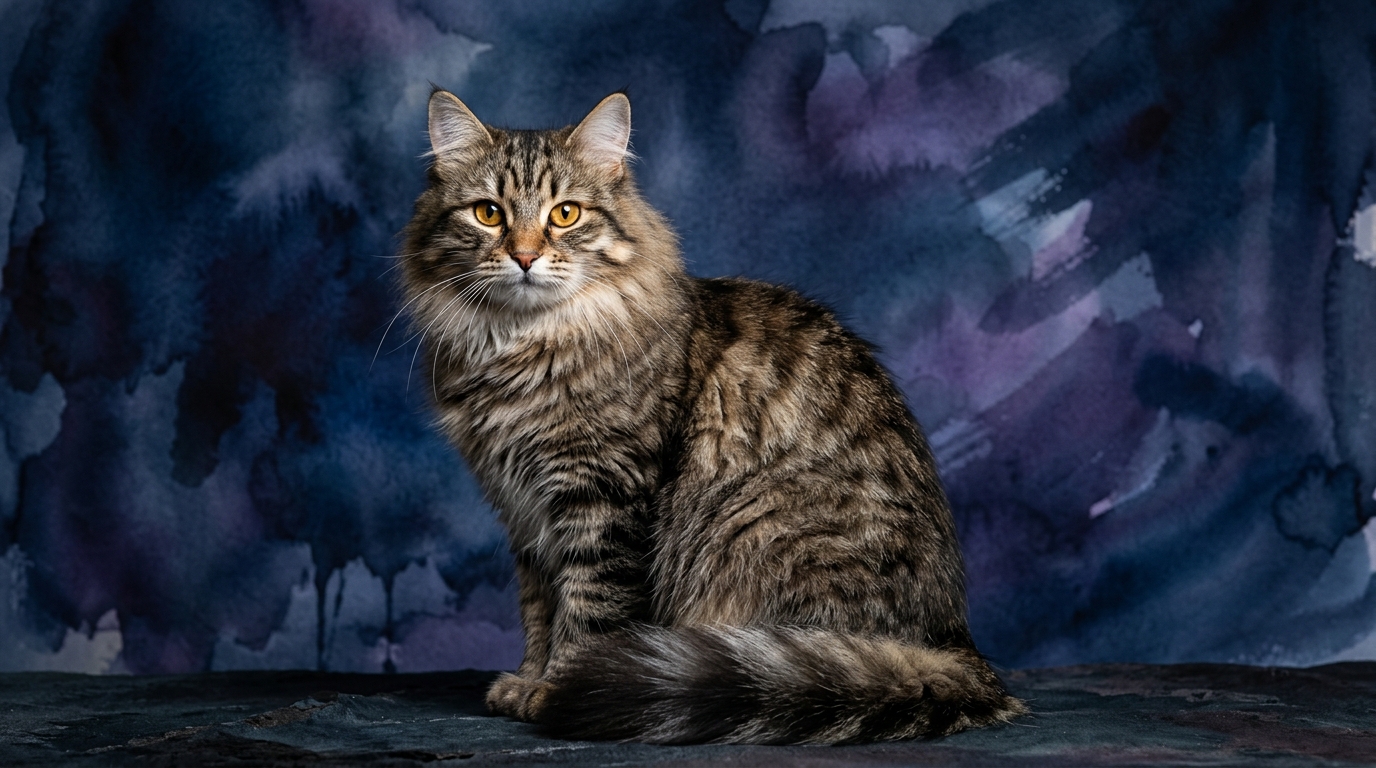
Siberian at a glance
| IQ Rank / Score | 20/25 |
|---|---|
| Trainability | ★★★☆☆ (3/5) |
| Social Intelligence | ★★★★☆ (4/5) |
| Lifespan | 12-16 years |
| Shedding | Moderate to high |
| Exercise Needs | Needs active play (45-60 min/day) |
| Origin | Russia |
The Resourceful Environmental Navigator: Siberian's Primary Cognitive Angle
The Siberian cat’s intelligence is fundamentally shaped by its origins as a landrace breed, naturally evolving in the unforgiving Russian wilderness. This demanding environment forged a cat whose primary cognitive angle is that of a 'Resourceful Environmental Navigator.' Unlike many domestic breeds, Siberians possess an innate, highly developed capacity for problem-solving in complex, dynamic natural settings, driven by an acute awareness of their surroundings and a strong drive for self-sufficiency.
This unique cognitive bent manifests in their exceptional spatial reasoning and motor planning. Whether it's navigating dense undergrowth, scaling trees to reach a vantage point, or cleverly outsmarting prey, Siberians excel at assessing their environment and devising effective physical solutions. Their ancestors survived by intuitively understanding physics and topography, skills still evident in their playful yet purposeful explorations of human homes.
Their resourcefulness isn't just about hunting; it extends to finding comfort and safety. A Siberian cat might be observed meticulously planning an ascent to a high shelf, or figuring out how to open a cupboard to investigate, demonstrating a persistent and adaptive approach to achieving their goals. This profound connection to their environment makes them exceptionally observant and quick to learn the layout and routines of their human homes.
Beyond the Hearth: A Surprising Glimpse into Siberian Cognition
While often admired for their beauty and companionship today, historical records reveal a surprising dimension to the Siberian cat's cognition and role in human society. Far from being mere mousers, Siberians were historically valued by Russian monasteries and homes as 'guard cats.' This designation hints at an unusual level of territorial awareness and protective instinct, distinguishing them from most feline breeds.
This historical role suggests a more complex social and cognitive profile than typically attributed to cats. A 'guard cat' would need keen observational skills, an ability to discern familiar from unfamiliar, and potentially a readiness to signal or even deter perceived threats. This goes beyond simple self-preservation, implying a cognitive capacity for understanding and acting upon a shared protective instinct alongside humans.
This surprising aspect underscores the Siberian’s innate intelligence and adaptability, demonstrating their capacity to integrate into human social structures in unique and demanding ways. It highlights their watchful nature and perhaps a deeper, more intertwined history with human communities than previously assumed, showcasing a cognitive flexibility that allowed them to fulfill roles beyond basic pest control.
Siberian IQ Breakdown: A Holistic View
The Cosmic Pet's Pet IQ Lab assesses feline intelligence across five key dimensions, providing a comprehensive understanding of a breed's cognitive strengths. For the Siberian, their scores reflect their semi-wild heritage and strong natural instincts, balanced with their profound social aptitude. These scores are relative to other feline breeds, highlighting where the Siberian truly shines.
Their Problem Solving score of 4 out of 5 underscores their capacity for creative solutions, particularly when faced with physical or environmental challenges. This is evident in their persistent attempts to reach coveted items or navigate intricate spaces. Training Speed, rated at 3 out of 5, reflects that while intelligent and capable of learning tricks, they retain a characteristic feline independence that means training requires patience and positive reinforcement, rather than instant obedience.
Social Intelligence, at 4 out of 5, showcases their remarkable ability to bond with humans and other pets, understanding social cues and communicating effectively. Their Instinctive Drive, a perfect 5 out of 5, is a testament to their strong hunting prowess, exploratory nature, and self-preservation instincts, deeply rooted in their origins. Finally, a Memory score of 4 out of 5 signifies their excellent recall for people, routines, and past experiences, aiding in their navigation and social interactions within their environment.
Why Size Matters: Physicality and Problem-Solving
The Siberian cat's large, robust build isn't merely for show; it's intricately linked to their cognitive approach to problem-solving. Their powerful musculature, impressive agility, and dense triple coat are all adaptations that historically supported their survival and, in turn, shaped their intelligence. A larger, stronger cat can tackle different kinds of physical challenges, and this capability influences how they perceive and interact with their world.
For a Siberian, a problem isn't just an abstract puzzle; it's often a physical obstacle that requires strategic planning and execution. Their enhanced proprioception (awareness of their body in space) allows them to navigate complex three-dimensional environments with grace and precision. This translates into a 'think-with-their-body' approach to problem-solving, where physical exploration and manipulation are often the first steps in understanding a new challenge.
Their size also contributes to their confidence in exploring novel environments, further stimulating their cognitive development. A smaller, more delicate cat might be hesitant to investigate a precarious perch or push open a heavy door, but the Siberian's physical prowess encourages a more direct and often successful engagement with their surroundings, solidifying their reputation as resourceful and capable problem-solvers.
The Social Savvy Siberian: Emotional Intelligence
Beyond their impressive physical and environmental problem-solving skills, Siberians possess a remarkable degree of social and emotional intelligence. They are known for forming deep, affectionate bonds with their human companions, often displaying a dog-like loyalty and a desire to be involved in household activities. This isn't just passive companionship; it's active engagement rooted in sophisticated social cognition.
Siberians are highly attuned to human emotions and body language, often providing comfort or seeking interaction when they sense their owners are distressed or joyful. Their distinctive chirping and trilling vocalisations are part of a rich communication repertoire, demonstrating an advanced ability to express their needs and desires within a social context. This capacity for nuanced interaction speaks volumes about their social intelligence.
Their ability to coexist harmoniously with children and other pets further highlights their social adaptability. They typically demonstrate patience and a gentle nature, often acting as peacemakers or engaging in interactive play rather than exhibiting aggression. This complex social navigation is a hallmark of their evolved intelligence, allowing them to thrive in diverse family dynamics.
The Hunter's Mind: Instincts and Environmental Awareness
The Siberian cat's powerful instinctive drive, reflected in their top IQ score, is intrinsically linked to their keen environmental awareness and memory. As apex predators in their natural habitat, every sensory input and learned experience contributes to their survival skills. Their intelligence isn't just about 'thinking' but about 'knowing' their world through an intricate web of instinct and learned data.
Their superior memory is crucial for recalling successful hunting strategies, safe routes, and the location of resources within their territory. This cognitive mapping extends into the home, where they quickly learn the layout, the location of their favorite toys, and the routines of their human family members. Deviations from these routines are often noticed and reacted to, showcasing their strong environmental monitoring capabilities.
Furthermore, their instinctive curiosity drives continuous exploration and learning. A new scent, a subtle change in the environment, or a novel object instantly triggers their investigative intellect. This relentless pursuit of understanding their surroundings, guided by powerful instincts, solidifies the Siberian's reputation as a highly aware and intelligently adaptive feline, always processing and remembering their world.
3 At-Home Tests to Measure Your Siberian's IQ
These tests are adapted from peer-reviewed ethology research. No equipment is needed beyond items you have at home. Run each test 5–10 times for reliable results.
The Myth: "Siberian cats are too wild, untrainable, or overly independent due to their natural origins."
✅ While certainly exhibiting strong natural instincts, Siberians are renowned for their affectionate, social, and intelligent nature. They often form deep bonds with their human families and readily engage in interactive play and training, dispelling any notions of untrainability; many Siberians enjoy learning tricks and playing fetch.
Siberian vs. Similar Breeds
🧠 What's Your Cat's IQ Score?
Our full Pet IQ Lab assessment includes 12+ tests across 5 cognitive dimensions, calibrated for Siberians specifically.
Take the Full IQ Test →Frequently Asked Questions
How smart is a Siberian?
Our Pet IQ Lab framework scores cognition across five dimensions (max 25). The Siberian totals 20/25 — very high for a domestic cat. The full article breaks down each dimension with at-home tests.
Are Siberians easy to train?
Siberians can learn most cues, but expect to repeat lessons and keep sessions short. They score 3/5 on Training Speed in our breed profile.
Are Siberians good with children and other pets?
Yes — their Social Intelligence rates 4/5 in our Pet IQ Lab framework. With early socialization and supervised play, most Siberians integrate well into families with respectful children and other pets.
Do Siberians need a lot of mental stimulation?
Absolutely. With Problem Solving 4/5 and Instinctive Drive 5/5, Siberians need daily mental work — puzzle feeders, scent games, training sessions, or interactive wand toys — to avoid boredom.
How much exercise does a Siberian need?
Siberians need active engagement. Plan for 45-60 minutes of play and climbing per day, plus mental stimulation.
How good is a Siberian's memory?
Siberians score 4/5 on memory. They remember routines, hiding spots, and learned cues for months, sometimes years.
What is the typical lifespan of a Siberian?
Most Siberians live 12-16 years with good veterinary care, quality diet, and indoor living.
The Siberian cat stands as a testament to natural selection, boasting a unique intelligence shaped by centuries of survival in challenging environments. Their blend of keen problem-solving, deep social bonds, and potent instincts makes them not just beautiful companions, but truly fascinating subjects of cognitive study at The Cosmic Pet's Pet IQ Lab.