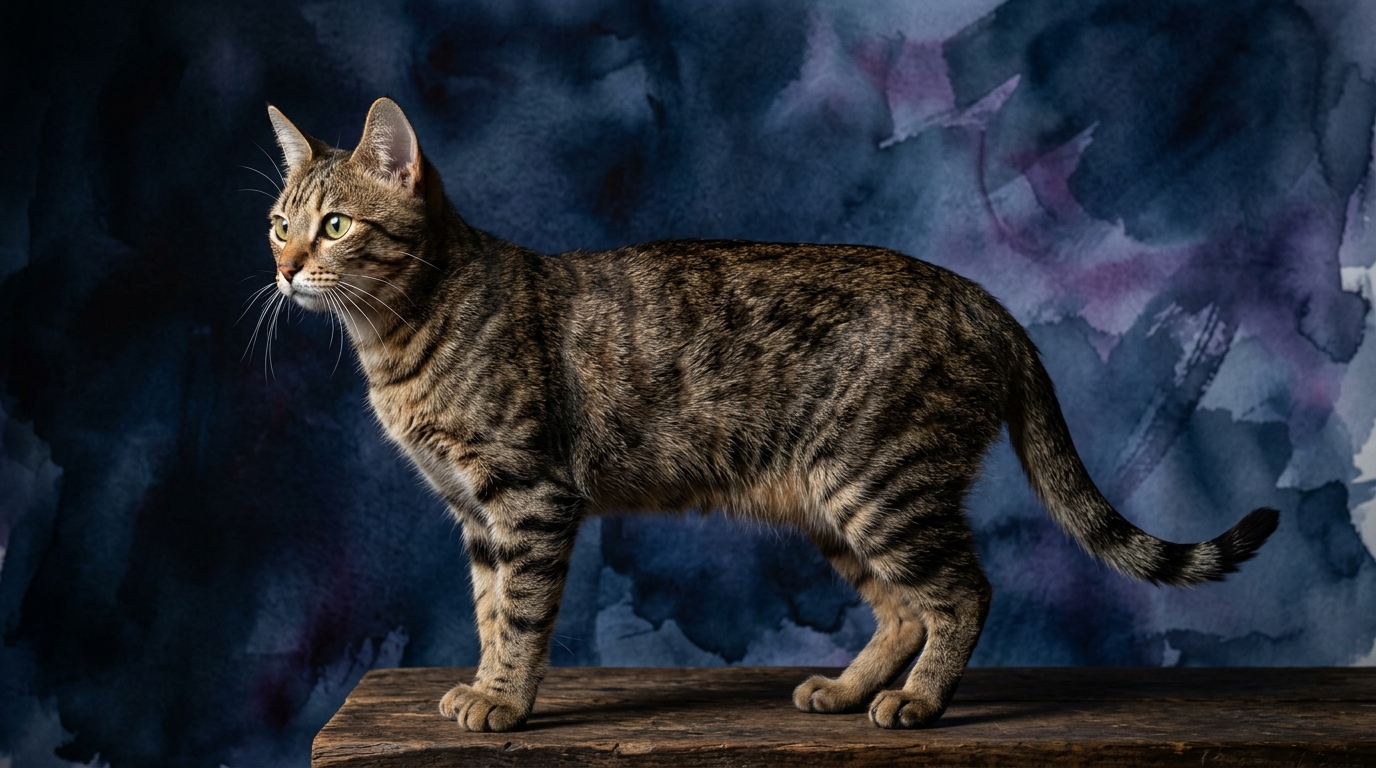
Sokoke at a glance
| IQ Rank / Score | 20/25 |
|---|---|
| Trainability | ★★★★☆ (4/5) |
| Social Intelligence | ★★★☆☆ (3/5) |
| Lifespan | 12-16 years |
| Shedding | Low to moderate |
| Exercise Needs | Needs active play (45-60 min/day) |
| Origin | Kenya |
The Sokoke Intellect: A Legacy of the Forest
The primary angle of Sokoke intelligence revolves around their exceptional environmental awareness and problem-solving skills, deeply rooted in their wild ancestry. They evolved to navigate complex, resource-rich forest terrains, developing a cognitive profile centered on acute observation, rapid adaptation, and strategic interaction. This inherent brilliance extends beyond survival, manifesting as a unique capacity for social learning within their bonded human 'pride,' making them more interactive and trainable than their wild appearance might suggest.
Unlike many domesticated breeds, the Sokoke's cognitive framework is heavily influenced by dynamic natural ecosystems. This fosters a mind that is perpetually alert, analyzing environmental nuances, and formulating solutions to novel situations with remarkable ingenuity. Their intelligence is a holistic understanding of cause and effect, an ability to predict outcomes, and an innate drive to explore and master their domain.
Instinctive Genius: From Hunter to Companion
The Sokoke's instinctive drive is perhaps its most defining cognitive trait, scoring a perfect 5 on our IQ scale. Their lineage as natural forest hunters imbued them with a profound connection to their environment, showcasing sharp predatory instincts, exceptional agility, and insatiable curiosity. This translates to understanding complex spatial relationships, anticipating movements, and utilizing environment for tactical advantage, skills readily transferred to interactive play.
A surprising aspect of Sokoke cognition lies in their unique affinity for water. Unlike many domestic breeds, Sokokes often play in, or even swim in, water. This is a historical cognitive adaptation from their ancestral forest environment in Kenya. Riparian zones and water sources were integral to hunting and survival, requiring a distinct form of environmental spatial intelligence and a lack of inherent fear towards water, providing a survival advantage for pursuing aquatic prey or navigating flooded areas.
Solving the Wild's Puzzles: Sokoke Problem-Solving
With a problem-solving score of 4, the Sokoke exhibits an impressive capacity for independent thought and strategic action. Their natural environment demands constant intellectual engagement, fostering an innate ability to devise creative solutions to challenges. This manifests as figuring out how to open complex latches, navigating intricate obstacles, or even manipulating humans to achieve a goal. They are not content with simple answers and will experiment with approaches until success.
This high aptitude for problem-solving is intrinsically linked to their observational skills. A Sokoke meticulously assesses a situation, remembers previous attempts, and adapts its strategy. They demonstrate a persistent and curious approach, often returning to a puzzle until it's solved. This makes them excellent candidates for puzzle toys and interactive games that truly challenge their intellect.
The Loyal Heart: Decoding Sokoke Social Intelligence
The Sokoke cat's social intelligence, rated a solid 3, is nuanced and deeply personal. They form incredibly strong, loyal bonds with their chosen human families, often described as 'dog-like' in their devotion. This is not indiscriminate friendliness; rather, it's a profound capacity for selective attachment, recognizing and remembering their core group. They are highly communicative within their family unit, using varied vocalizations and body language.
While initially reserved with strangers, once a Sokoke accepts you, their affection is unwavering. This social acumen involves understanding routines, anticipating human actions, and even mirroring emotions, showcasing deep emotional intelligence. They thrive on interaction, following their favorite people and actively seeking engagement through play or cuddles. Their social intelligence is geared towards creating a strong, cohesive family unit, echoing their natural pack mentality.
Training a Sokoke: A Partnership of Minds
Sokokes boast an impressive training speed, earning a score of 4, surprising many. Their keen intelligence, combined with their desire for interaction and strong bond, makes them remarkably receptive to training. They quickly pick up cues, learn complex tricks, and can even be leash-trained, enjoying walks. This trainability is a testament to their cognitive flexibility and willingness to engage in structured learning, especially with positive reinforcement.
Their memory, also rated at 4, plays a crucial role in rapid learning and retention. Sokokes remember commands, routines, and specific individuals with clarity, making training efficient. They recall complex action sequences and apply learned solutions to similar problems. This strong memory also contributes to their sense of routine and comfort, recognizing patterns and anticipating events, a hallmark of a highly intelligent and adaptable feline.
Sokoke IQ Scores at The Cosmic Pet's Pet IQ Lab
At The Cosmic Pet's Pet IQ Lab, we've carefully evaluated the Sokoke's unique cognitive strengths, assigning scores on a 1-5 scale. Their exceptional problem-solving abilities (4/5) and rapid training speed (4/5) highlight their quick wit and adaptability. A strong social intelligence (3/5) reflects their deep, selective bonds, while their unparalleled instinctive drive (5/5) underscores their wild heritage. Finally, a robust memory (4/5) ensures they retain learned information and navigate their world with confidence, presenting a holistic picture of a truly intelligent feline.
3 At-Home Tests to Measure Your Sokoke's IQ
These tests are adapted from peer-reviewed ethology research. No equipment is needed beyond items you have at home. Run each test 5–10 times for reliable results.
The Myth: "The most pervasive myth about Sokoke intelligence is that their 'wild' appearance and natural forest origins mean they are untrainable, fiercely independent, or lack the capacity for deep bonding with humans."
✅ In reality, Sokokes are highly social, forming profound bonds with their families, displaying remarkable loyalty and 'dog-like' behaviors such as fetching and walking on a leash, demonstrating high social intelligence and trainability with patience and positive reinforcement. They are intensely affectionate with their chosen humans.
Sokoke vs. Similar Breeds
🧠 What's Your Cat's IQ Score?
Our full Pet IQ Lab assessment includes 12+ tests across 5 cognitive dimensions, calibrated for Sokokes specifically.
Take the Full IQ Test →Frequently Asked Questions
How smart is a Sokoke?
Our Pet IQ Lab framework scores cognition across five dimensions (max 25). The Sokoke totals 20/25 — very high for a domestic cat. The full article breaks down each dimension with at-home tests.
Are Sokokes easy to train?
Sokokes are generally easy to train when you use consistent, reward-based sessions. They score 4/5 on Training Speed in our breed profile.
Are Sokokes good with children and other pets?
Sokokes can live well with families when socialized early. Their Social Intelligence scores 3/5, so supervise interactions with small children and introduce new pets gradually.
Do Sokokes need a lot of mental stimulation?
Absolutely. With Problem Solving 4/5 and Instinctive Drive 5/5, Sokokes need daily mental work — puzzle feeders, scent games, training sessions, or interactive wand toys — to avoid boredom.
How much exercise does a Sokoke need?
Sokokes need active engagement. Plan for 45-60 minutes of play and climbing per day, plus mental stimulation.
How good is a Sokoke's memory?
Sokokes score 4/5 on memory. They remember routines, hiding spots, and learned cues for months, sometimes years.
What is the typical lifespan of a Sokoke?
Most Sokokes live 12-16 years with good veterinary care, quality diet, and indoor living.
The Sokoke cat stands as a testament to sophisticated intelligence forged in nature, offering a uniquely engaging and profoundly rewarding companionship. Their blend of keen instincts, remarkable trainability, and deep loyalty makes them not just pets, but active, intelligent partners, continually enriching families with their wild grace and clever minds.