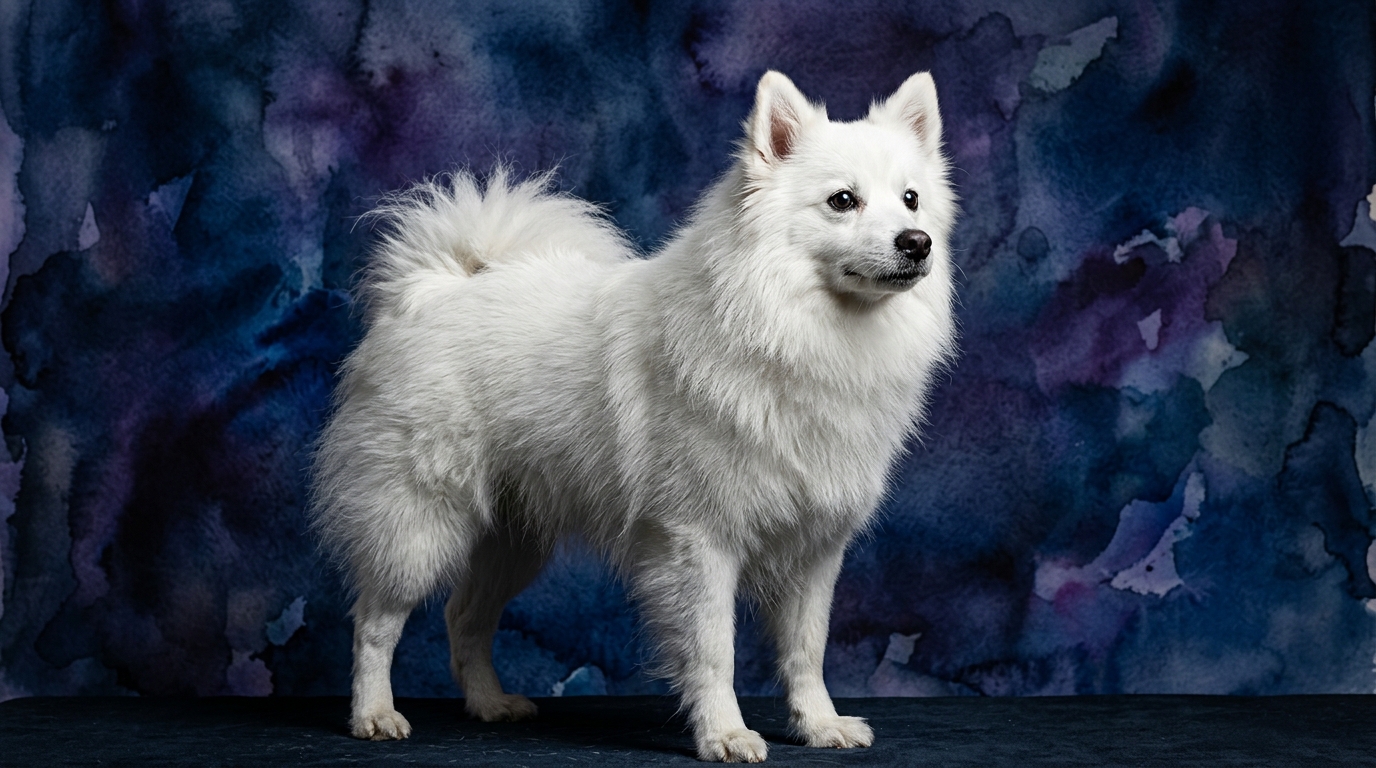

Side-by-Side Cognitive Profiles: Decoding Identical Scores
At first glance, the American Eskimo Dog (AED) and the Tibetan Terrier (TT) present a perplexing similarity in their Cosmic Pet Pet IQ Lab scores. Each breed registers a consistent 3/5 across problem-solving, training speed, social intelligence, instinctive drive, and memory. However, these identical metrics don't imply identical minds; rather, they highlight how a moderate level of cognitive ability can manifest uniquely based on a breed's evolutionary path and purpose.
For the **American Eskimo Dog**, a 3/5 in **Problem Solving** often translates to a cleverness in navigating human-centric puzzles, such as figuring out how to retrieve a hidden toy or manipulate a treat dispenser. Their **Training Speed** at 3/5 indicates a readiness to learn new commands and tricks efficiently, particularly when positive reinforcement and human attention are involved. Their **Social Intelligence** (3/5) is typically expressed through a keen awareness of human emotions and a strong desire to engage and please, often making them highly responsive companions. An **Instinctive Drive** of 3/5 reflects their moderate inclination towards play and companionship, without strong predatory or herding urges. Finally, their **Memory** (3/5) allows them to retain a wide repertoire of learned behaviors and social cues over time.
The **Tibetan Terrier**, in contrast, embodies its 3/5 scores with a different cognitive flavor. Their **Problem Solving** at 3/5 often involves navigating complex physical environments, assessing novel situations, or independently figuring out solutions to perceived challenges, such as finding the best vantage point or alerting to an unusual sound. A 3/5 in **Training Speed** suggests they learn reliably, though their independent streak means they may require more consistent motivation and a clear understanding of the 'why' behind a command. Their **Social Intelligence** (3/5) is characterized by a discerning nature; they are deeply bonded with their family but often reserved with strangers, reading social cues with a cautious yet perceptive eye. An **Instinctive Drive** of 3/5 points to their historical role as watchdogs and herders of small flocks, manifesting as a territorial awareness and a tendency to 'monitor' their surroundings. Their **Memory** (3/5) is robust for remembering routes, routines, and the specific behaviors of their human and animal companions.
Where the American Eskimo Dog Excels Cognitively
The American Eskimo Dog's cognitive strengths lean heavily into its history as a performer and companion. Their problem-solving acumen, while rated 3/5, shines brightest in tasks requiring sequential learning and fine motor skills, such as mastering a complex series of circus tricks or agility course obstacles. This isn't just about raw intellect, but about an eagerness to collaborate with humans to achieve a shared goal, often for the sheer joy of interaction. Their social intelligence, also 3/5, is particularly adept at interpreting subtle human cues and adjusting their behavior to elicit positive responses, making them exceptional at reading their owners' moods and intentions. This capacity for nuanced social engagement allows them to form incredibly strong, responsive bonds, often anticipating needs before they are explicitly expressed. Their memory, at 3/5, is particularly strong for recalling these social interactions and the specific routines that lead to reward or companionship.
Where the Tibetan Terrier Holds a Cognitive Edge
The Tibetan Terrier's cognitive advantages stem from its ancient role as a 'holy dog' and companion in challenging Himalayan environments, leading to a more independent and observant intelligence. Their 3/5 problem-solving ability often manifests as a resourceful self-sufficiency, adept at assessing and reacting to environmental changes without constant human direction. This might involve navigating a new hiking trail or figuring out how to 'herd' family members into a desired location. Their instinctive drive, also 3/5, is uniquely tuned to vigilance and territorial awareness; they possess a keen sense for detecting novelties or potential intruders, making them naturally alert watchdogs. Unlike the AED's performance-oriented social intelligence, the TT's 3/5 social intelligence is characterized by a discerning perception of strangers and a deep, often subtle, understanding of family dynamics. They process information about their surroundings with a thoughtful, almost contemplative approach, making them excellent at understanding the 'big picture' of their home environment. Their memory, at 3/5, is particularly strong for spatial layouts and the established patterns of their territory.
Training Dynamics: Eagerness vs. Independence
Despite identical 3/5 scores in training speed, the practical experience of training an American Eskimo Dog versus a Tibetan Terrier can feel quite different due to their underlying behavioral motivations. The AED, with its strong desire to please and history as a performer, often approaches training with an enthusiastic 'can-do' attitude. They thrive on positive reinforcement, praise, and the sheer joy of working alongside their human. This eagerness makes them highly responsive to learning complex commands and sequences, often picking them up quickly and enjoying the mental stimulation of a training session. Their social intelligence drives them to excel in interactive learning scenarios.
The Tibetan Terrier, while equally capable of learning (3/5 training speed), often brings a more independent and thoughtful approach to training. They are not inherently driven by a desire to 'perform' for human approval in the same way an AED might be. Instead, they need to understand the purpose or benefit of a command, and their compliance might be more a matter of considered cooperation than eager submission. This doesn't mean they are difficult, but rather that training requires patience, consistency, and a strong, trusting relationship. Owners might find themselves needing to be more creative with motivation, tapping into the TT's curiosity or moderate instinctive drives rather than relying solely on praise. Their discerning social intelligence means they form strong bonds, but they are less likely to blindly follow commands if they don't perceive a valid reason.
Matching Breeds to Lifestyles: Active Engagement vs. Thoughtful Companionship
When considering which breed aligns with a particular owner lifestyle, their cognitive styles play a significant role. The American Eskimo Dog, with its performance-oriented intelligence and strong social drive, thrives with active owners who enjoy engaging in dog sports, teaching new tricks, and providing consistent mental stimulation. They are often vocal and require ample interactive playtime and attention to prevent boredom, which can lead to undesirable behaviors. Owners who appreciate a dog that is eager to be involved in every aspect of family life, and who can dedicate time to training and interactive play, will find an AED a rewarding companion. Their 3/5 instinctive drive for companionship means they want to be where the action is.
The Tibetan Terrier, while adaptable, suits owners who appreciate a dog with a thoughtful, somewhat independent nature. They require regular exercise and mental enrichment but are often content with varied walks, puzzle toys, and opportunities to observe their surroundings. While they bond deeply with their families, their 3/5 social intelligence is more discerning, meaning they might not be as overtly 'needy' for constant interaction as an AED. They are excellent companions for owners who enjoy a dog that can entertain itself for periods, yet still desires close family connection. Owners who appreciate a dog that offers a quiet vigilance and a calm presence, while still enjoying active outings, will find the TT a good fit. Their 3/5 instinctive drive for territorial awareness means they are often content to 'supervise' their home.
The Verdict
Choose the American Eskimo Dog if you desire a highly interactive, eager-to-please companion who thrives on training, performance, and constant engagement, and you are prepared for their vocal nature and need for stimulation.
Opt for the Tibetan Terrier if you seek a discerning, adaptable companion with a thoughtful, independent streak, who offers quiet vigilance and deep family bonds, and you appreciate a dog that learns reliably with consistent, patient guidance.
🧠 Find Your Pet's IQ Score
Our Pet IQ Lab assessment covers 25+ tests across 5 cognitive dimensions — personalized to your breed.
Take the Full IQ Test →Frequently Asked Questions
Are American Eskimo Dogs and Tibetan Terriers good with children?
Both breeds can be excellent with children, provided they are properly socialized and the children are taught respectful interaction. American Eskimo Dogs tend to be more overtly playful and tolerant, while Tibetan Terriers are often patient but may prefer older, more considerate children due to their discerning nature.
Do these breeds require a lot of grooming?
Yes, both breeds require significant grooming. The American Eskimo Dog has a dense double coat that sheds and needs regular brushing to prevent mats. The Tibetan Terrier possesses a long, flowing double coat that does not shed excessively but requires consistent brushing to avoid tangles and matting.
Which breed is more prone to barking?
The American Eskimo Dog tends to be more vocal, often using barks, howls, and 'talking' to communicate and express themselves, especially if bored or seeking attention. The Tibetan Terrier is also known to be vocal, particularly in its role as a watchdog, alerting to strangers or unusual sounds, but generally less incessantly than an Eskie.