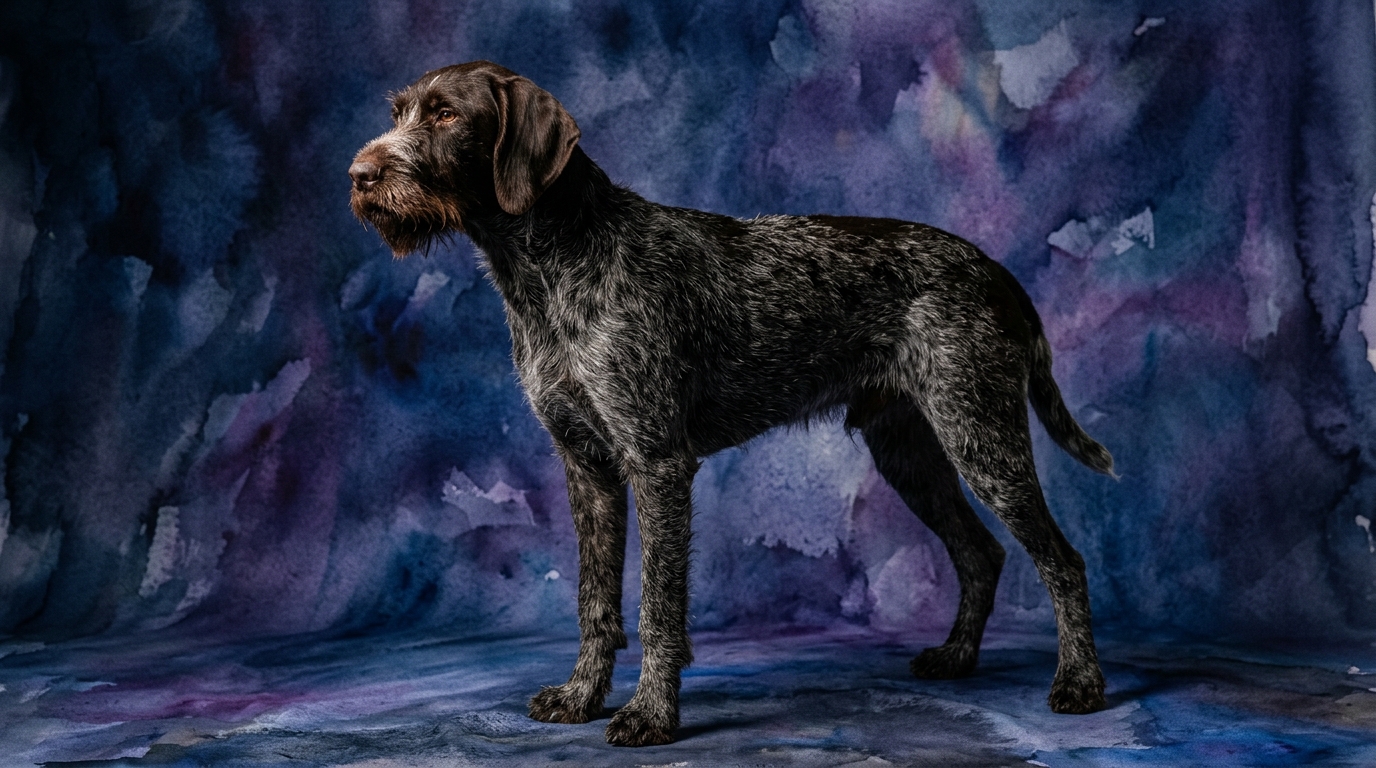
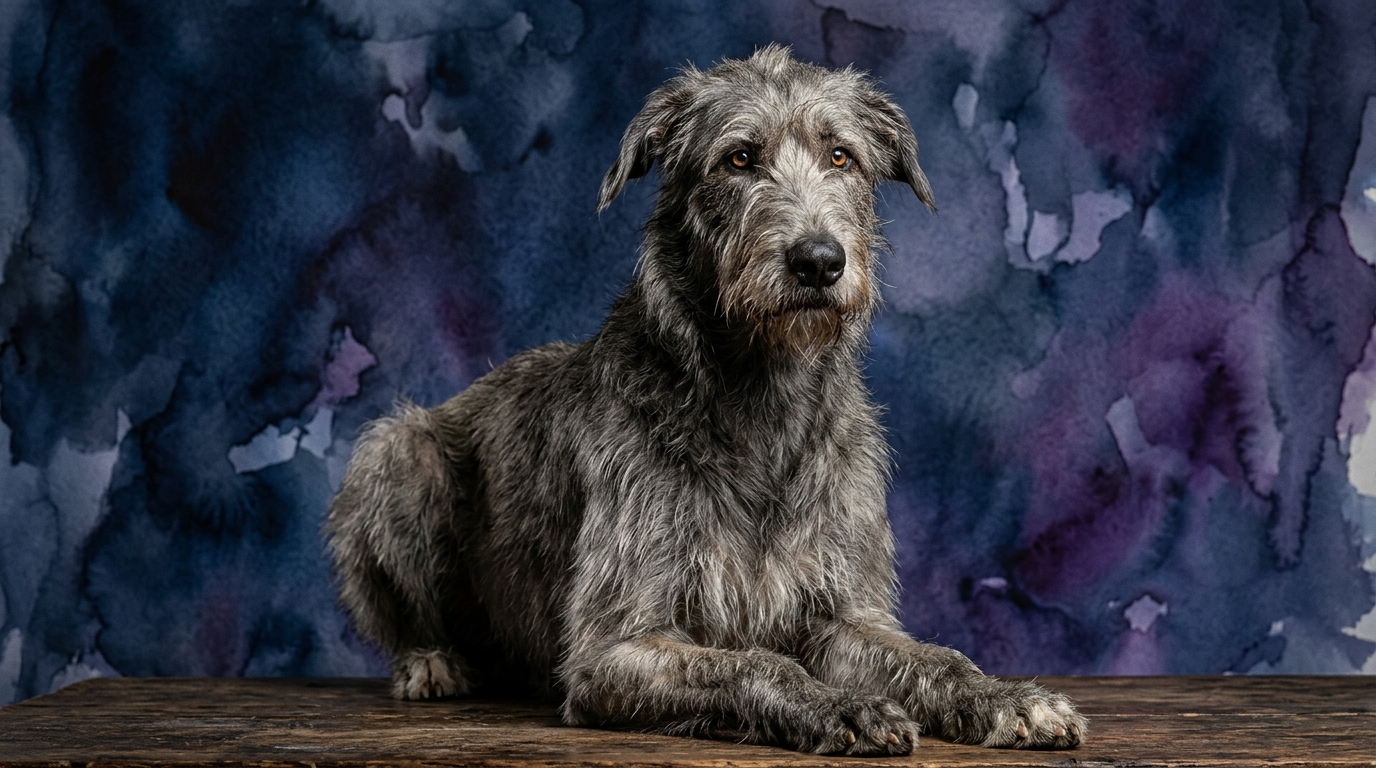
Side-by-Side Cognitive Profiles
At The Cosmic Pet Pet IQ Lab, we evaluate canine intelligence across five key dimensions. For the German Wirehaired Pointer (GWP), a Sporting breed ranked #28 by Coren, its profile is: Problem Solving 4/5, Training Speed 4/5, Social Intelligence 3/5, Instinctive Drive 3/5, and Memory 4/5. This suggests a dog with a strong aptitude for learning and adapting in practical, work-oriented scenarios.
The Irish Wolfhound (IW), a Hound breed not Coren-ranked, presents a different cognitive landscape: Problem Solving 3/5, Training Speed 3/5, Social Intelligence 3/5, Instinctive Drive 3/5, and Memory 3/5. This profile points to a more deliberate and independent thinker, whose intelligence manifests differently from the GWP's task-driven mindset.
The GWP exhibits a robust capacity for assessing complex situations and devising effective solutions, often seen in their ability to track game through varied terrain or navigate intricate field challenges. Their cognitive flexibility allows them to adapt strategies when initial attempts fail. They are quick learners, readily grasping new commands and routines, with an eagerness to work and a strong desire to please contributing to an efficient training process. While capable of forming strong bonds, their social acumen tends to be more utilitarian, focused on cooperative work rather than nuanced emotional mirroring. Possessing a strong natural inclination for hunting, pointing, and retrieving, their instinctive drives are well-honed for their sporting purpose. Their recall of learned commands, past experiences, and familiar routes is commendable, aiding in building upon previous training.
Irish Wolfhounds demonstrate a moderate aptitude for problem-solving, capable of figuring out straightforward obstacles or simple tasks. Their approach is often more considered and less frantic, relying on observation before action, though they might not devise complex multi-step solutions. While certainly trainable, Irish Wolfhounds learn at a steady pace rather than with rapid assimilation. They require patience and positive reinforcement, responding best to clear, consistent commands without excessive repetition, reflecting their independent sighthound nature. These gentle giants are known for their calm and amiable disposition, showing a good understanding of social cues within their family unit, and can be quite sensitive to the moods of their human companions. Their historical role as sighthounds means they possess a strong prey drive, particularly for fast-moving objects, which is less about intricate tracking and more about a powerful chase response. Irish Wolfhounds possess a solid memory for routines, people, and places, allowing for continuity in their learning and relationships.
Where the German Wirehaired Pointer Excels Cognitively
The German Wirehaired Pointer's superior Problem Solving (4/5 vs 3/5) and Training Speed (4/5 vs 3/5) are significant advantages. Their cognitive processing allows them to quickly analyze novel situations, such as figuring out how to retrieve a toy stuck under furniture or navigating an agility course with unexpected obstacles. This isn't just about speed, but about the flexibility to adapt their approach rather than repeating a failed strategy. For example, a GWP might experiment with different angles to dislodge a retrieve, whereas an IW might try the same approach several times or simply give up.
Their stronger Memory (4/5 vs 3/5) means they retain these problem-solving strategies and learned behaviors more effectively over time, reducing the need for constant refreshers. This translates into a dog that can master complex sequences of commands for field trials or advanced obedience with fewer repetitions and recall them reliably months later. While both breeds score 3/5 for Instinctive Drive, a GWP's drive is often channeled into cooperative tasks, making them more inclined to 'work through' a cognitive challenge alongside their handler, whereas an IW's drive is more independent.
Where the Irish Wolfhound Excels Cognitively
While not outscoring the GWP in raw IQ metrics, the Irish Wolfhound's cognitive strengths lie in their approach rather than sheer speed or complexity. Their Social Intelligence (3/5, equal to GWP) is expressed through a quiet, dignified understanding of family dynamics. They often possess an uncanny ability to sense emotional shifts in their humans, offering comfort through their presence without needing overt instruction. This subtle empathy, though not quantifiable as 'winning,' reflects a different facet of social cognition.
Their Problem Solving, while rated lower, is often characterized by a calm, deliberate assessment; they might take longer to solve a puzzle but will do so with a measured approach, less prone to frantic trial-and-error. Their Instinctive Drive (3/5) is less about intricate work and more about powerful, focused bursts for sighthound tasks, which requires a specific type of cognitive processing for target acquisition and pursuit that is distinct from a GWP's detailed tracking. This focused, independent drive means they excel in situations requiring singular determination rather than collaborative problem-solving.
Trainability: German Wirehaired Pointer vs. Irish Wolfhound
The German Wirehaired Pointer is demonstrably easier to train due to its higher scores in Training Speed (4/5 vs 3/5) and Problem Solving (4/5 vs 3/5), coupled with a strong Memory (4/5 vs 3/5). GWPs are bred to work closely with humans, eagerly taking direction and quickly forming associations between commands and actions. Their inherent desire to please and their capacity for rapid learning mean they pick up new skills faster and retain them longer. For instance, teaching a GWP a multi-step retrieve command would likely involve fewer repetitions and faster mastery compared to an Irish Wolfhound.
An Irish Wolfhound, while trainable, often requires more patience and a different approach. Their sighthound heritage imbues them with a more independent spirit; they might understand what you want but choose to comply on their own terms or after a brief consideration. This isn't a lack of cognitive ability, but a difference in motivation and processing style. They learn steadily but may require more consistent reinforcement and less variability in commands to ensure reliable execution. Their training benefits from a calm, respectful approach that acknowledges their thoughtful nature.
Matching Canine Cognition to Lifestyle: Active vs. Relaxed Owners
The German Wirehaired Pointer is an ideal match for active owners. Their robust instinctive drive and high training speed mean they thrive on mental and physical challenges. They excel in activities like hunting, agility, obedience, and extensive hiking, requiring an owner who can consistently provide outlets for their energy and cognitive engagement. A GWP left without sufficient mental stimulation and physical activity can become restless or destructive, using their problem-solving skills to entertain themselves in less desirable ways. Their cognitive profile demands a lifestyle that keeps their minds and bodies actively engaged.
Conversely, the Irish Wolfhound is better suited for more relaxed owners, though 'relaxed' does not mean inactive. While they need regular, moderate exercise—long walks and opportunities to stretch their immense legs in a secure area—they are not built for sustained, high-intensity work like a GWP. Their temperament is generally calm indoors, preferring to lounge after their exercise. Owners who appreciate a quiet, dignified companion and can provide a spacious, secure environment for their independent bursts of activity will find the Irish Wolfhound a fitting presence, understanding that their cognitive engagement leans more towards observation and companionship.
The Verdict
Choose the German Wirehaired Pointer if you are an active individual or family seeking a highly trainable, driven companion for outdoor adventures, field sports, or competitive dog activities, and you can commit to consistent mental and physical challenges.
Opt for the Irish Wolfhound if you desire a calm, gentle giant with a dignified presence, are prepared for their significant size and specific exercise needs, and appreciate a quietly independent companion who forms deep, sensitive bonds within the home.
🧠 Find Your Pet's IQ Score
Our Pet IQ Lab assessment covers 25+ tests across 5 cognitive dimensions — personalized to your breed.
Take the Full IQ Test →Frequently Asked Questions
Are German Wirehaired Pointers good family dogs?
Yes, German Wirehaired Pointers can be excellent family dogs, especially for active families who can provide ample exercise and training. Their social intelligence allows them to integrate well, though their energy might be overwhelming for very young children without proper supervision. They thrive on being part of the family's activities.
How much exercise does an Irish Wolfhound need?
Irish Wolfhounds require regular, moderate exercise, typically including at least one long daily walk or a good run in a securely fenced yard. While not endurance athletes, they need space to stretch their large limbs and satisfy their sighthound instincts, but they are generally calm indoors after their exercise.
Can an Irish Wolfhound live in an apartment?
Due to their immense size, an Irish Wolfhound is generally not ideal for apartment living. They need significant space to move around comfortably indoors and a secure outdoor area for exercise. While calm, their sheer physical presence can make small spaces feel cramped for both dog and owner.