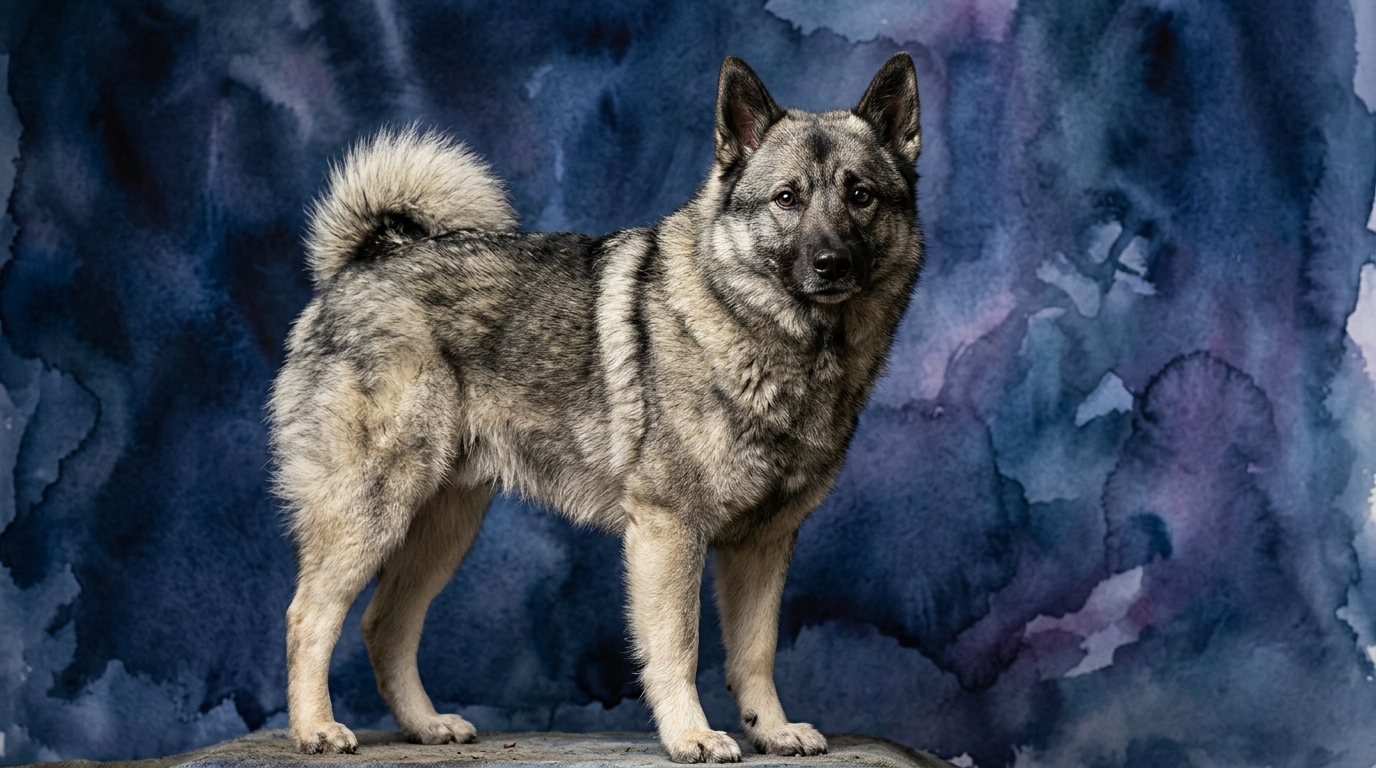
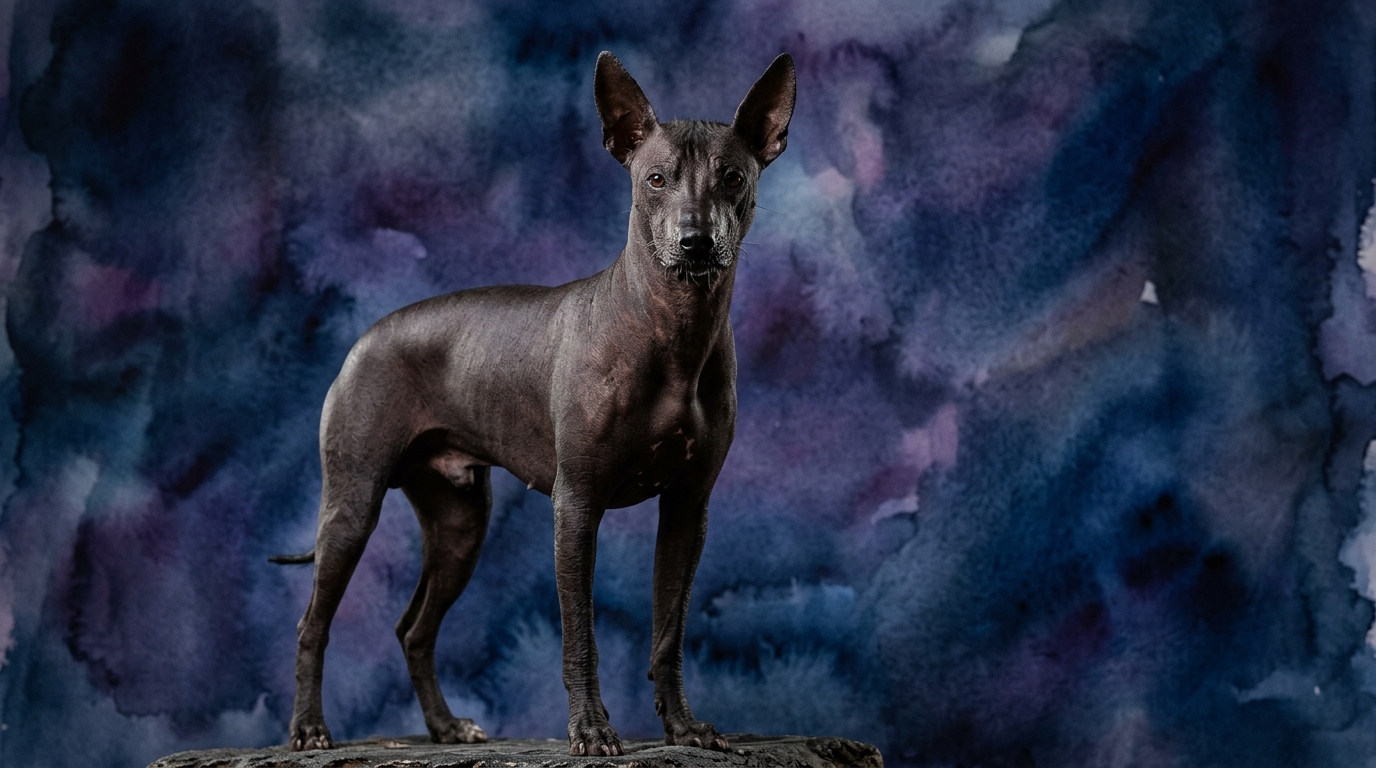
Side-by-Side Cognitive Profiles: Elkhound vs. Xoloitzcuintli
The Cosmic Pet Pet IQ Lab employs a five-dimensional framework to assess canine intelligence, offering a nuanced view of each breed's mental strengths. Let's break down the scores for the Norwegian Elkhound and the Xoloitzcuintli, understanding what each dimension signifies.
The Norwegian Elkhound, classified as a Hound breed, registers a Coren rank of #36, indicating a commendable capacity for learning and obedience. Its cognitive profile shows a Problem Solving score of 4/5, suggesting a keen ability to navigate novel situations and devise solutions. Training Speed also clocks in at 4/5, reflecting a relatively swift grasp of new commands and routines. Social Intelligence is rated 3/5, signifying a solid understanding of pack dynamics and human cues, while Instinctive Drive, characteristic of its hunting heritage, stands at 3/5. Finally, its Memory score is 4/5, indicating a strong capacity to retain learned information and experiences over time.
In contrast, the Xoloitzcuintli, falling under the Non-Sporting group and not assigned a Coren rank, presents a more uniformly moderate cognitive landscape. Its Problem Solving score is 3/5, meaning it can tackle challenges but perhaps with less innovative flair than the Elkhound. Training Speed also sits at 3/5, implying a steady, albeit not lightning-fast, learning pace. Its Social Intelligence matches the Elkhound at 3/5, highlighting an equivalent aptitude for forming bonds and interpreting social signals. Instinctive Drive is likewise 3/5, suggesting a moderate level of inherent behavioral patterns. The Xoloitzcuintli's Memory score rounds out its profile at 3/5, indicating a functional ability to recall information.
A direct comparison reveals the Elkhound generally exhibits higher scores in areas related to practical application and retention, while the Xoloitzcuintli maintains a consistent, balanced performance across all cognitive dimensions. This foundational difference sets the stage for distinct behavioral patterns and owner experiences.
Where the Norwegian Elkhound Excels Cognitively
The Norwegian Elkhound's cognitive profile showcases distinct advantages, particularly in areas demanding mental agility and retention. Its 4/5 Problem Solving score means it can independently assess and overcome obstacles, a trait honed by centuries of tracking game in challenging terrains. This isn't merely about opening a gate; it's about understanding the sequence of events needed to achieve a goal, such as figuring out how to retrieve a toy stuck under furniture or navigating a complex scent trail. This higher capacity for self-directed thought means Elkhounds often possess a resourceful streak, capable of devising their own entertainment if not adequately stimulated.
Furthermore, the Elkhound's 4/5 Training Speed indicates a quicker uptake of new commands and concepts. While its hound nature can sometimes introduce an independent streak, once engaged, an Elkhound can link actions to consequences and learn new behaviors with notable efficiency. This speed translates to fewer repetitions needed during training sessions and a faster progression through obedience levels, making it a rewarding experience for owners who enjoy teaching complex tasks. Their strong Memory (4/5) reinforces this, ensuring that once a lesson is learned, it tends to stick. This robust memory extends to recalling specific people, places, and routines, contributing to a stable and predictable daily life once patterns are established.
Where the Xoloitzcuintli's Cognitive Profile Shines
While the Xoloitzcuintli's individual scores are consistently moderate, its cognitive profile shines through its balanced and predictable nature, offering a different kind of strength. With Problem Solving, Training Speed, and Memory all at 3/5, the Xolo presents a reliably functional intellect without the potential for the more intense cognitive demands or complex behavioral challenges that sometimes accompany higher-scoring breeds. This consistent moderation can be a significant advantage for owners seeking a companion whose mental processes are straightforward and less prone to overthinking or developing intricate schemes.
The Xolo's uniform scores across all dimensions suggest a harmonious internal cognitive balance. Its 3/5 Social Intelligence, on par with the Elkhound, means it is equally capable of forming deep bonds and understanding subtle human cues, but perhaps expresses this social connection with less of an independent agenda. This breed's cognitive consistency often translates to a steady, agreeable temperament, making it less likely to be prone to boredom-induced destructive behaviors stemming from an overactive mind, or complex anxiety patterns that might require extensive cognitive redirection. Its cognitive profile supports a calm, observant demeanor, allowing it to integrate seamlessly into a variety of home environments without constantly seeking complex mental stimulation.
Ease of Training: Elkhound's Adaptability vs. Xolo's Consistency
When it comes to training, the distinctions in Problem Solving and Training Speed between these two breeds become quite evident. The Norwegian Elkhound, with its 4/5 in both Problem Solving and Training Speed, generally demonstrates a quicker grasp of new commands and a greater capacity for understanding complex sequences. This means an Elkhound can often learn new tricks or obedience cues with fewer repetitions and might even figure out solutions to training challenges on its own. However, their 3/5 Instinctive Drive, a remnant of their independent hunting heritage, means they can occasionally be selective in their obedience, especially if a more compelling scent or activity presents itself. Training an Elkhound requires consistency, clear communication, and often a creative approach to keep their bright minds engaged, preventing them from becoming bored or deciding their own agenda is more interesting.
The Xoloitzcuintli, with its 3/5 in both Problem Solving and Training Speed, offers a different training experience. While not as quick to pick up new concepts as the Elkhound, the Xolo is typically eager to please and less prone to the independent-mindedness that can characterize hound breeds. Their training progress might be steadier and require more patience and repetition, but their consistent nature often means fewer 'off days' or sudden bursts of selective hearing. A Xolo's training journey is often characterized by a gradual but reliable understanding, making positive reinforcement and clear, short training sessions particularly effective. Their moderate instinctive drive means they are generally less distracted by external stimuli, allowing for more focused training environments, making them a good choice for owners who appreciate a predictable learning curve.
Owner Lifestyles: Active Engagement vs. Calm Companionship
The cognitive profiles of the Norwegian Elkhound and the Xoloitzcuintli suggest suitability for different owner lifestyles. The Elkhound's higher Problem Solving (4/5) and Memory (4/5), coupled with its 3/5 Instinctive Drive, means it thrives with active owners who can provide consistent mental and physical engagement. These are dogs that benefit from structured activities like scent work, advanced obedience, or hiking, where their minds are challenged to solve problems and remember sequences. An Elkhound that isn't sufficiently stimulated might become restless or channel its problem-solving prowess into less desirable behaviors, like figuring out how to open cabinets or escape the yard. They are best suited for individuals or families who embrace outdoor adventures and enjoy involving their dog in daily activities that require thinking and participation.
Conversely, the Xoloitzcuintli's consistently moderate scores across all dimensions, including a 3/5 in Social Intelligence and Instinctive Drive, make it an excellent fit for owners seeking a more relaxed yet deeply connected companion. While they still appreciate walks and playtime, their lower cognitive intensity means they are generally content with a more predictable routine and less demanding mental stimulation. They are often described as calm and observant, perfectly happy to curl up by their owner's side. Their moderate instinctive drive means they are less likely to wander or become overly fixated on external stimuli, making them well-suited for urban living or quieter households. Owners who value a serene home environment and a dog that is present and affectionate without requiring constant, high-energy engagement will find the Xoloitzcuintli's cognitive makeup aligns perfectly with their lifestyle.
The Verdict: When to Choose Each Breed
Choosing between a Norwegian Elkhound and a Xoloitzcuintli ultimately depends on an owner's lifestyle, training philosophy, and desired level of canine engagement. Both breeds offer unique rewards, shaped by their distinct cognitive strengths and historical roles.
The Verdict
Choose the Norwegian Elkhound if you are an active individual or family seeking a mentally agile companion for outdoor adventures and enjoy engaging in complex training or dog sports. Their resourcefulness and quick learning will thrive with consistent challenges and opportunities for independent thought.
Opt for the Xoloitzcuintli if you prefer a calm, predictable, and deeply affectionate companion whose moderate cognitive demands align with a more relaxed home environment. Their consistent temperament and steady learning curve make them ideal for owners seeking a devoted presence without the need for intense mental or physical exertion.
🧠 Find Your Pet's IQ Score
Our Pet IQ Lab assessment covers 25+ tests across 5 cognitive dimensions — personalized to your breed.
Take the Full IQ Test →Frequently Asked Questions
Is the Norwegian Elkhound difficult to train due to its independent nature?
While Elkhounds possess an independent streak rooted in their hound heritage, their 4/5 Training Speed and Problem Solving mean they are capable learners. Consistent, positive reinforcement and engaging training methods are key to harnessing their intelligence effectively, preventing boredom and encouraging cooperation.
Does the Xoloitzcuintli's moderate IQ mean it's not a good choice for active owners?
Not necessarily. While the Xolo's cognitive profile is more suited for a relaxed pace, they still enjoy walks and playtime. Their moderate instinctive drive and social intelligence mean they can adapt to various activities, but they won't typically demand the same intensity or complex mental challenges as a higher-scoring, more driven breed like the Elkhound.
How does memory differ between the two breeds in daily life?
The Elkhound's 4/5 memory suggests it will quickly recall routines, commands, and experiences, potentially anticipating events. The Xolo's 3/5 memory is perfectly functional for daily life, allowing it to remember its family and basic training, but perhaps with less intricate recall of specific past events or complex sequences compared to the Elkhound.