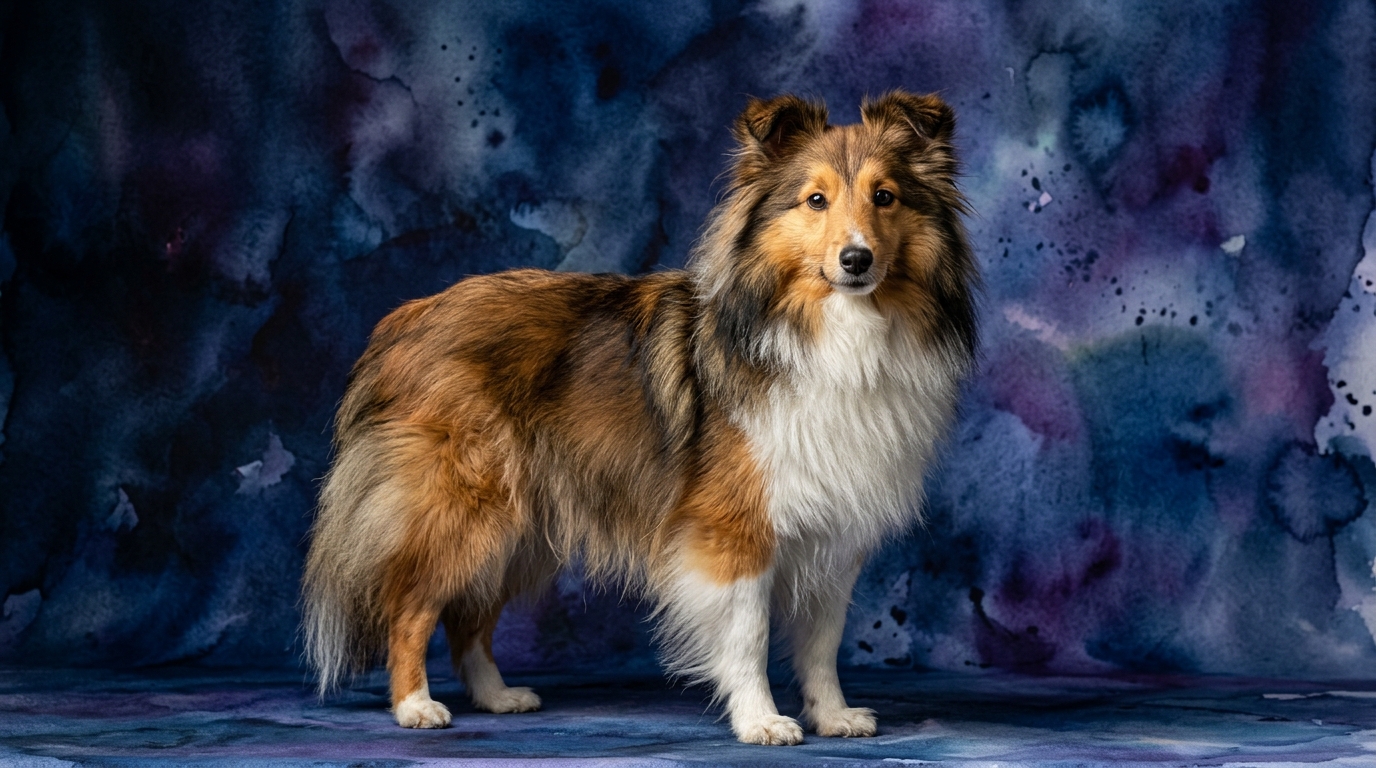

Side-by-Side Cognitive Profiles: Sheltie vs. Groenendael
To understand the nuanced differences in mental processing between the Shetland Sheepdog and the Belgian Sheepdog (Groenendael), we turn to The Cosmic Pet Pet IQ Lab's detailed metrics. These dimensions offer a window into how each breed perceives, learns, and interacts with its environment.
The Shetland Sheepdog, often affectionately called a Sheltie, holds a Coren rank of #6, placing it among breeds that consistently demonstrate a strong understanding of new commands with few repetitions and respond reliably to known commands. Its IQ profile includes: Problem Solving 4/5, indicating a good capacity for navigating novel situations; Training Speed 5/5, reflecting rapid acquisition of new behaviors; Social Intelligence 4/5, suggesting a strong ability to read and respond to human cues; Instinctive Drive 5/5, pointing to a robust herding impulse and inherent motivation for work; and Memory 5/5, showcasing excellent retention of information.
The Belgian Sheepdog (Groenendael), with a Coren rank of #15, also demonstrates impressive cognitive capabilities, though with a distinct emphasis. Its IQ profile reveals: Problem Solving 5/5, marking a superior ability to independently figure out complex challenges; Training Speed 5/5, matching the Sheltie in its quickness to learn commands; Social Intelligence 3/5, indicating a more independent or discerning approach to social interactions; Instinctive Drive 3/5, suggesting a present but perhaps less overwhelming or more generalized drive compared to the Sheltie; and Memory 5/5, highlighting an equally formidable capacity for recall.
Where the Shetland Sheepdog Excels Cognitively
The Shetland Sheepdog's cognitive strengths are particularly evident in its cooperative and responsive nature, largely driven by its elevated social intelligence and strong instinctive drive. With a Social Intelligence score of 4/5 compared to the Groenendael's 3/5, Shelties are more attuned to their human companions' emotional states and subtle body language. This makes them exceptionally responsive to guidance, often appearing to anticipate their owner's wishes and adjust their behavior accordingly. Their engagement in shared activities is frequently bolstered by this deep social connection.
Furthermore, the Sheltie's Instinctive Drive at 5/5, significantly higher than the Groenendael's 3/5, provides a powerful, consistent motivation that is readily channeled into directed tasks. This drive, combined with their social intelligence, makes them highly trainable for traditional obedience, agility, and competitive herding, where a handler's direction and a dog's intrinsic motivation for the task are paramount. Their higher Coren rank of #6 reflects this blend of responsiveness and drive, translating into a dog that consistently performs well in structured environments and rapidly internalizes commands, demonstrating a clear preference for working in close partnership.
Where the Belgian Sheepdog (Groenendael) Demonstrates Superiority
The Belgian Sheepdog (Groenendael) truly shines in its capacity for independent thought and complex problem-solving. Scoring a perfect 5/5 in Problem Solving, a point higher than the Sheltie's 4/5, the Groenendael displays a remarkable ability to analyze novel situations, devise creative solutions, and overcome obstacles without constant human direction. This cognitive prowess suggests a breed that doesn't just learn tasks, but truly comprehends the underlying mechanics and can adapt its approach when faced with unforeseen challenges. This translates into an animal that can excel in tasks requiring independent decision-making, such as tracking, search and rescue, or protection sports where the dog must assess and react quickly to dynamic environments.
While both breeds share an identical 5/5 score for Training Speed and Memory, the Groenendael's superior problem-solving, coupled with its slightly lower Social Intelligence (3/5), indicates a different processing style. The Groenendael might not be as overtly eager to please as the Sheltie, preferring to engage its intellect in the task itself rather than solely focusing on human approval. This independence fosters a dog capable of making sophisticated judgments on its own, a trait invaluable in roles demanding self-reliance. Its memory ensures that once a solution is found or a skill mastered, it is retained with precision.
Ease of Training: Behavioral Differences
When considering ease of training, both breeds possess exceptional Training Speed (5/5) and Memory (5/5), meaning they learn new commands quickly and retain them effectively. However, the 'ease' factor is significantly influenced by their differing social intelligence and instinctive drives, leading to distinct training experiences. The Shetland Sheepdog, with its 4/5 Social Intelligence and 5/5 Instinctive Drive, tends to be more inherently cooperative and eager to please. Their strong drive is easily channeled into motivation for training, often making them highly responsive to positive reinforcement and subtle cues. They frequently anticipate commands and are motivated by the desire to work closely with their handler, making them an excellent choice for obedience and competitive sports where precision and partnership are key.
The Belgian Sheepdog (Groenendael), while equally quick to grasp commands, presents a different training dynamic due to its 3/5 Social Intelligence and 3/5 Instinctive Drive, paired with its 5/5 Problem Solving. Groenendaels are less inclined to simply comply for the sake of pleasing; instead, they thrive on mental engagement and understanding the 'why' behind a command. If a training method is repetitive or lacks clear purpose, their problem-solving mind might lead them to find their own, potentially undesirable, solutions or simply disengage. They require a handler who can provide consistent, stimulating, and varied training that appeals to their independent intellect, making training an engaging mental exercise rather than rote memorization. Their lower social intelligence means that while they form strong bonds, they may not constantly seek human validation, necessitating a different motivational approach compared to the Sheltie.
Suited for Active vs. Relaxed Owners
Neither the Shetland Sheepdog nor the Belgian Sheepdog (Groenendael) is suitable for truly 'relaxed' owners; both are working breeds with substantial mental and physical needs. However, their specific cognitive profiles suggest different types of 'active' engagement. The Shetland Sheepdog's 5/5 Instinctive Drive and 4/5 Social Intelligence mean they thrive with owners who can provide consistent interaction, channel their herding instincts into structured activities like agility, rally, or competitive obedience, and appreciate a dog that is deeply involved in family life. They need daily exercise and mental challenges, but their strong social bond means a significant portion of their fulfillment comes from being a cooperative companion in these activities.
The Belgian Sheepdog (Groenendael), with its 5/5 Problem Solving and 3/5 Instinctive Drive, demands an owner who is not only active physically but also intellectually. These dogs need a 'job' that challenges their independent problem-solving capabilities. Activities like protection sports, advanced tracking, search and rescue, or complex obedience sequences that require independent decision-making are ideal. Their lower social intelligence means they might not be content with simply 'being with' their owner; they require stimulating tasks that engage their critical thinking. An owner who can consistently provide novel challenges and structured mental work will find a highly capable and engaged partner in a Groenendael, but a relaxed owner would likely find their independent nature and need for stimulation overwhelming.
The Verdict: When to Choose Each Breed
The Verdict
Choose the Shetland Sheepdog if you seek a highly responsive, cooperative partner for obedience, agility, or competitive herding, who thrives on close interaction and readily channels their strong work ethic into directed tasks within a family setting.
Opt for the Belgian Sheepdog (Groenendael) if you desire an independent problem-solver capable of complex, novel tasks, excelling in protection work or advanced independent challenges, and appreciate a partner who thinks critically and needs consistent, engaging mental stimulation.
🧠 Find Your Pet's IQ Score
Our Pet IQ Lab assessment covers 25+ tests across 5 cognitive dimensions — personalized to your breed.
Take the Full IQ Test →Frequently Asked Questions
Are Shetland Sheepdogs good family dogs?
Yes, Shetland Sheepdogs often integrate well into families due to their high social intelligence and desire for close interaction. They are typically gentle and form strong bonds, though their herding instincts might lead them to 'herd' children playfully.
Do Belgian Sheepdogs require professional training?
While not strictly necessary, an experienced trainer or owner familiar with working breeds will find the Groenendael's independent problem-solving and lower social intelligence require a consistent, engaging, and often creative training approach to channel their mental prowess effectively.
Which breed is better for apartment living?
The Shetland Sheepdog, being smaller and generally more adaptable to indoor living, could be suitable for an apartment if their significant exercise and mental stimulation needs are met daily. The larger, more intensely driven Belgian Sheepdog would typically require more space and consistent outdoor work to thrive.