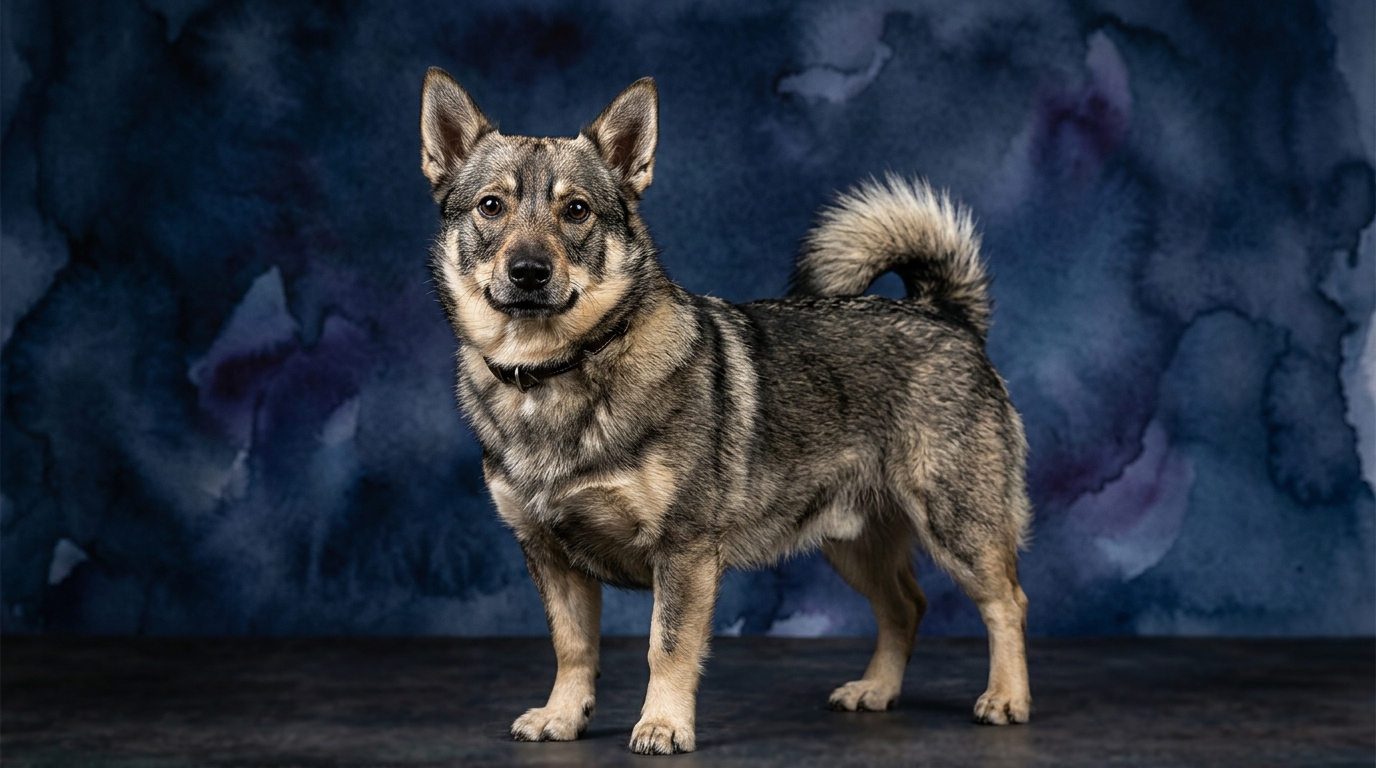
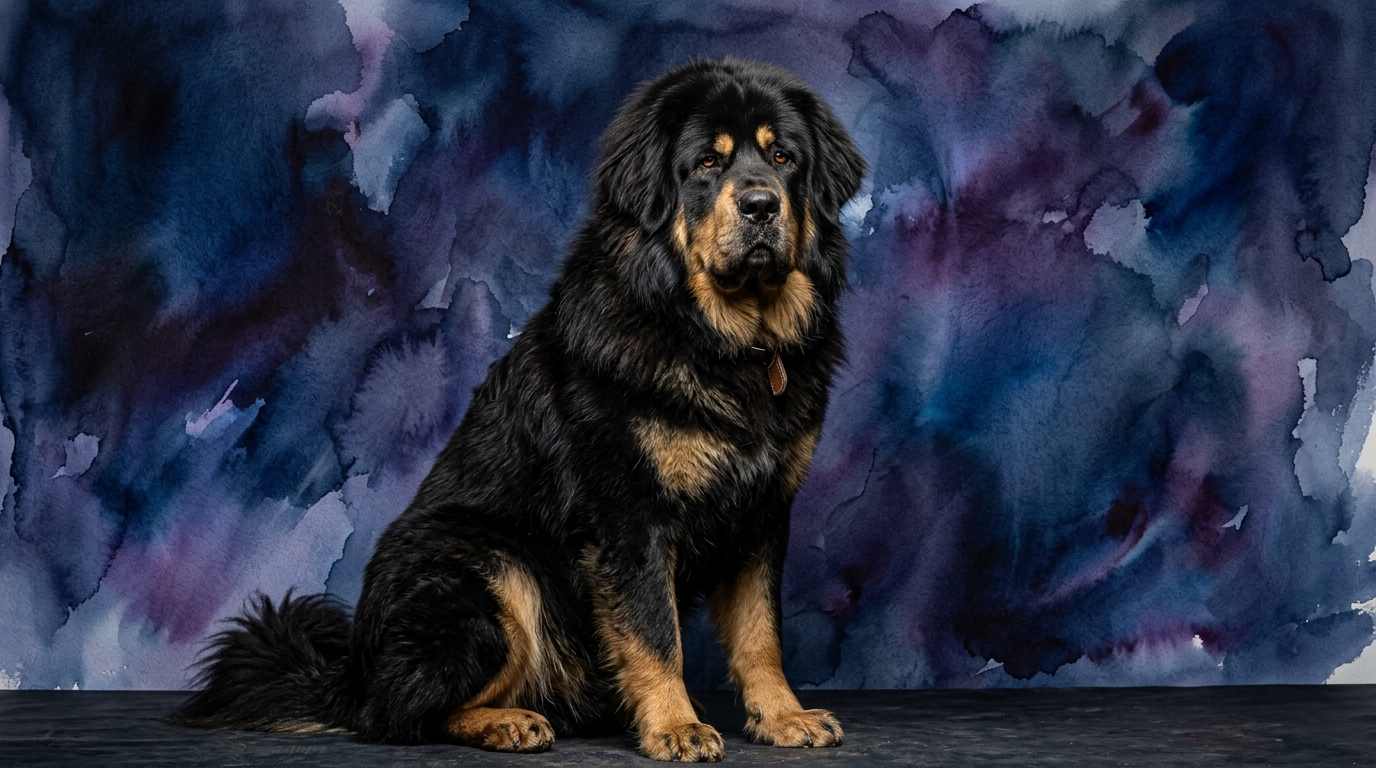
Side-by-Side Cognitive Profiles: Vallhund vs. Mastiff
Despite sharing identical scores in our Pet IQ Lab assessment, the underlying cognitive mechanisms and expressions of intelligence in the Swedish Vallhund and Tibetan Mastiff are profoundly distinct, shaped by centuries of selective breeding for vastly different roles. Understanding these nuances is crucial for appreciating their unique mental landscapes.
The Swedish Vallhund, a spirited herding dog of Viking descent, displays a practical and agile approach to problem-solving (3/5), particularly when it involves manipulating the environment or herd movement. They excel at figuring out how to navigate obstacles or direct livestock with their unique 'heeling' technique, demonstrating resourcefulness within their working parameters rather than abstract reasoning. Their training speed (3/5) is moderate; Vallhunds absorb new commands and routines, often eager to engage with their handler, but their independent spirit can sometimes lead to momentary distractions if not consistently reinforced. Social intelligence (3/5) in Vallhunds means they are adept at reading human body language and intentions, forming strong bonds with their family, though they can be discerning with strangers. Their instinctive drive (3/5) is pronounced, often manifesting as a desire to gather family members or even objects, coupled with a natural vigilance. Vallhunds possess a reliable memory (3/5) for learned commands, routines, and the layout of their environment, recalling past interactions and training cues effectively.
Conversely, the Tibetan Mastiff, an ancient guardian breed from the Himalayas, approaches problem-solving (3/5) through a lens of strategic territorial defense. They are patient observers, capable of assessing potential threats and determining the most effective course of action to protect their domain, often involving subtle deterrents rather than immediate confrontation. Their training speed (3/5) is also moderate, yet their formidable independence means they process information through self-sufficiency; they understand commands but may choose to comply only if they perceive a valid reason or if it aligns with their protective duties, demanding immense consistency from their trainer. Tibetan Mastiffs exhibit a profound social intelligence (3/5) within their immediate family, displaying deep loyalty and understanding of household dynamics; with outsiders, their social intelligence manifests as a discerning wariness, carefully evaluating new individuals. Their powerful guarding instinct (3/5) is the core of their being, encompassing territoriality, family protection, and an innate sense of responsibility for their domain. Tibetan Mastiffs possess an impressive long-term memory (3/5), particularly for people, places, and perceived threats or safe zones within their territory, remembering boundaries and routines with precision.
Where the Swedish Vallhund Cognitively Excels
The Swedish Vallhund's cognitive strengths are deeply rooted in its herding heritage, emphasizing agility and collaborative effort. One key advantage lies in their cognitive flexibility, which is their capacity to adapt quickly to new commands or changing scenarios in a dynamic environment, a trait essential for maneuvering livestock efficiently. This allows them to pivot between tasks and learn new variations of commands with relative ease, making them highly suitable for dog sports that demand quick thinking and responsiveness.
Furthermore, Vallhunds often demonstrate a stronger inclination towards collaborative problem-solving with a human partner. They are adept at processing human cues as integral parts of a solution, making them responsive and engaged companions in training and daily life. Their rapid associative learning, particularly in varied contexts, allows them to quickly form connections between cues and actions, which is a significant cognitive win when participating in activities like agility or obedience trials where swift, accurate responses are paramount.
Where the Tibetan Mastiff Cognitively Excels
The Tibetan Mastiff's cognitive prowess is fundamentally tied to its ancient role as a steadfast guardian, emphasizing independent judgment and strategic vigilance. A primary cognitive advantage is their strategic vigilance, which is an advanced ability to patiently observe and analyze potential threats over long periods, making calculated decisions about intervention. This isn't about rapid reaction, but about deep, sustained assessment of their surroundings, a complex cognitive process.
Moreover, Tibetan Mastiffs possess a superior territorial mapping memory, retaining a detailed cognitive map of their domain, including boundaries, entry points, and perceived security vulnerabilities. This deep spatial memory contributes significantly to their effectiveness as protectors. They also display sophisticated discernment in threat assessment, a cognitive strength that allows them to differentiate between genuine dangers and harmless stimuli, often relying on subtle social cues to determine the appropriate response, which is crucial for their independent guardian role.
Training Dynamics: Which is Easier and Why?
When it comes to ease of training, the Swedish Vallhund generally presents a more straightforward experience for most owners. Their herding background has instilled a natural biddability and an eagerness to work alongside humans. They enjoy the mental stimulation of learning new tasks and are typically more responsive to direction, viewing training as a collaborative activity. While they possess an independent streak, their desire to please their family usually outweighs it, making them more amenable to consistent positive reinforcement.
The Tibetan Mastiff, on the other hand, requires a significantly different approach to training. Their deep-seated independence, bred for autonomous decision-making in remote environments, means they are not inherently eager to blindly obey. They learn commands at a moderate pace, but their compliance is often conditional on whether they perceive the command as logical or aligned with their protective duties. Training a Tibetan Mastiff demands immense patience, unwavering consistency, and a profound understanding of their guardian mindset; an owner must earn their respect and trust rather than demand obedience.
Lifestyle Match: Active Engagement vs. Watchful Repose
For owners with an active lifestyle, the Swedish Vallhund is often a more suitable companion. These dogs thrive on mental and physical engagement, needing regular opportunities to channel their herding instincts and cleverness. They excel in activities like agility, obedience, herding games, and long hikes, becoming bored and potentially mischievous if their cognitive and physical needs are not met. An owner who enjoys dog sports or outdoor adventures will find a willing and enthusiastic partner in a Vallhund.
The Tibetan Mastiff suits a different kind of owner – one who appreciates a more independent, watchful presence. While they have bursts of energy and require secure space to patrol, they are not typically high-energy dogs in the same way a Vallhund is. Instead, they excel at long periods of calm, vigilant observation. They are best suited for experienced owners who understand the intricacies of guardian breeds, have ample secure space, and value a deeply loyal protector who makes their own judgments, rather than an always-on, highly interactive companion.
The Verdict
Choose the Swedish Vallhund if you seek an active, engaged companion eager to participate in dog sports and appreciate a responsive, clever partner in daily life.
Opt for the Tibetan Mastiff if you are an experienced owner who understands guardian breeds, has ample space, and values an independent, deeply loyal protector and sentinel.
🧠 Find Your Pet's IQ Score
Our Pet IQ Lab assessment covers 25+ tests across 5 cognitive dimensions — personalized to your breed.
Take the Full IQ Test →Frequently Asked Questions
Do Swedish Vallhunds bark a lot?
Yes, their herding instinct often includes vocalization to direct livestock or alert their family to perceived changes. Consistent training can manage this tendency, but they are naturally expressive dogs who will use their voice.
Are Tibetan Mastiffs good with children?
With proper socialization from a young age and consistent training, Tibetan Mastiffs can be very protective and tolerant of their own family's children. However, due to their impressive size and strong guardian instincts, supervision is always essential, especially with unfamiliar children.
Can a Tibetan Mastiff live in an apartment?
A Tibetan Mastiff is generally not well-suited for apartment living due to their massive size, inherent territorial instincts, and profound need for a secure outdoor space to patrol and observe. They thrive in homes with large, securely fenced yards where they can fulfill their natural duties.