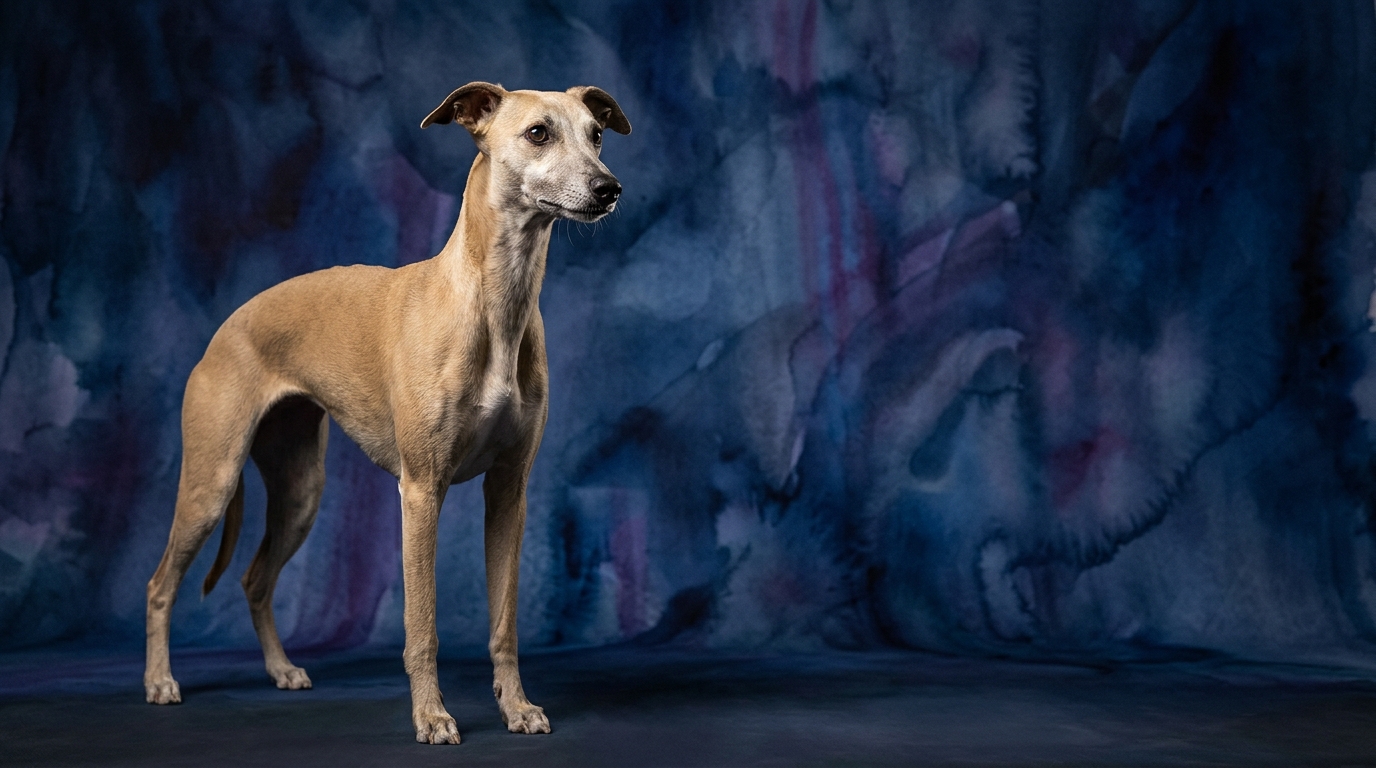

Side-by-Side IQ Profile: Whippet vs. Chesapeake Bay Retriever
The Cosmic Pet Pet IQ Lab offers a nuanced perspective on canine intelligence, moving beyond simple labels to specific cognitive dimensions. Here, we delve into the individual strengths and inclinations of these two distinct breeds.
The Whippet, with a Coren rank of #51, exhibits a specialized intelligence profile. Their Problem Solving score of 3/5 suggests a moderate ability to navigate novel situations or devise solutions, often relying on instinct or learned patterns rather than complex strategic thinking. Training Speed, at 2/5, indicates they may take more repetitions to grasp new commands, a characteristic often observed in sighthounds who value their independence. Where Whippets shine is in Social Intelligence, scoring 4/5, demonstrating a keen sensitivity to human emotions and subtle cues, making them deeply empathetic companions. Their Instinctive Drive is exceptionally high at 5/5, reflecting their powerful impulse to chase and pursue visual stimuli, a cornerstone of their sighthound heritage. Finally, their Memory, rated 3/5, is adequate for retaining basic routines and commands, but perhaps not for intricate, multi-step tasks.
The Chesapeake Bay Retriever, holding a more prominent Coren rank of #27, presents a robust, task-oriented intelligence. Their Problem Solving score of 4/5 indicates a strong capacity for figuring out challenges and adapting to new scenarios, a trait essential for their demanding retrieving work. Training Speed, also at 4/5, highlights their quick uptake of new commands and eagerness to learn, making them relatively responsive students. In Social Intelligence, they score 3/5, suggesting they are capable partners who understand human direction, but perhaps with a more independent or focused demeanor compared to the Whippet's emotional attunement. Their Instinctive Drive is 3/5, reflecting a strong working drive for retrieving and water activities, but a more controlled and directed drive than the Whippet's raw chase instinct. Crucially, their Memory is excellent at 4/5, enabling them to retain complex sequences of commands and retrieve locations with impressive accuracy.
Where the Whippet Excels Cognitively
The Whippet's cognitive strengths lie in areas deeply connected to their sighthound lineage and their role as sensitive companions. Their superior Social Intelligence, rated 4/5 compared to the Chessie's 3/5, allows them to excel at reading human body language, tone, and emotional states with remarkable accuracy. This makes them incredibly attuned to their owners, often anticipating needs or offering comfort without explicit commands, fostering profound, non-verbal bonds.
Furthermore, the Whippet's Instinctive Drive, an exceptional 5/5, while sometimes presenting training challenges, is a testament to a highly specialized cognitive system. This drive isn't just brute instinct; it involves lightning-fast visual processing, immediate assessment of moving stimuli, and precise motor planning for pursuit. Their brain is optimized for detecting minute movements at a distance and initiating an explosive, coordinated chase, a form of intelligence that is breathtaking in its efficiency and focus. This specialized visual-motor intelligence is unparalleled in the Chesapeake Bay Retriever, whose drives are more oriented towards directed tasks.
Where the Chesapeake Bay Retriever Leads Cognitively
The Chesapeake Bay Retriever demonstrates cognitive superiority in areas crucial for their demanding working roles. With a Problem Solving score of 4/5 versus the Whippet's 3/5, the Chessie shows a greater aptitude for navigating complex environments, figuring out how to access retrieves, or overcoming obstacles independently. This strategic thinking is invaluable in varied hunting scenarios, requiring adaptability and ingenuity.
Their Training Speed of 4/5, significantly higher than the Whippet's 2/5, means they acquire new commands and routines much more rapidly, often showing a keen desire to understand and execute tasks. This quick learning curve is coupled with an impressive Memory, rated 4/5 compared to the Whippet's 3/5, allowing them to retain vast repertoires of commands, retrieve locations, and multi-step procedures over long periods. This combination of problem-solving, rapid learning, and robust memory makes the Chesapeake Bay Retriever exceptionally capable of mastering intricate tasks and performing reliably in structured working environments, reflecting their higher Coren rank of #27.
Which Breed is Easier to Train and Why?
When considering ease of training, the Chesapeake Bay Retriever holds a distinct advantage. Their Training Speed of 4/5 combined with a strong Memory (4/5) and Problem Solving ability (4/5) means they typically pick up new commands quickly and retain them effectively. Chessies often possess a strong work ethic and a desire to please their handler, making them highly motivated students who thrive on having a purpose. Their instinctive drive, while present, is often directed towards their work, allowing for focused training sessions. For example, a Chessie will typically maintain focus on a retrieving drill, eager to complete the task and return the item.
In contrast, the Whippet's Training Speed of 2/5 suggests a slower learning pace, and their exceptional Instinctive Drive of 5/5 can be a significant training hurdle. A Whippet's attention can be instantly captured by a distant moving object, overriding any ongoing command, due to their profound sighthound nature. While intelligent and capable of learning, their independent spirit and powerful chase instinct mean training requires immense patience, positive reinforcement, and a deep understanding of their motivations, which are often less about pleasing and more about self-interest or comfort. Consistency and making training a game are key to success with a Whippet.
Matching Breed Intelligence to Owner Lifestyles
The choice between a Whippet and a Chesapeake Bay Retriever often hinges on an owner's lifestyle and energy levels. For active owners, particularly those who enjoy outdoor adventures, water sports, or structured dog sports, the Chesapeake Bay Retriever is an ideal companion. Their robust physical endurance, combined with their problem-solving skills and strong working drive, means they thrive when given a job to do, whether it's retrieving bumpers from a lake, participating in agility, or hiking challenging trails. They require consistent mental and physical engagement to prevent boredom and channel their considerable energy constructively.
Conversely, the Whippet is better suited for more relaxed owners. While they adore a good sprint in a secure area, they are largely content with shorter bursts of exercise followed by extensive lounging. Their high social intelligence means they deeply value quiet companionship and proximity to their human family, often seeking out soft, warm places for naps. They adapt well to apartment living as long as their need for a daily off-leash run is met, making them excellent choices for those seeking an affectionate, relatively low-maintenance companion who enjoys comfort and calm indoors.
The Verdict
Opt for a Whippet if you seek an affectionate, emotionally intelligent companion who thrives on quiet companionship and short bursts of intense activity, and you appreciate their independent, sensitive nature.
Select a Chesapeake Bay Retriever if you are an active individual or family seeking a highly trainable, problem-solving partner for outdoor adventures, water sports, and structured activities.
🧠 Find Your Pet's IQ Score
Our Pet IQ Lab assessment covers 25+ tests across 5 cognitive dimensions — personalized to your breed.
Take the Full IQ Test →Frequently Asked Questions
Are Whippets difficult to train due to their lower training speed?
Whippets are not inherently difficult to train, but their lower training speed (2/5) means they require patience and positive reinforcement, often taking more repetitions to grasp commands than some other breeds. Their strong instinctive drive (5/5) means training needs to be engaging and consistent to hold their attention against environmental distractions. They respond best to gentle methods that respect their sensitive nature rather than harsh corrections.
How does the Chesapeake Bay Retriever's high problem-solving ability manifest in daily life?
A Chesapeake Bay Retriever's problem-solving ability (4/5) often appears as resourcefulness; they might figure out how to open a gate, retrieve a toy from a tricky spot, or devise strategies to get what they want. This cognitive strength makes them adept at learning complex tasks and adapting quickly to new environments or challenges in their work or daily routines, showcasing their practical intelligence.
Which breed is more likely to thrive in a multi-pet household?
Both breeds can do well in multi-pet households, but their social intelligence profiles offer different nuances. Whippets, with higher social intelligence (4/5), often adapt smoothly, being sensitive to other pets' cues and generally preferring peaceful interactions. Chesapeake Bay Retrievers, while capable, might require more structured introductions due to their focused nature and potential for a stronger prey drive towards smaller, fast-moving animals, though generally they are amiable and can co-exist well with proper management.