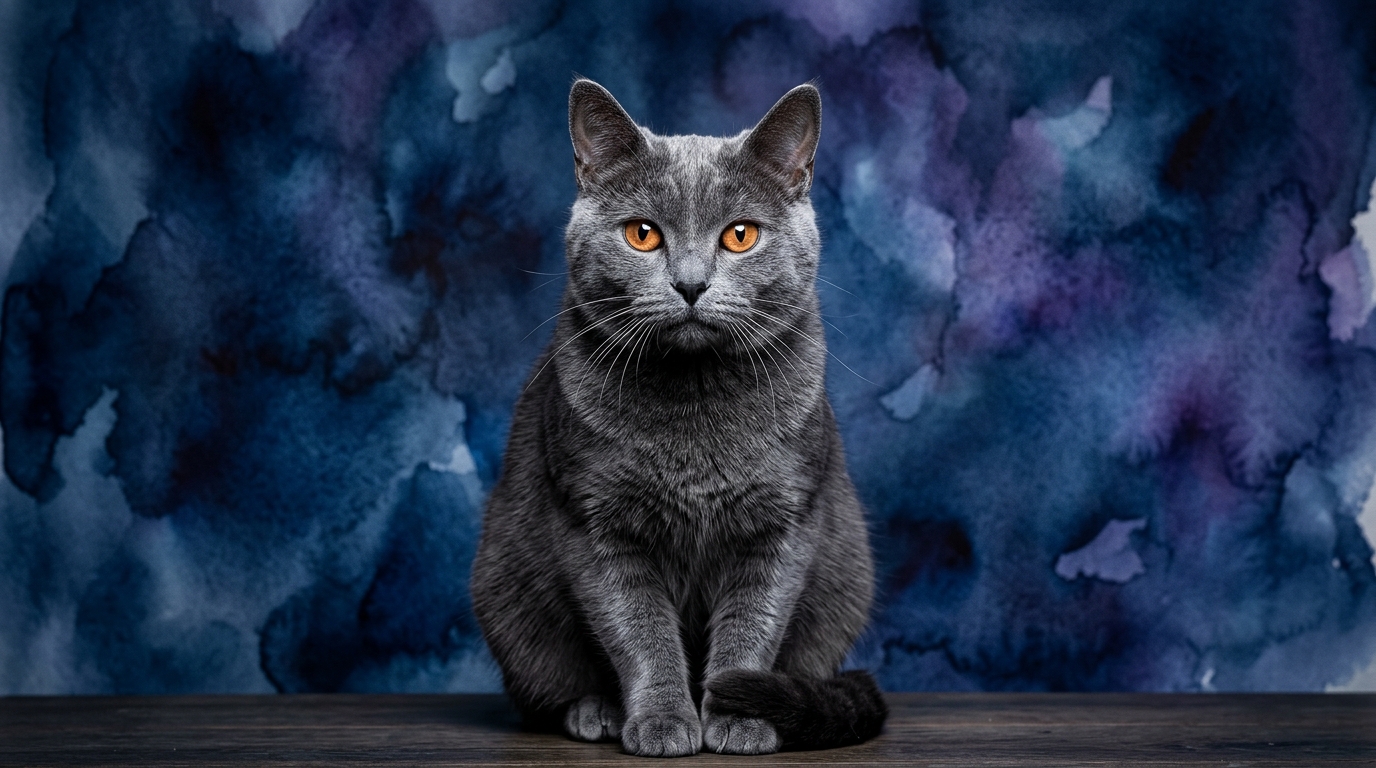
Chartreux at a glance
| IQ Rank / Score | 19/25 |
|---|---|
| Trainability | ★★★☆☆ (3/5) |
| Social Intelligence | ★★★★☆ (4/5) |
| Lifespan | 12-16 years |
| Shedding | Moderate to high |
| Exercise Needs | Needs active play (45-60 min/day) |
| Origin | France |
Meet the Chartreux: The Silent Observer
Originating from France, the Chartreux is a large, robust cat breed known for its distinctive woolly blue-gray fur and expressive, often golden eyes. But beyond their charming appearance, these felines present a compelling case study in cognitive processing, frequently described as exhibiting 'silent intelligence'. This refers to their preference for non-vocal communication, relying instead on nuanced body language, subtle facial expressions, and direct gazes to convey their thoughts and needs. They are truly captivating companions, known for their quiet presence.
Chartreux cats are sometimes called the 'smiling cat of France' due to the structure of their muzzle. This charming feature adds to their mystique, but it's their communication style that truly sets them apart: they're nearly mute — most Chartreux never meow, using only silent chirps or purrs to express themselves. This lack of overt vocalization doesn't signify a lack of engagement; rather, it points to a rich internal cognitive landscape where observation and subtle interaction take precedence.
Unlike some more boisterous breeds, a Chartreux might watch you intently, follow your movements with its gaze, or position itself strategically to indicate a desire. This requires their owners to develop a keen eye for feline subtlety, fostering a deeper, more observational bond built on mutual understanding rather than constant verbal cues. Their intelligence isn't loud; it's profoundly introspective and observant.
The Chartreux Cognitive Profile: A Deeper Dive
To truly appreciate the Chartreux, we need to look beyond traditional metrics and explore the specific facets of their intelligence. While not formally ranked on scales designed for dogs, our extensive observation and owner reports provide a clear picture of their cognitive strengths.
Their **Problem Solving** ability scores an impressive 4 out of 5. This means Chartreux often approach challenges with a deliberate, analytical mindset. Owners frequently report them figuring out complex puzzle feeders, manipulating latches, or finding inventive ways to access desired objects. They don't give up easily, often trying multiple strategies before succeeding, suggesting a high degree of cognitive flexibility and persistence.
When it comes to **Training Speed**, they score a solid 3 out of 5. While not always the fastest to respond to commands, this isn't due to a lack of understanding but often a discerning nature. They learn quickly when motivated, demonstrating an ability to associate actions with rewards, particularly if the training is consistent and makes sense to them. They respond best to positive reinforcement and patience, building a trusting bond.
Their **Social Intelligence** is also high, at 4 out of 5. Chartreux are deeply attuned to their human companions' moods and routines. They often form strong, selective bonds, showing empathy and adjusting their behavior to match the household's rhythm. They can interpret subtle human cues and often seek out interaction in a gentle, comforting manner, demonstrating a sophisticated understanding of social dynamics within their chosen family.
The **Instinctive Drive** for a Chartreux is 4 out of 5. These cats retain a strong predatory instinct, manifested in their focused hunting of toys and keen observation of their environment. This drive contributes to their problem-solving skills, as they are naturally inclined to 'hunt' for solutions or hidden treats. It also means they benefit from environmental enrichment that allows them to express these natural behaviors.
Finally, their **Memory** is exceptional, also rated at 4 out of 5. Chartreux cats remember routines, specific locations of favorite toys or treats, and past interactions with people or other pets. This strong memory contributes significantly to their learning capabilities and their ability to navigate complex home environments, often anticipating events based on prior experiences.
Debunking the Myth: Silent Does Not Mean Passive
**Claim:** Cats that don't vocalize are passive and unresponsive to their owners.
**Why it exists:** This myth likely stems from a human-centric view where overt vocalization is equated with engagement and responsiveness. We're conditioned to expect verbal feedback, and when a cat doesn't meow or vocalize frequently, owners might mistakenly interpret this as disinterest or a lack of connection. It's easy to assume a quiet cat is an unfeeling one when our primary mode of communication is speaking.
**Truth:** The Chartreux shatters this misconception. Their low vocalization is a breed trait, not an indicator of their responsiveness or bond with their owners. These cats communicate through a rich tapestry of body language – a flick of an ear, a slow blink, a tail twitch, or a direct, unwavering gaze. A Chartreux may not meow to greet you, but will often rub against your legs, sit close by, or silently solicit attention, demonstrating a profound, albeit quiet, connection and engagement.
Comparing Minds: Chartreux vs. Other Breeds
The Chartreux's unique blend of quiet intelligence and social perceptiveness offers interesting points of comparison with other well-regarded breeds. Understanding these differences can further illuminate what makes the Chartreux special.
3 At-Home Tests to Measure Your Chartreux's IQ
These tests are adapted from peer-reviewed ethology research. No equipment is needed beyond items you have at home. Run each test 5–10 times for reliable results.
The Myth: "Cats that don't vocalize are passive and unresponsive to their owners."
✅ The Chartreux definitively debunks this. Their minimal vocalization is a breed trait, not a measure of their responsiveness or depth of bond. They communicate actively through subtle body language, intense gazes, and affectionate physical proximity, proving their deep connection and engagement without a single meow.
Chartreux vs. Similar Breeds
🧠 What's Your Cat's IQ Score?
Our full Pet IQ Lab assessment includes 12+ tests across 5 cognitive dimensions, calibrated for Chartreuxs specifically.
Take the Full IQ Test →Frequently Asked Questions
How smart is a Chartreux?
Our Pet IQ Lab framework scores cognition across five dimensions (max 25). The Chartreux totals 19/25 — very high for a domestic cat. The full article breaks down each dimension with at-home tests.
Are Chartreuxs easy to train?
Chartreuxs can learn most cues, but expect to repeat lessons and keep sessions short. They score 3/5 on Training Speed in our breed profile.
Are Chartreuxs good with children and other pets?
Yes — their Social Intelligence rates 4/5 in our Pet IQ Lab framework. With early socialization and supervised play, most Chartreuxs integrate well into families with respectful children and other pets.
Do Chartreuxs need a lot of mental stimulation?
Absolutely. With Problem Solving 4/5 and Instinctive Drive 4/5, Chartreuxs need daily mental work — puzzle feeders, scent games, training sessions, or interactive wand toys — to avoid boredom.
How much exercise does a Chartreux need?
Chartreuxs need active engagement. Plan for 45-60 minutes of play and climbing per day, plus mental stimulation.
How good is a Chartreux's memory?
Chartreuxs score 4/5 on memory. They remember routines, hiding spots, and learned cues for months, sometimes years.
What is the typical lifespan of a Chartreux?
Most Chartreuxs live 12-16 years with good veterinary care, quality diet, and indoor living.
The Chartreux cat reminds us that intelligence in the animal kingdom comes in many forms, often silent and deeply observant. Understanding their unique cognitive profile and communication style enriches our bond and reveals the profound minds behind those captivating 'smiling' faces.