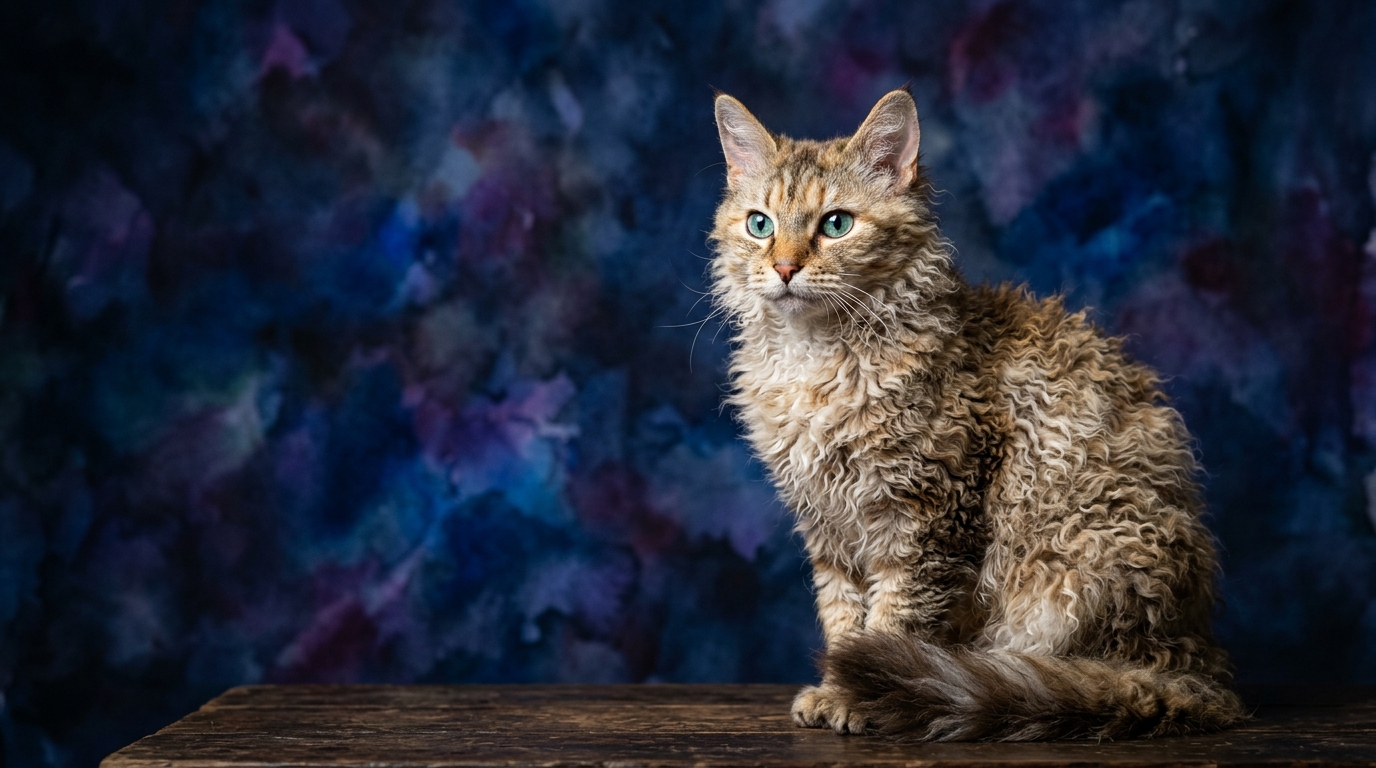
LaPerm at a glance
| IQ Rank / Score | 20/25 |
|---|---|
| Trainability | ★★★★☆ (4/5) |
| Social Intelligence | ★★★★★ (5/5) |
| Lifespan | 12-16 years |
| Shedding | Low to moderate |
| Exercise Needs | Moderate (20-40 min play/day) |
| Origin | USA |
Introduction to LaPerm Cognition
The LaPerm, a distinctive cat breed recognized by its unique curly coat, offers a fascinating window into the nuanced world of feline intelligence. Far from being merely a pretty face, these medium-sized felines originating from the USA boast a cognitive profile that challenges conventional perceptions of cat behavior. Often likened to dogs for their affectionate and interactive nature, LaPerms exhibit a depth of intelligence that transcends simple obedience, making them subjects of great interest in The Cosmic Pet's Pet IQ Lab. Their highly engaging personality isn't just a charming quirk; it's the outward manifestation of sophisticated cognitive processes centered around social interaction, problem-solving, and communicative prowess, setting them apart in the diverse tapestry of cat breeds.
The LaPerm's Unique Cognitive Signature: Proactive Companionship
The primary cognitive distinction of the LaPerm lies in their proactive and reciprocal social engagement. Unlike many cats who react, LaPerms actively initiate complex interactions, communicate nuanced desires, and problem-solve collaboratively to foster companionship and attention. They are cognitively wired to be interactive partners, viewing their human family as central to their daily lives. This is active dialogue, not passive affection. For instance, a LaPerm might observe routines, learning which actions elicit a desired response—pawing a cupboard for hunger or persistently chirping for play. They exhibit remarkable persistence, trying multiple methods until their message is understood or goal achieved. This proactive, socially-driven problem-solving reveals a sophisticated understanding of cause and effect within a social context, showing intelligence that actively participates in a shared life.
IQ Breakdown: Understanding the LaPerm Mind
At The Cosmic Pet's Pet IQ Lab, we evaluate feline intelligence, and the LaPerm consistently demonstrates a compelling cognitive blueprint:
**Problem Solving (Score: 4/5):** LaPerms excel at navigating their environment and overcoming obstacles. Their curiosity drives exploration and experimentation, whether opening a treat container or accessing a favorite perch. This purposeful, observant problem-solving often involves dexterous paw manipulation, showcasing practical intelligence effective in a domestic setting.
**Training Speed (Score: 4/5):** Their eagerness to please and strong desire for human interaction make them exceptionally quick learners. Responding enthusiastically to positive reinforcement, they readily pick up commands like "sit" or "stay." Their ability to form strong associations between actions, cues, and rewards means they learn with surprising speed, genuinely enjoying the challenge and attention.
**Social Intelligence (Score: 5/5):** This is where LaPerms truly shine. Their capacity to understand and respond to human emotions, body language, and vocal tones is outstanding. Highly empathetic, they thrive on reciprocal communication, integrating seamlessly into family life. This superior social intelligence makes them excellent companions who actively participate, remembering people, preferences, and routines to engage effectively.
**Instinctive Drive (Score: 3/5):** While possessing a healthy prey drive, it's balanced with their social instincts. They enjoy hunting toys and vigorous play, but these predatory urges are typically channeled into interactive play with humans, rather than detached hunting. This score reflects a well-integrated balance, where natural urges contribute to playful interaction.
**Memory (Score: 4/5):** LaPerms exhibit impressive long-term memory, particularly concerning companions, routines, and learned behaviors. They remember specific people, greeting them enthusiastically, and their recall of training cues and home layout is excellent, contributing to their adaptability. This strong memory underpins their high social intelligence and training speed, enabling lasting bonds and intricate pattern learning.
Beyond the Curls: A Surprising Glimpse into LaPerm History
The very first LaPerm, 'Curly,' was born bald in Oregon, USA, in 1982—a trait typically signaling genetic vulnerability. Yet, Curly not only survived and thrived but surprisingly developed a beautiful, wavy coat. More remarkably, her spontaneous genetic mutation for this curly coat proved dominant and healthy, passed to her offspring. This evolutionary leap from a seemingly disadvantageous mutation to a defining, celebrated characteristic highlights an innate resilience and adaptability within their lineage, showcasing nature's ability to turn perceived weaknesses into strengths, creating a robust new breed known for its vitality.
Unraveling the Myth: Are LaPerms Less Feline?
The most common myth surrounding LaPerm intelligence is that their 'dog-like' affection and eagerness to please indicate diminished feline independence or complex problem-solving. Many mistakenly believe their deep bond with humans makes them less 'cat-like' or intellectually sophisticated, suggesting reliance on human direction rather than innate cunning.
3 At-Home Tests to Measure Your LaPerm's IQ
These tests are adapted from peer-reviewed ethology research. No equipment is needed beyond items you have at home. Run each test 5–10 times for reliable results.
The Myth: "Due to their highly affectionate and 'dog-like' tendencies, many believe LaPerms are less independent or intrinsically 'cat-like' in their intelligence, needing constant human direction."
✅ In reality, LaPerms exhibit sophisticated cognitive skills, employing creative problem-solving and persistent communication for goals like opening cupboards or 'discussing' playtime. Their social intelligence *enhances* problem-solving by leveraging human resources and cues. They adeptly navigate human environments and even skillfully 'train' owners, demonstrating nuanced understanding beyond mere reliance.
LaPerm vs. Similar Breeds
🧠 What's Your Cat's IQ Score?
Our full Pet IQ Lab assessment includes 12+ tests across 5 cognitive dimensions, calibrated for LaPerms specifically.
Take the Full IQ Test →Frequently Asked Questions
How smart is a LaPerm?
Our Pet IQ Lab framework scores cognition across five dimensions (max 25). The LaPerm totals 20/25 — very high for a domestic cat. The full article breaks down each dimension with at-home tests.
Are LaPerms easy to train?
LaPerms are generally easy to train when you use consistent, reward-based sessions. They score 4/5 on Training Speed in our breed profile.
Are LaPerms good with children and other pets?
Yes — their Social Intelligence rates 5/5 in our Pet IQ Lab framework. With early socialization and supervised play, most LaPerms integrate well into families with respectful children and other pets.
Do LaPerms need a lot of mental stimulation?
Absolutely. With Problem Solving 4/5 and Instinctive Drive 3/5, LaPerms need daily mental work — puzzle feeders, scent games, training sessions, or interactive wand toys — to avoid boredom.
How much exercise does a LaPerm need?
LaPerms do well with 20-40 minutes of interactive play plus a few short training moments.
How good is a LaPerm's memory?
LaPerms score 4/5 on memory. They remember routines, hiding spots, and learned cues for months, sometimes years.
What is the typical lifespan of a LaPerm?
Most LaPerms live 12-16 years with good veterinary care, quality diet, and indoor living.
The LaPerm stands out as a cognitively sophisticated and profoundly social feline, whose intelligence is uniquely tailored for deep, interactive companionship. Their remarkable blend of proactive problem-solving, trainability, and exceptional social acuity ensures they are not just pets, but engaging, communicative members of the family, constantly seeking to understand and connect with their human world.