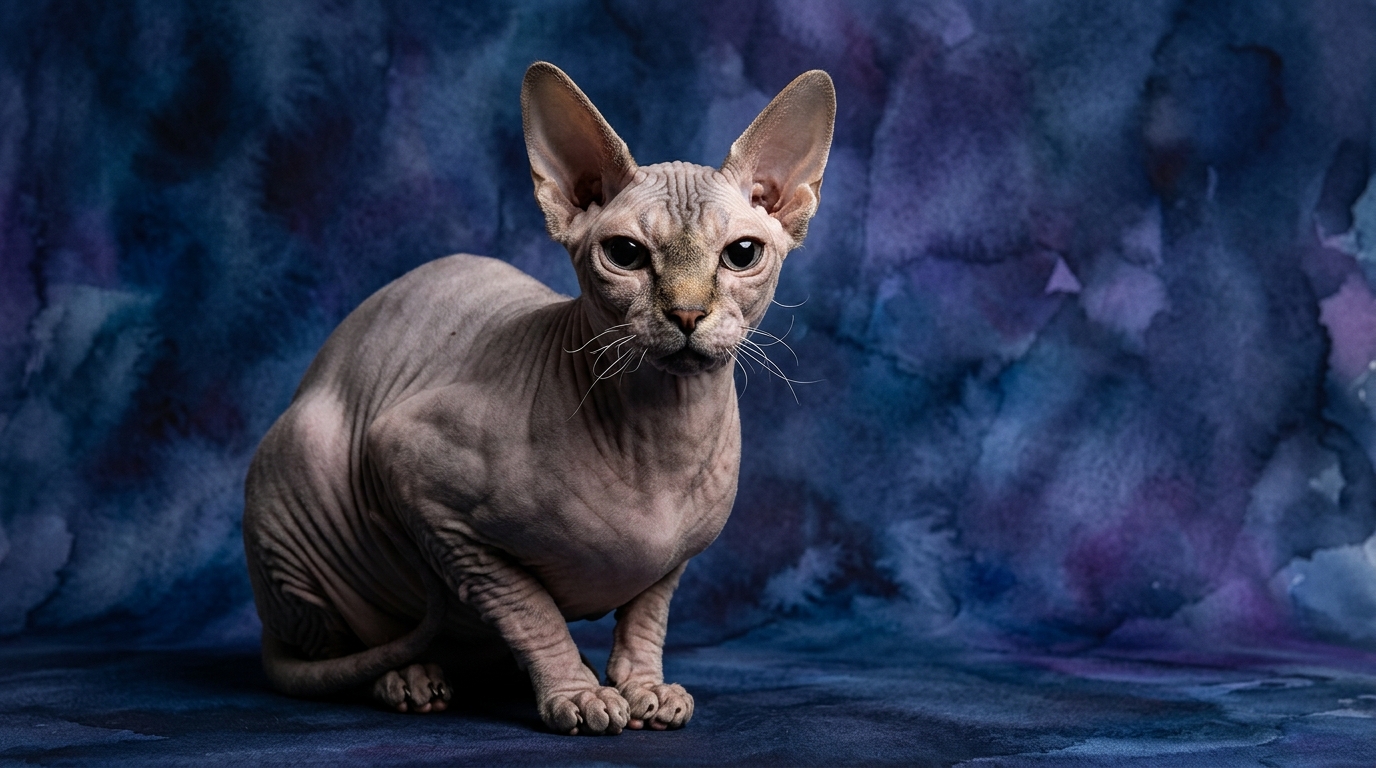
Sphynx at a glance
| IQ Rank / Score | 20/25 |
|---|---|
| Trainability | ★★★★☆ (4/5) |
| Social Intelligence | ★★★★★ (5/5) |
| Lifespan | 12-16 years |
| Shedding | Low to moderate |
| Exercise Needs | Moderate (20-40 min play/day) |
| Origin | Canada |
The Sphynx: A Masterclass in Social Adaptation
Originating from Canada, the medium-sized Sphynx cat isn't just visually distinct; its unique physiology profoundly shapes its intellectual development, particularly in the realm of social intelligence. Lacking a protective fur coat, these felines have evolved a compelling dependency on external warmth and intimate contact, translating into an unusually strong bond with their human companions. This isn't merely affection; it’s a sophisticated adaptive strategy that has honed their communicative abilities and emotional understanding to a remarkable degree.
This primary intelligence angle — skin-to-skin social intelligence — manifests as an active, almost relentless, pursuit of contact. Sphynx cats aren't content with mere proximity; they seek direct physical connection, burrowing under blankets, snuggling into laps, and intertwining themselves with their owners. This constant interaction fosters an unusually rich two-way communication, where Sphynx cats learn to interpret human moods and intentions with uncanny accuracy, and in turn, develop a diverse repertoire of vocalizations and body language to express their own needs and desires.
Crucially, Sphynx cats have a higher body temperature than furred cats (38.9°C vs 38.5°C) — their body works harder to maintain heat. This constant internal furnace means they burn more calories, require more food to sustain their energy, and are genuinely more physically active as a result. This relentless drive for warmth and sustained activity isn't just a physical quirk; it profoundly fuels their intense social nature and problem-solving skills, as they actively seek out warm laps, blankets, and creative solutions to stay cozy, making them unusually present and interactive members of their human families.
Problem Solvers with a Purpose: Brains Beyond the Bare Skin
With a Problem Solving score of 4 out of 5, the Sphynx demonstrates a keen analytical mind, often surprising owners with their cleverness. This innate drive for warmth and activity, born from their unique physiology, translates directly into a remarkable capacity for figuring things out. Whether it's manipulating cabinet latches to access a favored treat, orchestrating complex climbing routes to reach a sunny perch, or inventing intricate games with their toys, Sphynx cats approach challenges with a determined and often ingenious spirit, learning from their environment and adapting their strategies.
Their Training Speed also rates highly at 4 out of 5, placing them among the more trainable feline companions. Sphynx cats thrive on interaction and positive reinforcement, making them eager participants in learning new commands and tricks. Their desire for connection and the rewards associated with successful training sessions—be it treats, praise, or extended cuddle time—motivates them to quickly grasp concepts like 'sit,' 'stay,' or even 'fetch.' This responsiveness isn't a fluke; it's a testament to their social acuity and their understanding of cause and effect in their interactions with humans.
A Memory for Meals and Masterminds: Instinct and Recall
A Memory rating of 4 out of 5 underscores the Sphynx's ability to recall past experiences, learn from them, and apply that knowledge to future situations. This strong memory isn't just about remembering where their food bowl is; it extends to recalling routines, recognizing familiar faces, and understanding complex sequences of events. This cognitive strength is essential for their social dynamics, allowing them to build enduring relationships and anticipate owner behavior, further enriching their communication and bonding.
While their Instinctive Drive is a moderate 3 out of 5, reflecting a less traditional predatory instinct compared to some breeds, this doesn't diminish their overall intelligence. Instead, their instincts are often re-channeled into interactive play, exploration, and, crucially, seeking comfort and attention. Their problem-solving abilities frequently serve these re-directed 'instinctual' drives, turning daily activities into opportunities for engagement and mental stimulation. They are less about the silent hunt and more about the interactive chase, involving their human companions at every turn.
Unpacking Sphynx Intelligence: Common Myths and Reality
Dispelling misconceptions is vital to appreciating the Sphynx's true intellectual capacity. Their striking appearance often leads to inaccurate assumptions about their intelligence and capabilities, yet the scientific evidence and anecdotal experiences of owners paint a much richer picture of their cognitive world. Understanding their unique needs and how they've adapted allows us to see their intelligence not as an anomaly, but as a specialized form of feline brilliance.
The Sphynx's intelligence is not just about raw problem-solving; it's deeply interwoven with their social structure and physiological needs. Their unique brain power is a testament to adaptive evolution, where environmental pressures (the lack of fur) directly sculpted their cognitive and behavioral traits, leading to a cat that is profoundly connected, highly trainable, and remarkably clever in navigating its world.
3 At-Home Tests to Measure Your Sphynx's IQ
These tests are adapted from peer-reviewed ethology research. No equipment is needed beyond items you have at home. Run each test 5–10 times for reliable results.
The Myth: "Hairless cats are strange mutations with no natural intelligence"
✅ The Sphynx is a naturally occurring genetic mutation that was then selectively bred, and far from being unintelligent, they exhibit remarkable social intelligence, problem-solving skills, and memory. Their unique characteristics have driven them to develop sophisticated communication and adaptive behaviors, proving them to be highly clever and engaged companions, not unintelligent curiosities.
Sphynx vs. Similar Breeds
🧠 What's Your Cat's IQ Score?
Our full Pet IQ Lab assessment includes 12+ tests across 5 cognitive dimensions, calibrated for Sphynxs specifically.
Take the Full IQ Test →Frequently Asked Questions
How smart is a Sphynx?
Our Pet IQ Lab framework scores cognition across five dimensions (max 25). The Sphynx totals 20/25 — very high for a domestic cat. The full article breaks down each dimension with at-home tests.
Are Sphynxs easy to train?
Sphynxs are generally easy to train when you use consistent, reward-based sessions. They score 4/5 on Training Speed in our breed profile.
Are Sphynxs good with children and other pets?
Yes — their Social Intelligence rates 5/5 in our Pet IQ Lab framework. With early socialization and supervised play, most Sphynxs integrate well into families with respectful children and other pets.
Do Sphynxs need a lot of mental stimulation?
Absolutely. With Problem Solving 4/5 and Instinctive Drive 3/5, Sphynxs need daily mental work — puzzle feeders, scent games, training sessions, or interactive wand toys — to avoid boredom.
How much exercise does a Sphynx need?
Sphynxs do well with 20-40 minutes of interactive play plus a few short training moments.
How good is a Sphynx's memory?
Sphynxs score 4/5 on memory. They remember routines, hiding spots, and learned cues for months, sometimes years.
What is the typical lifespan of a Sphynx?
Most Sphynxs live 12-16 years with good veterinary care, quality diet, and indoor living.
The Sphynx cat stands as a testament to specialized feline intelligence, proving that true brilliance comes in many forms, often shaped by unique adaptations. These captivating creatures challenge us to look beyond superficial appearances and appreciate the profound cognitive depths revealed through every purr, cuddle, and clever interaction.