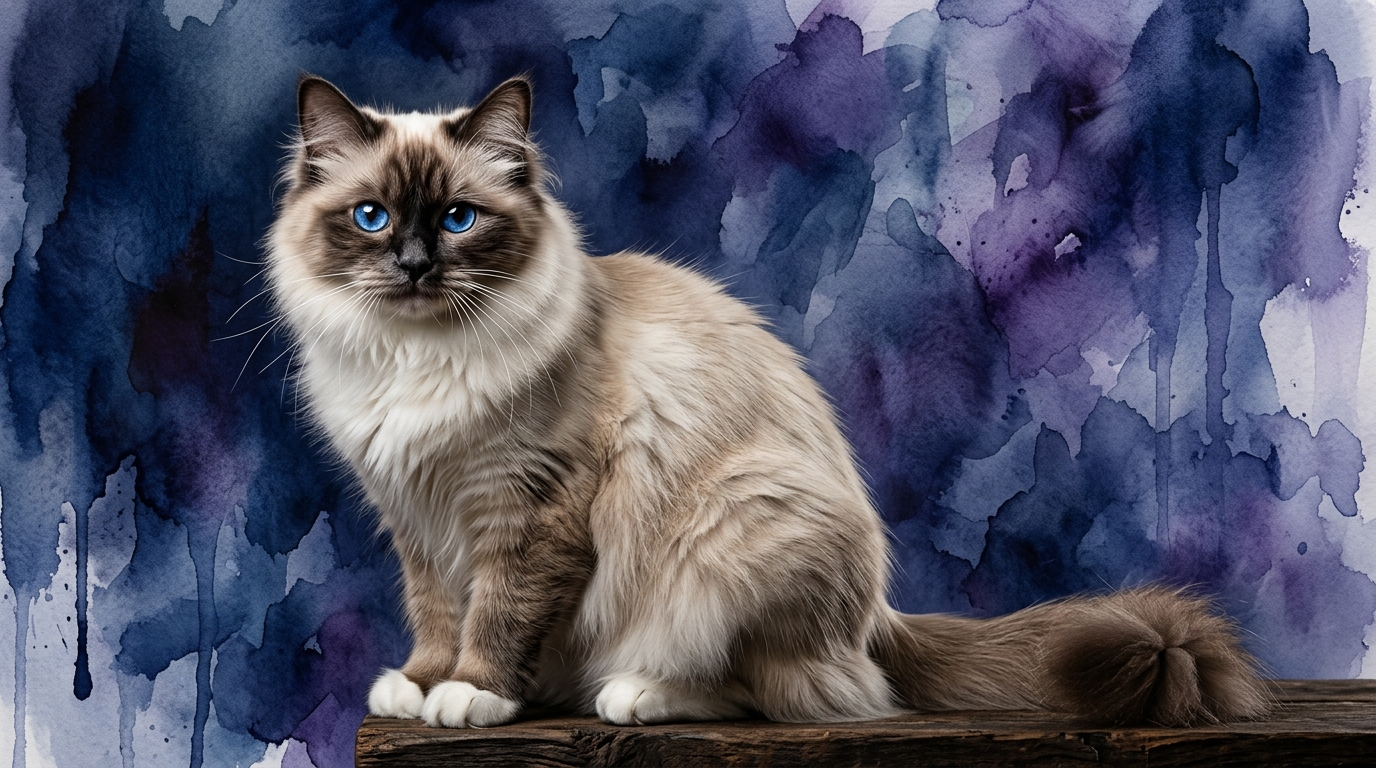
Birman at a glance
| IQ Rank / Score | 19/25 |
|---|---|
| Trainability | ★★★★☆ (4/5) |
| Social Intelligence | ★★★★★ (5/5) |
| Lifespan | 12-16 years |
| Shedding | Moderate to high |
| Exercise Needs | Moderate (20-40 min play/day) |
| Origin | France (Burma origin) |
The Birman's Cognitive Blueprint: Social Attunement and Gentle Trainability
Birman intelligence centers on exceptional social attunement and remarkable gentle trainability. Unlike many cats with independent cognitive styles, Birmans are profoundly people-oriented, understanding and responding to human emotions and communication cues. This deep empathetic connection is a sophisticated social intelligence, allowing them to integrate seamlessly into human families, often developing a bond akin to a devoted canine.
This unique cognitive strength manifests in their willingness to learn and cooperate. Birmans actively seek interaction and positive reinforcement, making them surprisingly receptive to training. Whether learning to walk on a leash, retrieve toys, or perform simple tricks, their gentle nature and desire to please make training rewarding. This highlights the Birman’s distinctive focus on relational intelligence.
A Glimpse into History: The Sacred Gloves of Devotion
The Birman's unique cognitive profile is intertwined with its mystical origins as Burma's sacred temple cats. A captivating legend explains the breed's distinctive pure white 'gloves' and 'laces' on each paw. According to ancient lore, a venerable monk named Mun-Ha lived in a temple dedicated to the goddess Tsim-Kyan-Kse, along with his devoted companion, Sinh. When invaders attacked and killed Mun-Ha, Sinh stood guard over his master's body.
As Sinh looked upon the goddess statue, a miraculous transformation occurred: his eyes turned sapphire blue, his coat became golden, and his paws, resting gently on his master, remained pure white, symbolizing purity and unwavering devotion. This ancient myth imbues the Birman with perceived spiritual wisdom, serenity, and loyalty, characteristics still evident in their calm, observant, and deeply affectionate nature today.
Decoding the Birman IQ: A Deeper Look
At The Cosmic Pet's Pet IQ Lab, we've assessed the Birman's cognitive abilities across five key dimensions, reflecting their unique intelligence. Their scores highlight a breed thriving on social connection and cooperative learning.
Their **problemSolving** score of 3 indicates moderate capacity for independent complex problem-solving. Birmans often prefer engaging humans to solve puzzles, reflecting a relational cognitive style over intense solitary exploration.
A **trainingSpeed** score of 4 signifies impressive aptitude for learning new commands and tricks quickly. This high score results from strong social intelligence and eagerness to please, making them one of the more easily trainable cat breeds. They respond well to positive reinforcement.
The **socialIntelligence** score of 5 is where Birmans truly shine. This top score reflects profound ability to understand human emotions, intentions, and social cues, forming exceptionally strong bonds. They are adept at communicating needs and sensitive to household changes.
Their **instinctiveDrive** rates at a 3. While Birmans enjoy playful chasing and interactive toy sessions, their prey drive is generally not as intense or obsessive as some other breeds. Their focus is more on companionship and gentle play.
Finally, a **memory** score of 4 demonstrates excellent recall for routines, learned behaviors, and human family faces. This strong memory supports trainability and allows them to anticipate daily activities, contributing to a smooth home environment.
3 At-Home Tests to Measure Your Birman's IQ
These tests are adapted from peer-reviewed ethology research. No equipment is needed beyond items you have at home. Run each test 5–10 times for reliable results.
The Myth: "Birmans are simply beautiful lap cats, more ornamental than intelligent, preferring serene idleness over engaging mentally."
✅ While undeniably beautiful and loving lap cats, Birmans are highly intelligent and deeply social creatures who thrive on interaction. Their intelligence manifests in perceptive understanding of human emotions, remarkable trainability, and consistent desire for interactive play and companionship. They are far from passive and actively seek mental stimulation with their human family.
Birman vs. Similar Breeds
🧠 What's Your Cat's IQ Score?
Our full Pet IQ Lab assessment includes 12+ tests across 5 cognitive dimensions, calibrated for Birmans specifically.
Take the Full IQ Test →Frequently Asked Questions
How smart is a Birman?
Our Pet IQ Lab framework scores cognition across five dimensions (max 25). The Birman totals 19/25 — very high for a domestic cat. The full article breaks down each dimension with at-home tests.
Are Birmans easy to train?
Birmans are generally easy to train when you use consistent, reward-based sessions. They score 4/5 on Training Speed in our breed profile.
Are Birmans good with children and other pets?
Yes — their Social Intelligence rates 5/5 in our Pet IQ Lab framework. With early socialization and supervised play, most Birmans integrate well into families with respectful children and other pets.
Do Birmans need a lot of mental stimulation?
Birmans benefit from 10-15 minutes of focused enrichment a day: food puzzles, short training drills, or novel toys rotated weekly.
How much exercise does a Birman need?
Birmans do well with 20-40 minutes of interactive play plus a few short training moments.
How good is a Birman's memory?
Birmans score 4/5 on memory. They remember routines, hiding spots, and learned cues for months, sometimes years.
What is the typical lifespan of a Birman?
Most Birmans live 12-16 years with good veterinary care, quality diet, and indoor living.
The Birman cat stands as a testament to diverse feline intelligence, excelling in social attunement and cooperative learning. Their unique cognitive profile makes them not just beloved pets, but highly intelligent companions who enrich lives through perceptive understanding and gentle, engaging interactions.