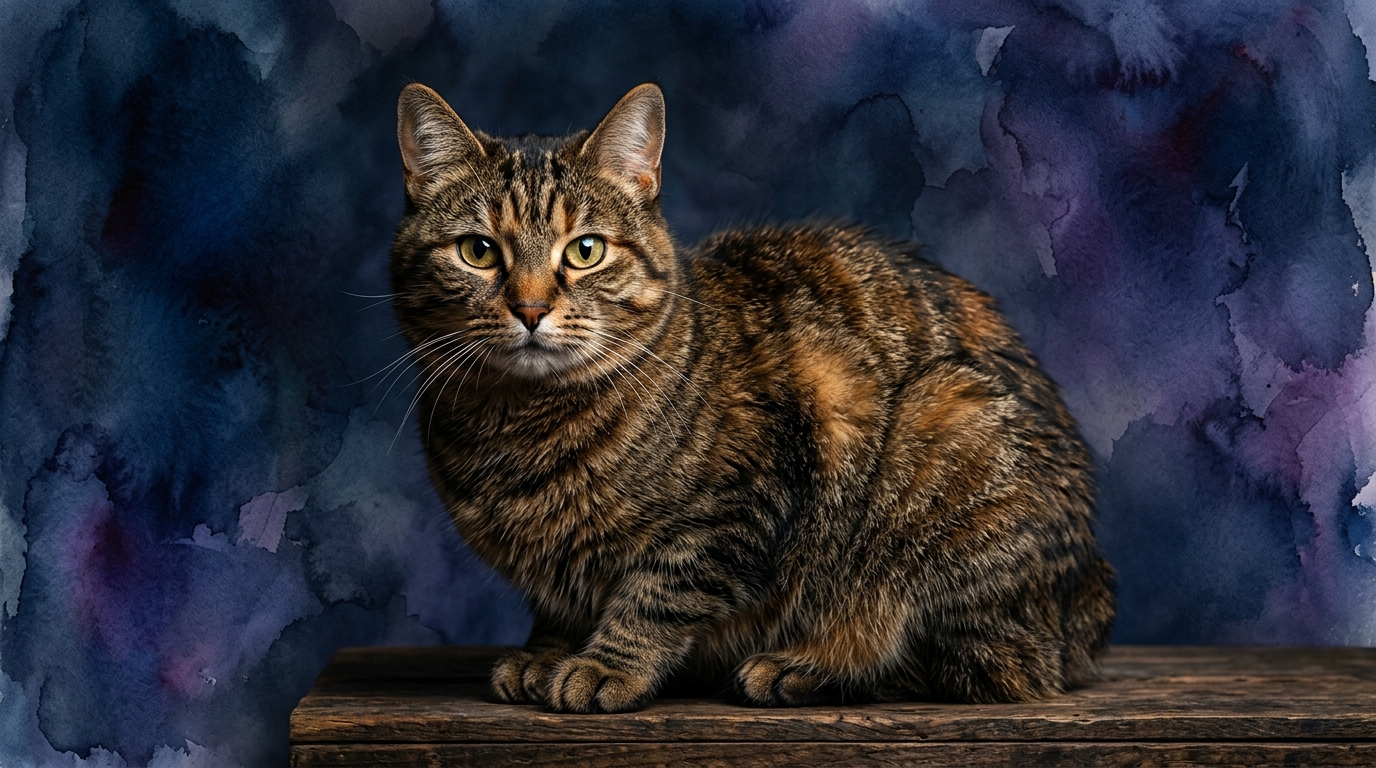
Manx at a glance
| IQ Rank / Score | 18/25 |
|---|---|
| Trainability | ★★★★☆ (4/5) |
| Social Intelligence | ★★★★☆ (4/5) |
| Lifespan | 12-16 years |
| Shedding | Low to moderate |
| Exercise Needs | Moderate (20-40 min play/day) |
| Origin | Isle of Man |
The Manx Mind: Beyond the Tailless Trait
The Manx cat’s intelligence is fundamentally shaped by a combination of their unique genetic lineage and an inherent adaptability that has allowed them to thrive in diverse environments. Their primary cognitive angle lies in their exceptional problem-solving abilities combined with a pronounced capacity for social learning and trainability, often drawing comparisons to dogs rather than typical cats. This 'dog-like' intelligence manifests in their quick grasp of commands, their ability to navigate complex tasks, and their deep, often singular, bond with their human companions. Unlike many felines content with independent exploration, the Manx often seeks interaction and participation, making them highly engaged learners.
Their lack of a tail, while a striking physical characteristic, has also subtly influenced their cognitive development, particularly in spatial awareness and balance. Rather than hindering them, Manx cats have developed an enhanced proprioception and a finely tuned vestibular system, allowing them to compensate and even excel in agility and precision. This innate physical intelligence complements their mental acuity, making them adept hunters and nimble navigators of their environment. They don't just react to stimuli; they actively assess, plan, and execute, whether it's scaling furniture or figuring out how to open a cupboard door.
This breed's cognitive uniqueness extends to their emotional intelligence as well. Manx cats are known for their profound loyalty and ability to pick up on human moods and routines. They often become integral family members, participating in household activities and even exhibiting a protective streak. Their intelligence isn't just about solving puzzles; it's about understanding their social world and actively engaging within it, making them incredibly rewarding companions for those who appreciate a feline with a truly interactive and responsive mind.
A Puzzling Past & Present: Scientific Insights into the Manx
One of the most surprising scientific facts about the Manx cat relates directly to their defining physical trait: their taillessness. The Manx gene (M gene) responsible for this characteristic is a dominant mutation, and in its homozygous form (MM), it is lethal. Kittens inheriting two copies of the Manx gene (MM) suffer from severe spinal defects, a condition known as Manx Syndrome, which is often fatal, causing death in utero or shortly after birth. This fascinating genetic reality means that all living Manx cats carry only one copy of the dominant gene (Mm), inheriting one normal gene (m) from one parent and one dominant Manx gene (M) from the other. This genetic lottery has a profound impact on breeding practices, requiring careful selection to ensure healthy litters, revealing a delicate balance of nature in their very existence.
Historically, Manx cats were highly valued on the Isle of Man, where they originated, and later on ships around the world, for their exceptional hunting prowess. Despite their perceived physical disadvantage without a full tail for balance, they proved to be incredibly effective mousers and ratters. This historical role underscores their strong instinctive drive and spatial reasoning capabilities. Their ability to adapt their hunting techniques and maintain superior agility without a tail demonstrates a remarkable inherent intelligence and body awareness that allowed them to thrive in challenging environments. Early folklore even suggested they were a cross between a cat and a rabbit due to their hopping gait and lack of a tail, highlighting how distinctively their physical form impacted human perception and fueled intriguing, albeit inaccurate, theories about their origin.
Decoding Manx IQ: A Cognitive Breakdown
The Manx cat's intelligence profile, as assessed by the Pet IQ Lab, paints a picture of a clever, adaptable, and highly social feline. Each cognitive dimension reveals a facet of their unique mental makeup, influencing how they interact with their world and their human companions.
problemSolving (IQ Score: 4/5): Manx cats exhibit a high degree of resourcefulness, often demonstrating ingenuity in achieving their goals. They are known for figuring out how to open doors, cabinets, and even complex puzzle toys. This score reflects their ability to analyze situations, devise strategies, and learn from trial and error, making them adept at navigating their home environment and manipulating objects to their advantage.
trainingSpeed (IQ Score: 4/5): This breed truly stands out for its exceptional trainability, a trait often likened to that of canines. Manx cats can quickly learn a variety of commands and tricks, from fetching toys and walking on a leash to performing complex sequences. Their eagerness to please and strong desire for interaction contribute significantly to their rapid acquisition of new skills, making them ideal candidates for positive reinforcement training.
socialIntelligence (IQ Score: 4/5): Manx cats are remarkably social and deeply emotionally connected to their families. They display a keen awareness of human moods, routines, and social cues. Their strong bonds often manifest in clear communication, affectionate gestures, and a desire to be involved in family activities. They can form strong attachments with multiple family members and often get along well with other pets, showcasing their sophisticated understanding of social dynamics.
instinctiveDrive (IQ Score: 3/5): While renowned for their hunting prowess historically, their instinctive drive is considered moderate compared to some highly predatory breeds. They retain a healthy prey drive, making them excellent mousers and enthusiastic players who enjoy stalking and pouncing. However, this drive is typically well-balanced with their social and domestic inclinations, meaning they are less likely to be solely driven by primal urges and can integrate seamlessly into a household setting without constant need for hunting outlets.
memory (IQ Score: 3/5): Manx cats possess a solid and reliable memory. They remember routines, the location of their favorite toys and sleeping spots, and the people they have encountered. While not exhibiting extraordinary feats of memory, their ability to retain information about their environment and social interactions is perfectly adequate for their complex cognitive needs, allowing them to anticipate events and build lasting relationships.
Tailoring Cognitive Challenges: Manx-Specific IQ Tests
To truly appreciate the Manx cat's distinctive cognitive profile, the Pet IQ Lab recommends a series of specialized tests designed to highlight their strengths in problem-solving, trainability, and spatial awareness.
The Trick Acquisition Test is particularly suitable for Manx cats, as it directly assesses their remarkable trainability and capacity for learning complex behaviors. Given their 'dog-like' intelligence, this test allows us to observe their speed of learning and retention of various tricks. The Puzzle Box Test is ideal for evaluating their natural problem-solving skills and dexterity, as Manx cats are known for their resourcefulness and ability to manipulate objects to achieve a goal. Finally, the Barrier Navigation Test is crucial for understanding their exceptional spatial awareness and agility, especially significant given their unique tailless physique which demands superior body control and compensatory balance mechanisms.
These tests collectively offer a comprehensive view into the Manx cat's adaptable mind, showcasing not just their intelligence but also how their unique physical characteristics influence their cognitive strategies and capabilities.
Separating Fact from Fable: The Manx Intelligence Myth
claim: The most common myth about Manx cat intelligence is that their lack of a tail impairs their balance and makes them clumsy, consequently suggesting they might be less intelligent or less capable than tailed cats.
whyItExists: This myth likely originated from the common understanding that a tail is crucial for balance in felines, and observing the Manx's unique hopping gait led to assumptions of physical and perhaps cognitive deficits. People naturally associate physical completeness with full functionality, and the missing tail might seem like a disadvantage without understanding the cat's biological adaptations.
truth: In reality, Manx cats are remarkably agile and possess excellent balance. They have evolved an enhanced vestibular system and superior proprioception (awareness of their body in space) that more than compensates for the lack of a tail. Far from being clumsy, they are often excellent hunters and highly athletic, demonstrating sophisticated spatial awareness and coordination that challenges this widespread misconception. Their intelligence is in no way diminished by their taillessness; if anything, their adaptability highlights their cognitive resilience.
3 At-Home Tests to Measure Your Manx's IQ
These tests are adapted from peer-reviewed ethology research. No equipment is needed beyond items you have at home. Run each test 5–10 times for reliable results.
The Myth: "Manx cats are clumsy or have poor balance due to their lack of a tail, making them less capable than other cat breeds."
✅ Manx cats possess an exceptionally well-developed vestibular system and superior proprioception, allowing them to maintain excellent balance and agility. They are highly coordinated, adept hunters, and navigate complex environments with ease, demonstrating their remarkable adaptive intelligence.
Manx vs. Similar Breeds
🧠 What's Your Cat's IQ Score?
Our full Pet IQ Lab assessment includes 12+ tests across 5 cognitive dimensions, calibrated for Manxs specifically.
Take the Full IQ Test →Frequently Asked Questions
How smart is a Manx?
Our Pet IQ Lab framework scores cognition across five dimensions (max 25). The Manx totals 18/25 — high for a domestic cat. The full article breaks down each dimension with at-home tests.
Are Manxs easy to train?
Manxs are generally easy to train when you use consistent, reward-based sessions. They score 4/5 on Training Speed in our breed profile.
Are Manxs good with children and other pets?
Yes — their Social Intelligence rates 4/5 in our Pet IQ Lab framework. With early socialization and supervised play, most Manxs integrate well into families with respectful children and other pets.
Do Manxs need a lot of mental stimulation?
Absolutely. With Problem Solving 4/5 and Instinctive Drive 3/5, Manxs need daily mental work — puzzle feeders, scent games, training sessions, or interactive wand toys — to avoid boredom.
How much exercise does a Manx need?
Manxs do well with 20-40 minutes of interactive play plus a few short training moments.
How good is a Manx's memory?
Manxs score 3/5 on memory. They remember high-value associations well; less-used cues fade without refresher sessions.
What is the typical lifespan of a Manx?
Most Manxs live 12-16 years with good veterinary care, quality diet, and indoor living.
The Manx cat is a testament to unique feline intelligence, blending remarkable problem-solving skills, profound social acumen, and dog-like trainability. Far from being defined by their physical distinction, their cognitive adaptability and engaging personalities truly set them apart in the feline world.