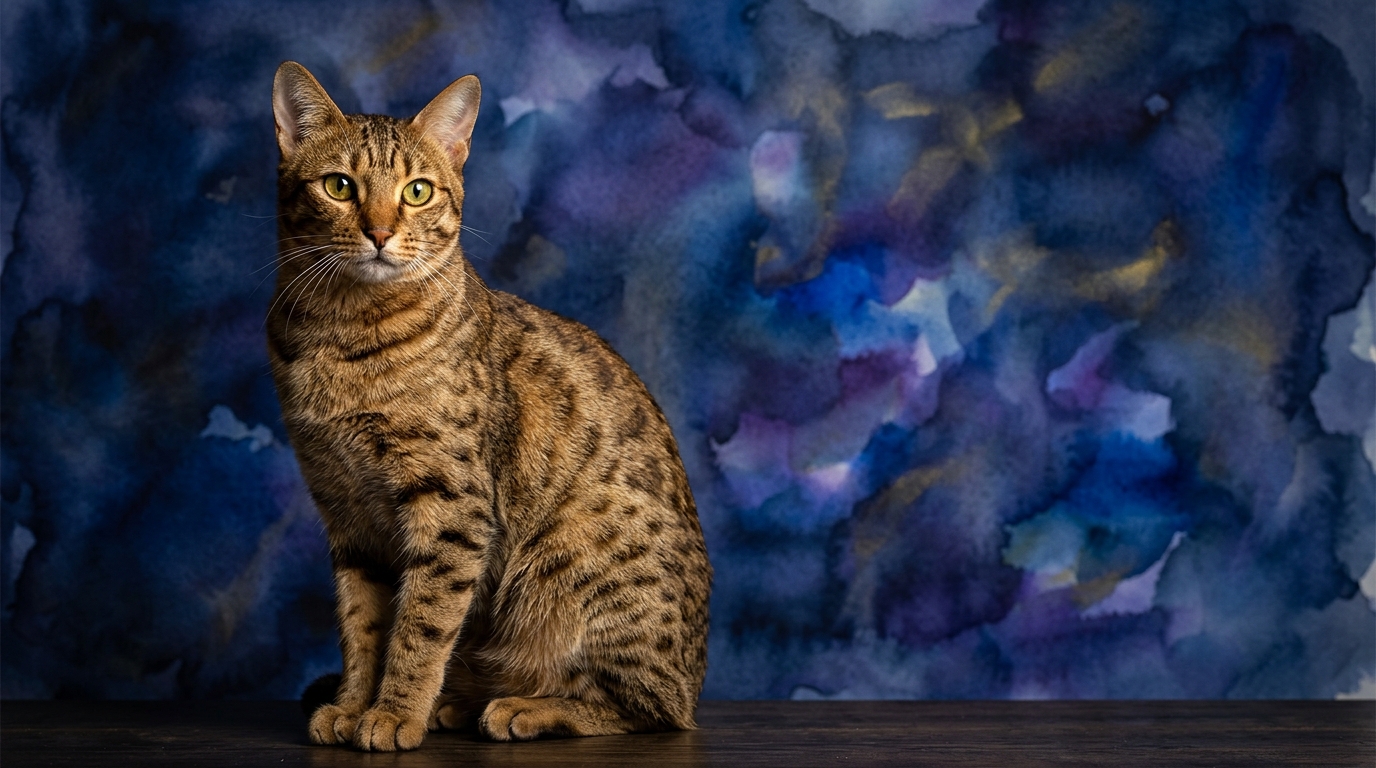
Ocicat at a glance
| IQ Rank / Score | 21/25 |
|---|---|
| Trainability | ★★★★★ (5/5) |
| Social Intelligence | ★★★★☆ (4/5) |
| Lifespan | 12-16 years |
| Shedding | Low to moderate |
| Exercise Needs | Needs active play (45-60 min/day) |
| Origin | USA |
The Ocicat: A Spotted Paradox of Trainability
From the moment you lay eyes on an Ocicat, its captivating spotted coat instantly brings to mind images of majestic wild felines. This medium-sized domestic cat, originating in the USA, commands attention with its athletic build and distinctive markings. Yet, beneath this wild exterior lies a fascinating contradiction: a companion animal uniquely amenable to structured play and command training, often surprising new owners with its eager participation. At The Cosmic Pet's Pet IQ Lab, we delve beyond appearances to explore the genuine cognitive capabilities that define breeds, and the Ocicat presents a particularly intriguing case study in feline intelligence.
Many pet owners, captivated by their striking looks, might assume an Ocicat would be a handful – perhaps aloof or difficult to engage in conventional domestic activities. However, the truth of the Ocicat's temperament and intelligence is far more nuanced and, for many, delightfully unexpected. They possess a curious blend of social awareness, problem-solving prowess, and a willingness to cooperate that sets them apart in the feline world. This unique combination makes them not just beautiful companions, but active participants in their human families' lives, eager to learn and engage.
Our exploration into the Ocicat's mind reveals a cat that genuinely enjoys mental stimulation and structured interaction, transforming what might seem like a wild spirit into a highly trainable and affectionate partner. Forget preconceived notions about spotted cats; the Ocicat is here to rewrite the rulebook on feline trainability and prove that true intelligence comes in many forms, even those that mimic the jungle's most elusive hunters.
Decoding the Ocicat's Intelligence Scorecard
At Pet IQ Lab, we evaluate feline intelligence across several key dimensions, providing a comprehensive profile rather than a single 'smart' label. For the Ocicat, this assessment highlights a distinct aptitude for structured play and rapid skill acquisition. Their Problem Solving score of 4/5 indicates a cat that consistently figures out puzzles, navigates new environments with strategic thinking, and adapts well to novel situations. Owners frequently report Ocicats quickly mastering treat dispensers or opening cabinets, showcasing their practical intellect.
Perhaps the most striking aspect of the Ocicat's cognitive makeup is its Training Speed, earning an exceptional 5/5. This cat responds to command training with an alacrity that often rivals some dog breeds, absorbing new cues and associating them with actions in remarkably few repetitions. Whether it's learning to 'sit,' 'stay,' or come when called, Ocicats demonstrate a keen ability to understand and execute human requests, making them incredibly rewarding partners for positive reinforcement methods like clicker training.
Their Social Intelligence also ranks high at 4/5, indicating a strong capacity for understanding human cues, forming deep bonds, and engaging in cooperative behaviors. Ocicats are not aloof; they thrive on interaction, often seeking out their human companions for play and attention. This social acumen, combined with a Memory score of 4/5, means they recall learned commands and routines over extended periods, reinforcing their quick training speed. An Instinctive Drive of 4/5 reflects their playful, prey-driven nature, which can be channeled effectively into engaging games and structured activities.
Debunking the Myth: Wild Looks, Domestic Heart
The visual association between the Ocicat's striking spotted coat and actual wild felines has unfortunately fueled a common misconception: that 'spotted wild-looking cats are unruly and impossible to train.' This myth persists largely because people instinctively link a wild aesthetic to an untamed temperament, assuming that a cat that looks like a miniature leopard must behave like one. This couldn't be further from the truth for the Ocicat, whose lineage and disposition tell a completely different story.
Here’s the surprising truth that counters this widespread belief: The Ocicat has no wild cat DNA despite its spotted, ocelot-like appearance. It was created through a meticulous breeding program in the USA, crossing domestic Siamese, Abyssinian, and American Shorthair cats. The characteristic spots, which give the breed its captivating look, appeared as an accidental byproduct of these domestic crosses, not as an inheritance from any wild ancestor. This foundational fact fundamentally disproves the notion that their appearance dictates an untrainable nature.
Far from being unruly, Ocicats actively seek engagement and respond exceptionally well to consistent, positive training. Their intelligence profile, particularly their high training speed and social intelligence, makes them highly amenable to learning tricks, walking on a leash, and playing interactive games like fetch. Owners who approach Ocicats with an open mind quickly discover a cooperative and affectionate companion eager to participate in their world, effectively shattering the myth of the untamable spotted cat.
Beyond Instinct: Ocicats and Command-Based Learning
The Ocicat's primary intelligence angle, 'structured play intelligence,' highlights their remarkable capacity to integrate playful instincts with learned commands. While many cats enjoy independent play, Ocicats thrive on guided interaction where rules and rewards are clear. This is why they so readily respond to command training with a speed that consistently surprises most owners. Their strong social intelligence makes them keen observers, eager to please and interact with their human companions, translating into quick learning.
This aptitude for structured play means Ocicats often excel at activities beyond typical feline behaviors. Teaching them to 'sit,' 'stay,' 'spin,' or even retrieve specific toys isn't just possible, it's often genuinely enjoyed by the cat. The mental stimulation provided by these challenges keeps their sharp minds engaged, preventing boredom and channeling their natural energy and instinctive drive into positive interactions. They learn quickly not just *what* to do, but *how* their actions earn them rewards and positive attention.
Owners leveraging clicker training will find an Ocicat to be an exceptionally fast study. The precise timing of the click and treat helps these cats rapidly associate a specific action with a positive outcome, solidifying their understanding of commands. Their robust memory ensures that once a trick or behavior is learned, it is retained, making subsequent training sessions cumulative and highly effective. This blend of attributes makes the Ocicat a prime candidate for enrichment through active, command-based interaction.
Cultivating Cognitive Growth: Engaging Your Ocicat
For Ocicat owners, understanding and nurturing this unique intelligence is key to a happy and fulfilling relationship. Providing ample opportunities for structured play is paramount. Engage your Ocicat daily with interactive toys that mimic prey, but also introduce puzzle feeders that challenge their problem-solving skills. These activities prevent boredom and help channel their significant instinctive drive into productive and enriching experiences, satisfying their intellectual curiosity.
Consistency in command training, even just 5-10 minutes a day, will yield remarkable results. Use positive reinforcement methods, such as clicker training and high-value treats, to capitalize on their exceptional training speed. Start with simple commands like 'sit' or 'come,' gradually moving to more complex sequences or obstacle courses. Their strong memory means once a behavior is learned, it's often retained, building a robust repertoire of skills.
Ocicats also benefit greatly from social engagement, leveraging their high social intelligence. Include them in family activities, talk to them, and provide plenty of physical affection. Their desire for interaction makes them receptive to leash training, allowing them to safely explore the outdoors under supervision, further stimulating their senses and cognitive functions. By actively fostering their structured play intelligence, owners unlock the full potential of this truly surprising and interactive feline companion.
3 At-Home Tests to Measure Your Ocicat's IQ
These tests are adapted from peer-reviewed ethology research. No equipment is needed beyond items you have at home. Run each test 5–10 times for reliable results.
The Myth: "Spotted wild-looking cats are unruly and impossible to train."
✅ In reality, the Ocicat has no wild cat DNA despite its striking appearance, debunking the idea that its looks dictate its trainability. Created from a blend of domestic Siamese, Abyssinian, and American Shorthair, its spots emerged as an accidental byproduct, not a genetic link to wilderness. These cats are remarkably amenable to training, eager to engage, and consistently disprove the notion that their wild appearance translates to an unruly disposition.
Ocicat vs. Similar Breeds
🧠 What's Your Cat's IQ Score?
Our full Pet IQ Lab assessment includes 12+ tests across 5 cognitive dimensions, calibrated for Ocicats specifically.
Take the Full IQ Test →Frequently Asked Questions
How smart is a Ocicat?
Our Pet IQ Lab framework scores cognition across five dimensions (max 25). The Ocicat totals 21/25 — very high for a domestic cat. The full article breaks down each dimension with at-home tests.
Are Ocicats easy to train?
Ocicats learn new cues very quickly — often in 5-15 repetitions. They score 5/5 on Training Speed in our breed profile.
Are Ocicats good with children and other pets?
Yes — their Social Intelligence rates 4/5 in our Pet IQ Lab framework. With early socialization and supervised play, most Ocicats integrate well into families with respectful children and other pets.
Do Ocicats need a lot of mental stimulation?
Absolutely. With Problem Solving 4/5 and Instinctive Drive 4/5, Ocicats need daily mental work — puzzle feeders, scent games, training sessions, or interactive wand toys — to avoid boredom.
How much exercise does a Ocicat need?
Ocicats need active engagement. Plan for 45-60 minutes of play and climbing per day, plus mental stimulation.
How good is a Ocicat's memory?
Ocicats score 4/5 on memory. They remember routines, hiding spots, and learned cues for months, sometimes years.
What is the typical lifespan of a Ocicat?
Most Ocicats live 12-16 years with good veterinary care, quality diet, and indoor living.
The Ocicat stands as a testament to the surprising depths of feline intelligence, offering a rewarding partnership built on active engagement and mutual discovery. Far from being just a beautiful face, this spotted domestic cat redefines trainability and proves that an intelligent companion is truly a cosmic pet.