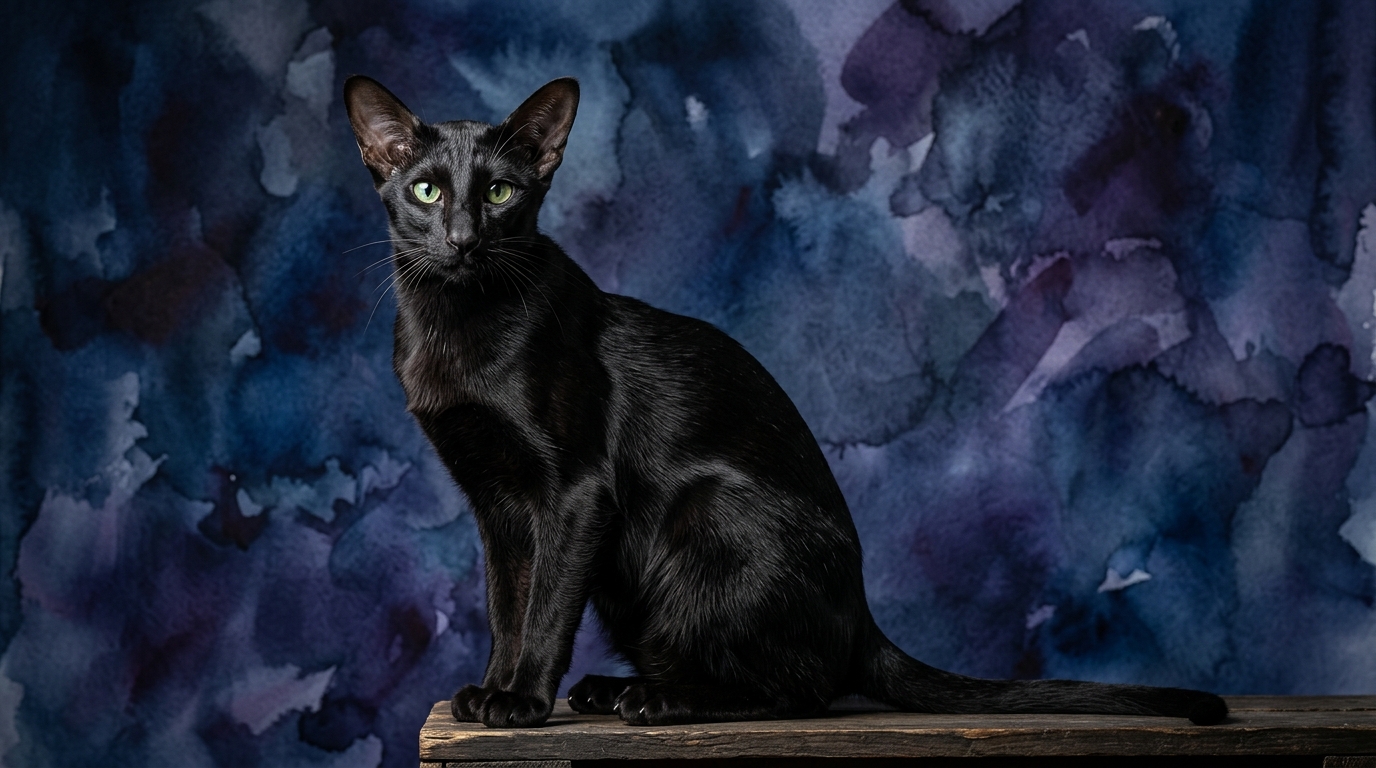
Oriental Shorthair at a glance
| IQ Rank / Score | 21/25 |
|---|---|
| Trainability | ★★★★★ (5/5) |
| Social Intelligence | ★★★★★ (5/5) |
| Lifespan | 12-16 years |
| Shedding | Low to moderate |
| Exercise Needs | Moderate (20-40 min play/day) |
| Origin | England (Siamese variant) |
The Oriental Shorthair's Unique Cognitive Signature: The Communicative Connoisseur
The Oriental Shorthair's intelligence isn't merely about cunning; it's profoundly rooted in communication and connection. What makes this breed cognitively unique is its intensely communicative nature, expressed through a unique, extensive vocabulary of vocalizations and intricate body language. This desire to 'converse' and engage with humans drives a distinctive social intelligence, making them masters at fostering connection and soliciting interaction.
Unlike many felines known for their stoic independence, Oriental Shorthairs thrive on constant interaction, actively using their diverse vocalizations—from insistent meows to expressive chirps and trills—to articulate needs, desires, and even opinions. This cognitive emphasis on social engagement means their brains are highly attuned to interpreting human cues and crafting responses, solidifying their reputation as truly interactive and emotionally intelligent companions.
Their cognitive processes are geared towards understanding and manipulating their social environment. They learn not just what behaviors get a treat, but *how* to tailor their communication for specific outcomes, demonstrating a sophisticated awareness of cause and effect within a social context. This proactive engagement sets them apart, indicating a higher level of cognitive effort invested in social bonding.
Intellectual Traits in Detail
The Oriental Shorthair's impressive intelligence extends across several key cognitive domains, painting a picture of a clever, adaptable, and deeply social feline.
**Problem-Solving Prowess:** These cats possess a keen curiosity that fuels their problem-solving abilities. Whether it's figuring out how to open a cupboard, retrieve a favorite toy from a tight spot, or even escape a 'cat-proofed' room, Oriental Shorthairs approach challenges with remarkable persistence and an almost scientific trial-and-error methodology. Their high motivation for interaction and rewards often translates into sustained effort, showcasing strong adaptive intelligence.
**A Trainer's Dream: Learning & Memory:** Renowned for their trainability, Oriental Shorthairs quickly grasp commands, tricks, and routines. Their eagerness to please, combined with excellent associative learning capabilities, makes them swift students. They often enjoy learning new behaviors, viewing it as another form of engaging interaction with their humans. This rapid acquisition of skills is underpinned by a robust memory, allowing them to retain complex sequences and associations over long periods, making advanced training a genuinely rewarding experience for both cat and owner.
**Social & Emotional Acuity:** The Oriental Shorthair's social intelligence is paramount. They form incredibly strong bonds with their human families, often displaying a dog-like devotion. They are highly attuned to human emotions, capable of sensing changes in mood and offering comfort. Their communicative vocalizations and expressive body language are not random; they are intentional attempts to connect, solicit attention, or express affection, demonstrating a deep understanding of social dynamics within the household.
**Instincts Redefined: Playful Drive:** While Oriental Shorthairs possess a natural predatory instinct, this drive is frequently channeled into sophisticated, interactive play rather than purely solitary hunting. Their high energy levels make them enthusiastic participants in games like fetch or laser pointer chases. This intelligent channeling of instinct into socially acceptable and engaging activities highlights their cognitive flexibility and preference for shared experiences, transforming basic drives into opportunities for connection.
A Surprising Lexicon: The Learned Art of Oriental Communication
While all cats vocalize, the Oriental Shorthair takes feline communication to an astonishing level, often developing a personalized, learned lexicon. The surprising fact about their cognition is that their extensive and varied 'vocabulary' isn't purely innate; individual cats often learn to associate specific sounds with distinct requests, emotional states, or desired outcomes through consistent interaction with their human companions.
This isn't merely instinctual meowing; it’s a dynamic, learned form of communication. Oriental Shorthairs actively experiment with different pitches, volumes, and cadences, observing their human's response. Over time, they refine these vocalizations, learning which specific 'words' or 'phrases' reliably elicit a desired reaction, whether it's an 'I'm hungry' chirp, a 'play with me' trill, or a 'pet me now' insistent meow. This capacity for developing a context-specific, learned communicative repertoire showcases a sophisticated level of cognitive adaptability, allowing them to effectively bridge the communication gap between species in a truly impressive way, demonstrating active learning and memory in a social context.
The Myth of the 'Needy' Noisemaker: Unpacking Oriental Vocalizations
Recommended IQ Tests for the Oriental Shorthair
Given the Oriental Shorthair's unique cognitive profile, a selection of tests focusing on their communicative, problem-solving, and social learning abilities provides the most accurate assessment of their intelligence.
**Trick Acquisition Test:** This test directly assesses an Oriental Shorthair's renowned trainability and eagerness to engage in cooperative learning. It measures their learning speed, capacity for forming associations, and motivation to interact through positive reinforcement. This breed's high scores here reflect their natural inclination to engage with humans in structured activities.
**Puzzle Box Test:** Ideal for evaluating their problem-solving skills, persistence, and curiosity-driven intelligence, the Puzzle Box Test challenges an Oriental Shorthair to retrieve a reward from an enclosure requiring manipulation or multiple steps. Their analytical approach and determination, often fueled by a strong desire for engagement or treats, highlight their cognitive flexibility and tenacity.
**Name Recognition Test:** This test specifically explores an Oriental Shorthair's understanding of human language and the depth of their social bond. Given their highly communicative nature and attachment to humans, recognizing and responding consistently to their name without other cues demonstrates their auditory processing abilities and sophisticated associative learning in a social context.
Oriental Shorthair IQ Scores Explained
The Oriental Shorthair's intelligence profile is a harmonious blend of keen intellect, rapid learning, and profound social acumen, as reflected in their IQ scores:
**Problem-Solving (4/5):** Oriental Shorthairs demonstrate above-average problem-solving capabilities. Their innate curiosity drives them to explore and understand their environment, often leading them to cleverly circumvent obstacles or figure out complex mechanisms, especially when motivated by a reward or the desire for interaction.
**Training Speed (5/5):** This breed excels in trainability, making them exceptionally quick learners. Their strong desire for human companionship and eagerness to please translate into rapid acquisition of commands, tricks, and even leash training, placing them at the pinnacle of feline trainability.
**Social Intelligence (5/5):** The Oriental Shorthair's defining trait is their extraordinary social intelligence. They form deep, communicative bonds with their human families, exhibiting an uncanny ability to interpret emotions, respond to subtle cues, and actively participate in household life. Their constant vocalizations are a testament to this profound social engagement.
**Instinctive Drive (3/5):** While retaining natural predatory instincts, the Oriental Shorthair's high social drive often channels these behaviors into interactive play rather than solitary hunting. Their desire for companionship frequently overrides purely independent instinctive actions, resulting in a balanced, but not dominant, instinctive score.
**Memory (4/5):** Oriental Shorthairs possess an excellent memory, crucial for retaining the vast array of tricks they learn and the intricate routines of their daily lives. They remember people, places, and associations with remarkable accuracy, contributing significantly to their ease of training and strong social bonds.
Cognitive Development & Training Tips for Your Oriental Shorthair
Nurturing the intelligence of an Oriental Shorthair is a rewarding experience, requiring consistent engagement and stimulating environments. Regular interactive play is paramount; use puzzle toys to challenge their problem-solving skills and keep their agile minds active. Incorporate daily training sessions using positive reinforcement – their high training speed makes them eager students, quick to learn fetch, leash walking, and various tricks. Their social intelligence thrives on interaction, so ensure ample one-on-one time, responding to their vocalizations and engaging in 'conversations' to reinforce their unique communication skills. Environmental enrichment, such as climbing structures and safe outdoor access, also prevents boredom and encourages their innate curiosity, channeling their intelligence productively.
3 At-Home Tests to Measure Your Oriental Shorthair's IQ
These tests are adapted from peer-reviewed ethology research. No equipment is needed beyond items you have at home. Run each test 5–10 times for reliable results.
The Myth: "Their incessant vocalizations are simply excessive 'demanding' or a sign of anxiety."
✅ Far from being merely demanding, their vocalizations are a fundamental expression of their high social intelligence, deep desire for interaction, and sophisticated communicative strategies, actively engaging with their environment and companions to build and maintain strong bonds.
Oriental Shorthair vs. Similar Breeds
🧠 What's Your Cat's IQ Score?
Our full Pet IQ Lab assessment includes 12+ tests across 5 cognitive dimensions, calibrated for Oriental Shorthairs specifically.
Take the Full IQ Test →Frequently Asked Questions
How smart is a Oriental Shorthair?
Our Pet IQ Lab framework scores cognition across five dimensions (max 25). The Oriental Shorthair totals 21/25 — very high for a domestic cat. The full article breaks down each dimension with at-home tests.
Are Oriental Shorthairs easy to train?
Oriental Shorthairs learn new cues very quickly — often in 5-15 repetitions. They score 5/5 on Training Speed in our breed profile.
Are Oriental Shorthairs good with children and other pets?
Yes — their Social Intelligence rates 5/5 in our Pet IQ Lab framework. With early socialization and supervised play, most Oriental Shorthairs integrate well into families with respectful children and other pets.
Do Oriental Shorthairs need a lot of mental stimulation?
Absolutely. With Problem Solving 4/5 and Instinctive Drive 3/5, Oriental Shorthairs need daily mental work — puzzle feeders, scent games, training sessions, or interactive wand toys — to avoid boredom.
How much exercise does a Oriental Shorthair need?
Oriental Shorthairs do well with 20-40 minutes of interactive play plus a few short training moments.
How good is a Oriental Shorthair's memory?
Oriental Shorthairs score 4/5 on memory. They remember routines, hiding spots, and learned cues for months, sometimes years.
What is the typical lifespan of a Oriental Shorthair?
Most Oriental Shorthairs live 12-16 years with good veterinary care, quality diet, and indoor living.
The Oriental Shorthair stands as a testament to the profound and diverse cognitive capabilities within the feline world, demonstrating that intelligence isn't solely measured by solitary cunning but by the depth of connection and the richness of communication. Their vibrant minds and affectionate spirits make them truly exceptional companions, constantly engaging, learning, and surprising their human families with their remarkable intellect.