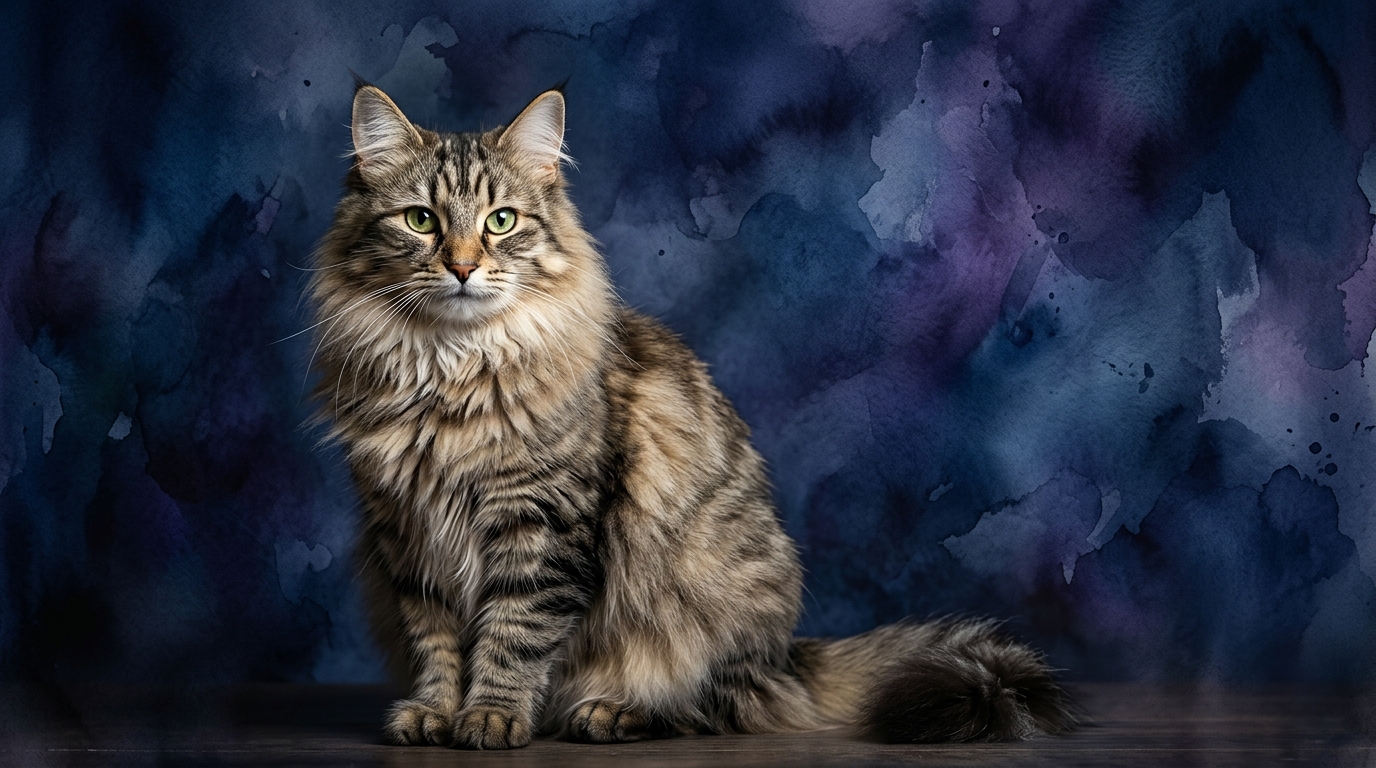
Norwegian Forest Cat at a glance
| IQ Rank / Score | 19/25 |
|---|---|
| Trainability | ★★★☆☆ (3/5) |
| Social Intelligence | ★★★☆☆ (3/5) |
| Lifespan | 12-16 years |
| Shedding | Moderate to high |
| Exercise Needs | Needs active play (45-60 min/day) |
| Origin | Norway |
The Wegie Mind: A Legacy of Forest-Honed Intelligence
The Norwegian Forest Cat isn't just a beautiful breed; it's a testament to natural selection favoring a remarkably capable mind. Originating from Norway, these large, majestic cats evolved in harsh, woodland environments, necessitating keen senses and sharp cognitive functions for survival. Their intelligence profile paints a picture of a resourceful and independent thinker, perfectly adapted for life among the trees and wild landscapes of their ancestral home.
Their capacity for problem-solving stands out with an impressive score of 4 out of 5. This isn't merely about manipulating toys; it's about navigating complex environments, finding food, and assessing threats. This aptitude for intricate spatial understanding is brilliantly showcased in a specific physical adaptation: Norwegian Forest Cats can descend trees headfirst—a physical adaptation from their climbing ancestors that requires real-time spatial calculation most cats cannot perform. This unique ability speaks volumes about their dynamic cognitive processing, combining agility with advanced spatial reasoning.
Complementing their problem-solving prowess is a formidable Instinctive Drive, scoring a perfect 5 out of 5. This drive manifests as an innate curiosity, a persistent hunting instinct, and an unwavering determination to explore and understand their surroundings. For a breed that once thrived autonomously in the wild, these instincts are not just remnants of their past; they are fundamental to their cognitive makeup, fueling their exploratory nature and adaptability in domestic settings.
Memory, rated at 4 out of 5, plays a crucial role in their success. Wegies remember complex routes, preferred hunting grounds, and the locations of resources, a skill vital for territorial animals. In a home, this translates to remembering intricate layouts, routines, and even specific cues from their human companions, showcasing a depth of recall that supports their problem-solving endeavors.
While their Training Speed scores 3 out of 5 and Social Intelligence also at 3 out of 5, these numbers are not indicative of a lack of ability, but rather reflect their independent nature. They are certainly capable of learning commands and understanding social cues, but their motivation often stems from personal interest or perceived benefit rather than a strong desire to please. This makes them thoughtful learners who evaluate situations, rather than simply obeying, forming deep, affectionate bonds on their own terms. Their social intelligence, while not overtly demonstrative, allows them to forge strong, understanding relationships with their chosen family, reading subtle cues and responding with quiet affection and intelligent interaction.
Decoding Feline Genius: At-Home Cognitive Tests for Your Wegie
Curious to see your Norwegian Forest Cat's brainpower in action? These simple, engaging tests can reveal fascinating insights into their problem-solving, memory, and adaptive intelligence. Remember to conduct these in a quiet, familiar environment when your cat is relaxed and receptive, always ending with praise and a favorite treat, regardless of the 'score'.
3 At-Home Tests to Measure Your Norwegian Forest Cat's IQ
These tests are adapted from peer-reviewed ethology research. No equipment is needed beyond items you have at home. Run each test 5–10 times for reliable results.
The Myth: "Long-haired cats are less active and less intelligent than short-haired breeds."
✅ The Norwegian Forest Cat powerfully debunks this notion, showcasing a long, luxurious coat perfectly suited to an active, intellectually demanding outdoor life. Their deep intelligence, problem-solving capabilities, and high instinctive drive are not hindered by their magnificent fur; rather, these traits are characteristic of a breed bred for navigating challenging natural environments. Many long-haired breeds, including the Siberian and Maine Coon, demonstrate complex cognitive abilities and robust activity levels, proving that coat length has no bearing on a cat's mental prowess or physical vigor.
Norwegian Forest Cat vs. Similar Breeds
🧠 What's Your Cat's IQ Score?
Our full Pet IQ Lab assessment includes 12+ tests across 5 cognitive dimensions, calibrated for Norwegian Forest Cats specifically.
Take the Full IQ Test →Frequently Asked Questions
How smart is a Norwegian Forest Cat?
Our Pet IQ Lab framework scores cognition across five dimensions (max 25). The Norwegian Forest Cat totals 19/25 — very high for a domestic cat. The full article breaks down each dimension with at-home tests.
Are Norwegian Forest Cats easy to train?
Norwegian Forest Cats can learn most cues, but expect to repeat lessons and keep sessions short. They score 3/5 on Training Speed in our breed profile.
Are Norwegian Forest Cats good with children and other pets?
Norwegian Forest Cats can live well with families when socialized early. Their Social Intelligence scores 3/5, so supervise interactions with small children and introduce new pets gradually.
Do Norwegian Forest Cats need a lot of mental stimulation?
Absolutely. With Problem Solving 4/5 and Instinctive Drive 5/5, Norwegian Forest Cats need daily mental work — puzzle feeders, scent games, training sessions, or interactive wand toys — to avoid boredom.
How much exercise does a Norwegian Forest Cat need?
Norwegian Forest Cats need active engagement. Plan for 45-60 minutes of play and climbing per day, plus mental stimulation.
How good is a Norwegian Forest Cat's memory?
Norwegian Forest Cats score 4/5 on memory. They remember routines, hiding spots, and learned cues for months, sometimes years.
What is the typical lifespan of a Norwegian Forest Cat?
Most Norwegian Forest Cats live 12-16 years with good veterinary care, quality diet, and indoor living.
The Norwegian Forest Cat stands as a magnificent example of nature's intelligence, a breed whose every pounce and problem-solved reflects a profound legacy of forest survival. Their unique cognitive strengths make them not just beloved companions, but fascinating subjects in the ongoing study of feline brilliance.