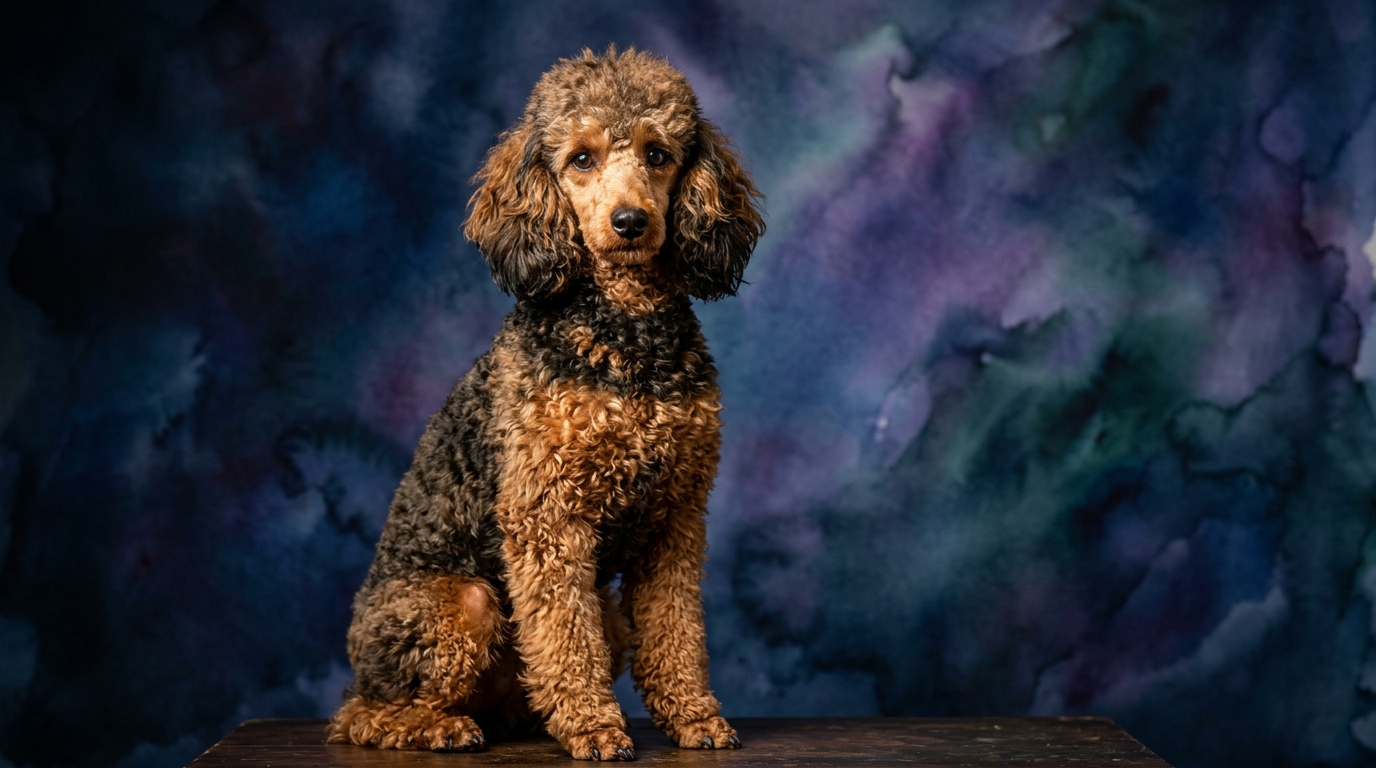
Poodle (Standard) at a glance
| IQ Rank / Score | #2 |
|---|---|
| Trainability | ★★★★★ (5/5) |
| Social Intelligence | ★★★★★ (5/5) |
| Lifespan | 10-12 years |
| Shedding | Moderate to high |
| Exercise Needs | High (60+ min/day + training) |
| Origin | Germany/France |
The Standard Poodle: A Mind Beyond the Mane
Hailing from Germany and refined in France, the Standard Poodle is a large dog often recognized for its distinguished appearance in the show ring. Yet, beneath that famous coat lies a powerful intellect that positions this breed as one of the most cognitively capable canines. Far from a mere fashion statement, the Poodle's mental agility and capacity for understanding are truly exceptional, challenging many common perceptions.
In the comprehensive obedience rankings compiled by Dr. Stanley Coren, the Standard Poodle stands at an astounding #2 out of 138 breeds, a testament to their remarkable trainability and willingness to cooperate with human instruction. This high ranking isn't just about learning tricks quickly; it reflects a profound ability to interpret and execute complex commands, demonstrating a sophisticated understanding of cause and effect in human interaction. Their mental framework allows them to grasp new concepts with astonishing speed, making them eager and efficient learners.
What truly sets the Standard Poodle apart, however, is their primary intelligence angle: an acute emotional intelligence and mastery of cross-context learning. These dogs possess an uncanny knack for reading rooms, understanding the subtle shifts in human moods, and adapting their behavior accordingly. Whether it's sensing a household's quiet tension or mirroring a family's joyful energy, their ability to process and respond to nuanced social cues is among the most refined of any dog species.
Decoding the Poodle's Deep Mind
When we delve into the Standard Poodle's full intelligence profile, the picture that emerges is one of robust cognitive strength across multiple dimensions. Their Problem Solving skills rank a perfect 5/5, indicating an ability to navigate novel situations and overcome obstacles with impressive ingenuity. This isn't just about figuring out puzzle toys; it extends to understanding complex routines and even manipulating their environment to achieve desired outcomes.
Their Training Speed also scores a flawless 5/5, meaning new commands are not only acquired rapidly but also retained with remarkable consistency. This efficiency in learning, coupled with a Memory score of 5/5, suggests a dog that not only picks up information quickly but also integrates it into a durable understanding, reducing the need for constant repetition. This makes them ideal candidates for advanced obedience, service work, and a wide array of specialized tasks.
The Poodle’s Social Intelligence is also top-tier at 5/5, reflecting their profound connection with human companions and other animals. This attribute underscores their ability to form strong, empathic bonds and to interpret social dynamics within a group, making them incredibly adaptable companions. While their Instinctive Drive registers a strong 4/5, reminding us of their working dog heritage, it's their blend of primal drive with refined social cognition that truly makes them stand out.
It's a historical truth that provides crucial insight into the Poodle’s natural capabilities: Poodles were originally water retrievers, highly prized for their athleticism and keen senses in the marshlands of Germany. Their iconic clip, often mistaken for mere ornamentation, was actually functional – less fur meant less drag in the water, crucial for speed and endurance, while strategically left tufts protected vital joints from the cold. This heritage speaks to a breed built for purpose, requiring both physical prowess and mental acuity.
The Art of Cross-Context Learning and Emotional Resonance
The Standard Poodle's capacity for cross-context learning is perhaps its most fascinating cognitive superpower. This isn't merely about memorizing a trick; it's about understanding the underlying principle behind a command or a situation and applying that knowledge effectively across varied environments. For instance, a Poodle that learns to 'wait' at a doorway will likely apply that same patience to a dinner plate, a car door, or a meeting with a new person, demonstrating a true grasp of the concept rather than rote memorization.
Their emotional intelligence is similarly profound. Standard Poodles frequently exhibit an almost human-like ability to pick up on subtle emotional cues – a change in tone of voice, a worried glance, a slumped posture. They often respond with comforting nudges, playful distractions, or a quiet presence, showcasing a deep empathic connection. This ability to 'read the room' and react appropriately makes them exceptional therapy dogs and deeply intuitive family members, thriving on strong social bonds.
This unique combination of intellectual versatility and emotional depth means that a Standard Poodle isn't just a pet that performs commands; they are a truly interactive partner. They engage with their human companions on a level that goes beyond basic training, often anticipating needs or reacting to unstated intentions. Understanding these facets allows us to appreciate the full spectrum of their sophisticated cognitive landscape.
3 At-Home Tests to Measure Your Poodle (Standard)'s IQ
These tests are adapted from peer-reviewed ethology research. No equipment is needed beyond items you have at home. Run each test 5–10 times for reliable results.
The Myth: "Poodles are prissy show dogs with little real-world intelligence"
✅ In reality, the Standard Poodle's historical role as a water retriever speaks volumes about their robust physical capabilities and sharp intellect, requiring both problem-solving skills and obedience in challenging environments. Their top-tier performance in obedience rankings and their exceptional emotional intelligence demonstrate a profound cognitive capacity far removed from a superficial existence. They are adaptable, eager to learn, and incredibly perceptive companions.
Poodle (Standard) vs. Similar Breeds
🧠 What's Your Dog's IQ Score?
Our full Pet IQ Lab assessment includes 12+ tests across 5 cognitive dimensions, calibrated for Poodle (Standard)s specifically.
Take the Full IQ Test →Frequently Asked Questions
How smart is a Poodle (Standard)?
Our Pet IQ Lab framework scores cognition across five dimensions (max 25). The Poodle (Standard) totals 24/25 — exceptionally high for a domestic dog. The full article breaks down each dimension with at-home tests.
Are Poodle (Standard)s easy to train?
Poodle (Standard)s learn new cues very quickly — often in 5-15 repetitions. They score 5/5 on Training Speed in our breed profile.
Are Poodle (Standard)s good with children and other pets?
Yes — their Social Intelligence rates 5/5 in our Pet IQ Lab framework. With early socialization and supervised play, most Poodle (Standard)s integrate well into families with respectful children and other pets.
Do Poodle (Standard)s need a lot of mental stimulation?
Absolutely. With Problem Solving 5/5 and Instinctive Drive 4/5, Poodle (Standard)s need daily mental work — puzzle feeders, scent games, training sessions, or nose-work — to avoid boredom.
How much exercise does a Poodle (Standard) need?
Poodle (Standard)s need active engagement. Plan for 45-60 minutes of exercise and training per day, plus mental stimulation.
How good is a Poodle (Standard)'s memory?
Poodle (Standard)s score 5/5 on memory. They remember routines, hiding spots, and learned cues for months, sometimes years.
What is the typical lifespan of a Poodle (Standard)?
Typical lifespan is 10-12 years for a large dog like the Poodle (Standard).
The Standard Poodle truly redefines what we expect from a canine companion, blending a profound emotional depth with impressive problem-solving skills and a history rooted in vigorous work. Through the Pet IQ Lab, we hope you've gained a new appreciation for the sophisticated mind living beneath that iconic coat.