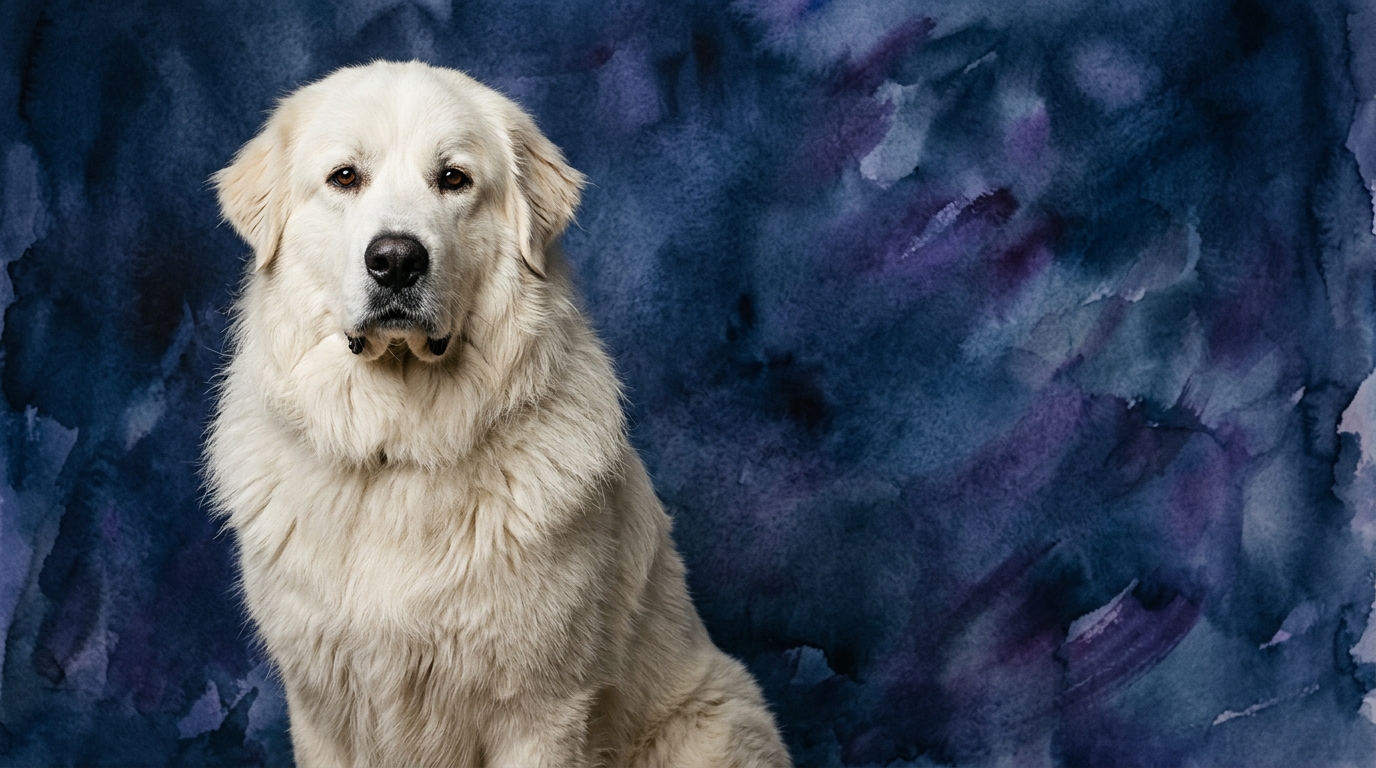
Great Pyrenees at a glance
| IQ Rank / Score | #64 |
|---|---|
| Trainability | ★★☆☆☆ (2/5) |
| Social Intelligence | ★★★★☆ (4/5) |
| Lifespan | 10-12 years |
| Shedding | Moderate to high |
| Exercise Needs | Moderate (30-45 min/day) |
| Origin | France/Spain |
The Primary Angle: Independent Guardian Cognition
The Great Pyrenees' intelligence is defined by its 'Independent Guardian Cognition.' Unlike many working breeds trained for explicit human commands, the Pyrenees was bred to think for itself, making critical decisions without direct instruction while protecting livestock. This means their cognitive strengths lie in constant environmental assessment, threat identification, strategic positioning, and autonomous problem-solving to ensure the safety of their charge. Their intelligence isn't measured by how quickly they fetch a ball or heel on command, but by their unwavering judgment and ability to act decisively in complex, unpredictable situations, often far from human intervention. This cognitive independence is both their greatest asset and the source of common misconceptions about their trainability.
Their brain is constantly processing information related to their territory and 'flock' – whether that's sheep, chickens, or human family members. They are masters of observation, noting subtle changes in wind direction, the distant sound of an unfamiliar vehicle, or the behavior of an approaching animal. This vigilance requires a highly developed form of situational awareness and the ability to differentiate between benign and potential threats, making them formidable protectors whose decision-making process is largely internal and instinct-driven.
Unpacking the Great Pyrenees IQ Scores
**Problem-Solving (IQ Score: 4/5):** Great Pyrenees excel at practical, real-world problem-solving, especially when it relates to their guarding duties. This isn't about solving a complex puzzle box for a treat (though they can) but about finding the most effective way to deter a predator, navigate a difficult terrain to reach their flock, or outsmart a persistent threat. They'll use their size, bark, and strategic positioning to resolve conflicts, demonstrating intelligence geared towards self-sufficiency and protection.
**Training Speed (IQ Score: 2/5):** This score reflects their responsiveness to *traditional obedience training*, not their capacity to learn. Great Pyrenees are intelligent but possess a strong independent streak. They question commands, especially if they don't perceive an immediate purpose or if it conflicts with their innate guarding instincts. They learn what they deem important quickly, but expect a 'why' behind every 'what.' This means training requires patience, consistency, and a deep understanding of their guardian motivation, often focusing on partnership rather than strict compliance.
**Social Intelligence (IQ Score: 4/5):** Within their established 'flock' – be it humans, other pets, or livestock – Pyrenees display high social intelligence. They form deep, empathetic bonds, understanding social cues, moods, and the hierarchy within their family. They are incredibly gentle and protective with those they consider their own, adapting their behavior to vulnerable members like children or lambs. However, their social intelligence shifts dramatically with strangers, where they exhibit cautious, observant, and sometimes aloof behavior, a necessary trait for a guardian assessing potential threats.
**Instinctive Drive (IQ Score: 5/5):** The Great Pyrenees' instinctive drive for guardianship is unparalleled. It is the core of their being, encompassing territoriality, protective instincts, vigilance, and an inherent need to oversee and secure their environment. This drive is not taught; it is deeply ingrained, manifesting as constant patrolling, barking at perceived threats, and an unwavering commitment to their charges. This powerful instinct is the engine of their unique intelligence and dictates many of their cognitive behaviors.
**Memory (IQ Score: 4/5):** Pyrenees possess excellent long-term memory, particularly for people, places, routines, and perceived threats. They remember individuals who have been kind or hostile, the layout of their territory, and the daily rhythms of their environment. This strong memory is crucial for their role as guardians, allowing them to track changes, recognize patterns, and anticipate events within their protected domain, contributing significantly to their vigilance and effectiveness.
A Surprising Fact: Early Life Immersion in Cognition
A fascinating historical and cognitive aspect of Great Pyrenees is their traditional upbringing. Unlike most breeds, Pyrenees puppies destined to be working Livestock Guardian Dogs are often raised *directly with the livestock* they are meant to protect from a very young age, frequently spending more time with lambs, goats, or cattle than with humans during critical developmental periods. This intentional early immersion is a deliberate cognitive conditioning strategy; it imprints the livestock as their primary 'flock,' solidifying their protective instincts towards animals rather than solely towards humans, thereby hardwiring their unique independent guardian cognition from the earliest stages of life. This specialized socialization fosters a profound bond and an inherent understanding of livestock behavior that is crucial for their life's work, truly setting their cognitive priorities.
Myth Debunked: The 'Stubborn' Pyrenees
**Claim:** Great Pyrenees are inherently stubborn and difficult to train, indicating a lower intelligence.
**Why It Exists:** This myth stems from a misunderstanding of their primary angle of intelligence – independent guardian cognition. Pyrenees are not bred for eager obedience or to perform tricks on command. Their role requires them to make autonomous decisions, often prioritizing the safety of their flock over immediate human direction. When a Pyrenees doesn't instantly comply with a command, it's often because they are evaluating it against their internal logic, their guardian instincts, or their assessment of the situation, rather than simply being 'stubborn.' Their independence is mistakenly interpreted as defiance or lack of intelligence by those expecting a different type of working dog.
**The Truth:** Great Pyrenees are highly intelligent, but their intelligence manifests as independent problem-solving and vigilance. They are perfectly capable of learning, but they are not 'biddable' in the same way as a Border Collie or a German Shepherd. Training a Pyrenees requires patience, understanding, positive reinforcement, and a willingness to work *with* their natural instincts, rather than against them. They will learn commands that they perceive as useful and fair, but they retain their innate ability to make their own decisions when circumstances demand it. Their 'stubbornness' is, in fact, an expression of their specialized, independent intellect.
Recommended Cognitive Tests for the Great Pyrenees
These tests are chosen to illuminate the Pyrenees' unique guardian intelligence, focusing on their problem-solving, independence, and patience rather than simple command-following.
The Cosmic Pet's Pet IQ Lab Tests
3 At-Home Tests to Measure Your Great Pyrenees's IQ
These tests are adapted from peer-reviewed ethology research. No equipment is needed beyond items you have at home. Run each test 5–10 times for reliable results.
The Myth: "Great Pyrenees are not intelligent because they are stubborn and difficult to train."
✅ The Great Pyrenees possesses a highly specialized and profound intelligence centered on independent guardianship. They are adept problem-solvers, vigilant observers, and strategic thinkers, perfectly suited for their role as protectors. Their 'stubbornness' is often a demonstration of their intelligence and discernment, as they evaluate commands based on purpose and necessity rather than blind compliance. Training requires a deep understanding of their unique motivations and a partnership approach.
Great Pyrenees vs. Similar Breeds
🧠 What's Your Dog's IQ Score?
Our full Pet IQ Lab assessment includes 12+ tests across 5 cognitive dimensions, calibrated for Great Pyreneess specifically.
Take the Full IQ Test →Frequently Asked Questions
How smart is a Great Pyrenees?
Our Pet IQ Lab framework scores cognition across five dimensions (max 25). The Great Pyrenees totals 14/25 — above-average for a domestic dog. The full article breaks down each dimension with at-home tests.
Are Great Pyrenees easy to train?
Great Pyreneess are independent learners; short, highly-motivating sessions work best. They score 2/5 on Training Speed in our breed profile.
Are Great Pyrenees good with children and other pets?
Yes — their Social Intelligence rates 4/5 in our Pet IQ Lab framework. With early socialization and supervised play, most Great Pyrenees integrate well into families with respectful children and other pets.
Do Great Pyrenees need a lot of mental stimulation?
Great Pyrenees benefit from 10-15 minutes of focused enrichment a day: food puzzles, short training drills, or novel toys rotated weekly.
How much exercise does a Great Pyrenees need?
Great Pyrenees do well with 20-40 minutes of daily walks and play plus a few short training moments.
How good is a Great Pyrenees's memory?
Great Pyreneess score 3/5 on memory. They remember high-value associations well; less-used cues fade without refresher sessions.
What is the typical lifespan of a Great Pyrenees?
Typical lifespan is 10-12 years for a giant dog like the Great Pyrenees.
The Great Pyrenees offers a profound lesson in the diversity of canine intelligence, proving that true 'smartness' comes in many forms beyond mere obedience. Their independent guardian cognition is a testament to centuries of specialized breeding, resulting in a dog whose thoughtful vigilance and self-reliant protection are nothing short of remarkable.