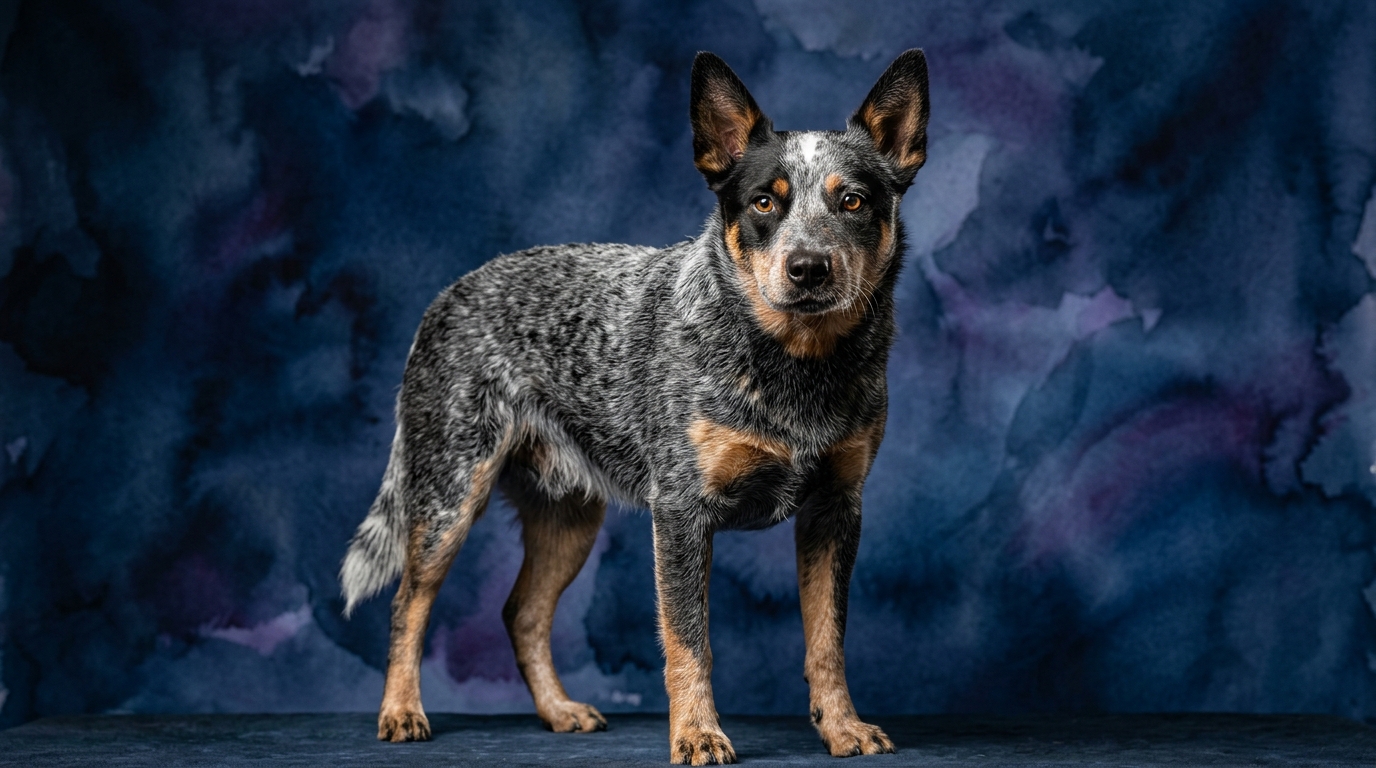
Australian Cattle Dog at a glance
| IQ Rank / Score | #10 |
|---|---|
| Trainability | ★★★★★ (5/5) |
| Social Intelligence | ★★★☆☆ (3/5) |
| Lifespan | 11-14 years |
| Shedding | Low to moderate |
| Exercise Needs | High (60+ min/day + training) |
| Origin | Australia |
The ACD's Brain: A Masterclass in Physical-Cognitive Integration
The Australian Cattle Dog is a medium-sized herding powerhouse originating from the rugged landscapes of Australia, where they were bred to manage stubborn cattle across vast distances. Their cognitive strength isn't just about learning tricks; it's a sophisticated physical-cognitive integration, meaning they use their body and mind together to solve complex herding problems in ways other breeds simply cannot. This isn't just about speed or strength, but about foresight, adaptability, and the capacity to anticipate and react effectively to ever-changing situations.
Imagine a dog that not only understands a command but can also strategize the most efficient path through a herd, predicting the movement of individual animals and adjusting its approach in real-time. This dynamic interplay of physical action and mental processing is the hallmark of the ACD's distinctive intelligence. They excel at tasks requiring both quick reflexes and thoughtful decision-making, making them uniquely suited for challenging working environments. According to Stanley Coren's obedience ranking, the Australian Cattle Dog stands impressively at #10 out of 138 breeds, underscoring their exceptional capacity for understanding and executing commands.
The Dingo Difference: Unpacking the ACD's Unique Heritage
To truly understand the Australian Cattle Dog's exceptional cognitive abilities, we must look to their fascinating origins. The ACD was developed by crossing Dingoes with Collies and Dalmatians, a unique genetic blend that profoundly shaped their intelligence. While Collies brought herding prowess and Dalmatians contributed stamina and unique spotting patterns, it's the Dingo contribution that gives them an independent problem-solving capacity not found in fully domesticated herding breeds. This ancestral link provides a critical insight into why ACDs approach challenges differently.
This Dingo influence imbues them with a deep-seated instinct for independent action and resourcefulness. Where some herding dogs might wait for explicit instructions, an ACD often takes the initiative, assessing a situation and devising a solution on their own. This translates into a remarkable aptitude for Problem Solving, earning them a top score of 5/5, and an equally robust Instinctive Drive, also rated 5/5. Their independence isn't a flaw; it's a defining feature of their brilliance, allowing them to excel in environments where self-reliance is paramount.
What Makes an ACD's Brain Tick? A Deeper Look at Their Cognitive Profile
Delving deeper into the Australian Cattle Dog's intelligence profile reveals a compelling picture of a canine strategist. Their Problem Solving is rated 5/5, highlighting their capacity to overcome obstacles and figure things out. Coupled with a Training Speed of 5/5, ACDs are incredibly quick to grasp new concepts and commands, often learning tasks in just a few repetitions. This makes them highly responsive to consistent, engaging training methods, and they thrive on mental challenges that keep their sharp minds occupied.
Their Memory also scores a perfect 5/5, meaning they retain information and experiences with impressive clarity. This contributes to their effective long-term learning and their ability to apply past lessons to new situations. However, their Social Intelligence, while perfectly adequate for a working partner, is rated 3/5. This indicates a more reserved social approach compared to some breeds; ACDs typically bond intensely with their primary family but might be more discerning or aloof with strangers. This trait isn't a lack of affection, but rather a reflection of their independent nature and preference for a tight-knit, predictable social circle, aligning with their heritage as self-reliant working dogs.
Comparing Canine Cognition: ACDs vs. Other Herding Dynamos
When we look at other brilliant herding breeds, the Australian Cattle Dog's unique cognitive blend truly stands out. While many herding dogs are renowned for their smarts, the ACD brings a distinctive flavor of independent thought and physical execution to the table. This makes them a fascinating point of comparison for owners interested in canine psychology.
They are undeniably bright, but it's crucial for owners to understand how their specific brand of intelligence manifests to ensure a fulfilling partnership. Their mental acuity demands more than just basic training; it requires consistent engagement, stimulating activities, and a handler who appreciates their self-directed problem-solving skills.
3 At-Home Tests to Measure Your Australian Cattle Dog's IQ
These tests are adapted from peer-reviewed ethology research. No equipment is needed beyond items you have at home. Run each test 5–10 times for reliable results.
The Myth: "Blue Heelers are too intense and stubborn for average owners to handle"
✅ While Australian Cattle Dogs certainly possess a robust working drive and independent spirit, calling them 'too intense' or 'stubborn' often misrepresents their true nature. When provided with consistent, engaging training, ample mental enrichment, and sufficient physical activity, ACDs are incredibly loyal, responsive, and adaptable companions. Their 'intensity' is actually a profound drive for purpose and engagement; channeling this effectively unlocks a devoted, highly capable, and eager-to-please partner who thrives on being an active participant in their owner's life.
Australian Cattle Dog vs. Similar Breeds
🧠 What's Your Dog's IQ Score?
Our full Pet IQ Lab assessment includes 12+ tests across 5 cognitive dimensions, calibrated for Australian Cattle Dogs specifically.
Take the Full IQ Test →Frequently Asked Questions
How smart is a Australian Cattle Dog?
Our Pet IQ Lab framework scores cognition across five dimensions (max 25). The Australian Cattle Dog totals 23/25 — exceptionally high for a domestic dog. The full article breaks down each dimension with at-home tests.
Are Australian Cattle Dogs easy to train?
Australian Cattle Dogs learn new cues very quickly — often in 5-15 repetitions. They score 5/5 on Training Speed in our breed profile.
Are Australian Cattle Dogs good with children and other pets?
Australian Cattle Dogs can live well with families when socialized early. Their Social Intelligence scores 3/5, so supervise interactions with small children and introduce new pets gradually.
Do Australian Cattle Dogs need a lot of mental stimulation?
Absolutely. With Problem Solving 5/5 and Instinctive Drive 5/5, Australian Cattle Dogs need daily mental work — puzzle feeders, scent games, training sessions, or nose-work — to avoid boredom.
How much exercise does a Australian Cattle Dog need?
Australian Cattle Dogs need active engagement. Plan for 45-60 minutes of exercise and training per day, plus mental stimulation.
How good is a Australian Cattle Dog's memory?
Australian Cattle Dogs score 5/5 on memory. They remember routines, hiding spots, and learned cues for months, sometimes years.
What is the typical lifespan of a Australian Cattle Dog?
Expect a lifespan of 11-14 years for a healthy Australian Cattle Dog.
The Australian Cattle Dog offers a captivating study in canine cognition, blending ancient Dingo wisdom with modern herding prowess to create a truly unique partner. Understanding their physical-cognitive intelligence unlocks a deeper bond with this remarkable, independently-minded breed, revealing a loyal and highly capable companion.